
Can a tooth without pain need root canal treatment?
A tooth can lose vitality and develop infection without causing obvious pain — absence of pain does not always mean absence of disease



Short Answer
Yes, a tooth can need root canal treatment even without pain. In some cases, the nerve inside the tooth becomes non-vital gradually, allowing infection or apical disease to progress silently without producing strong symptoms. Some teeth requiring root canal treatment are discovered only during examination or X-rays because the disease progresses with little or no discomfort.
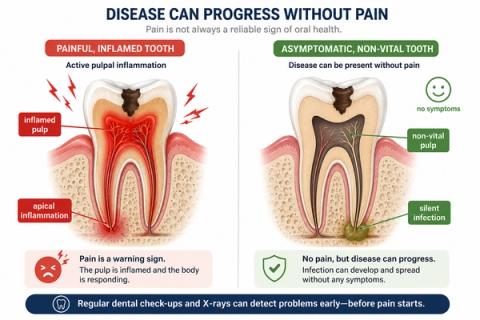
Can a Tooth Be Infected Without Hurting?
Yes.
Pain is only one possible sign of dental disease.
Sometimes the nerve inside the tooth:
- becomes inflamed,
- gradually loses vitality,
- and stops responding normally.
As this happens:
- pain may reduce,or:
- never become severe at all.
However:the underlying disease may still continue progressing around the root.
This often surprises patients because:
- the tooth does not hurt,
- chewing or biting may feel normal,
- and the problem is discovered only during examination or imaging.
What Are Signs of a Silent Tooth Problem?
Some teeth needing root canal treatment cause:
- very little pain,or:
- no pain at all.
People may notice:
- a tooth that feels “different,”
- discoloration or darkening,
- occasional chewing or biting discomfort,
- swelling or gum changes,
- a history of prior pain that later disappeared,
- or no symptoms at all in some cases.
A tooth may require root canal treatment because of:
- infection,
- pulp necrosis,
- apical inflammation,
- or loss of vitality—not simply because it is painful.
Why the Pattern of Symptoms Matters
| Symptom Pattern | What It May Suggest |
|---|---|
| Severe pain that later disappears | Possible pulpal necrosis |
| Tooth darkening or discoloration | Loss of vitality |
| No response to cold testing | Non-vital pulp |
| Occasional chewing or biting discomfort | Apical inflammation |
| Swelling without major pain | Silent infection progression |
| No symptoms but apical changes on X-ray | Chronic apical disease |
- vitality status,
- radiographic findings,
- apical tissue response,
- structural condition,
- and symptom historyrather than relying on pain alone.
What This Means
The important question is not simply:
“Does the tooth hurt?”
but:
“Is the pulp still biologically healthy and capable of recovery?”
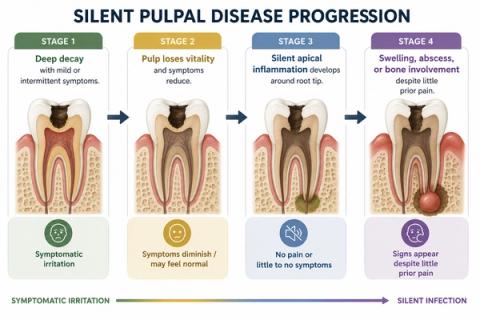
As pulpal disease progresses:
- inflammation may transition into necrosis,
- nerve responsiveness may decline,
- and apical disease may continue developing silently.
Some teeth actually become:
- less painfulas vitality is lost,which is why disappearing pain does not always mean healing.
Early detection may help:
- prevent larger infections,
- reduce structural damage,
- and improve long-term tooth prognosis.
When to See a Dentist
You should consider evaluation if:
- a tooth changes color,
- swelling or gum changes appear,
- there is a history of severe pain that later disappeared,
- a tooth feels “different” during chewing or biting,
- a dentist identifies deep decay or apical changes on imaging,
- or sensitivity suddenly disappears after prolonged symptoms.
- vitality response,
- radiographic findings,
- apical status,
- structural integrity,
- and symptom history—not just current pain levels.
Some teeth requiring root canal treatment remain asymptomatic until infection becomes more advanced.
Related Questions
Clinical Perspective
For dental professionalsThis section discusses clinical reasoning and is not intended for self-diagnosis.
Asymptomatic Pulpal Necrosis – Silent Endodontic Disease
Clinical Takeaway
Absence of pain does not exclude irreversible pulpal or apical pathology; asymptomatic pulpal necrosis and chronic apical disease are common presentations requiring diagnosis through vitality assessment and radiographic interpretation rather than symptom presence alone.
Interpretation Framework
Asymptomatic endodontic disease represents a biologic progression state where inflammatory and infectious processes persist despite limited nociceptive signaling.
Interpretation requires integrating:
- vitality status,
- prior symptom history,
- apical tissue response,
- radiographic findings,
- structural condition,
- restorability,
- and progression risk.
Clinical silence does not imply biological stability.
Many asymptomatic teeth represent:
- post-symptomatic,
- slowly progressive,
- or chronic necrotic disease states.
Current interpretation increasingly emphasizes:
- biologic vitality assessment,
- apical disease behavior,
- and progression-risk analysisrather than the presence of pain alone.
Current Understanding (Guidelines + Evidence)
Endodontic Perspective (AAE / ESE Aligned)
Teeth requiring root canal treatment may present:
- with severe symptoms,or:
- completely asymptomatically.
Common asymptomatic endodontic presentations include:
- pulpal necrosis,
- chronic apical periodontitis,
- previously symptomatic teeth with symptom resolution,
- and trauma-associated necrosis.
Important interpretation principles include:
- vitality testing is more informative than pain presence alone,
- radiographic apical changes may develop without symptoms,
- necrotic teeth may remain clinically silent for extended periods,
- and symptom disappearance may reflect pulpal degeneration rather than healing.
Biologic Insight
Progressive pulpal necrosis may:
- reduce neural responsiveness,
- alter nociceptive signaling,
- and decrease acute symptom generation.
Chronic apical lesions may continue enlarging despite:
- minimal patient awareness,
- absent thermal symptoms,
- or lack of spontaneous pain.
Differential Diagnosis
1. Asymptomatic Pulpal Necrosis
Features:
- absent vitality response,
- no active symptoms,
- possible discoloration,
- apical progression risk.
2. Chronic Apical Periodontitis
Features:
- radiographic apical lesion,
- minimal symptoms,
- long-standing inflammatory state.
3. Previously Symptomatic Irreversible Pulpitis Progressing to Necrosis
Features:
- history of prior pain,
- symptom disappearance,
- altered vitality status,
- evolving apical involvement.
4. Trauma-Induced Pulpal Necrosis
Features:
- discoloration,
- delayed vitality loss,
- minimal symptom presentation,
- history of dental trauma.
Key Diagnostic Distinctions
| Feature | Symptomatic disease | Asymptomatic disease |
|---|---|---|
| Pain | Common | Minimal/absent |
| Vitality status | Variable | Often altered/absent |
| Radiographic changes | May or may not be present | Often important diagnostically |
| Progression awareness | More obvious | Frequently silent |
| Detection pathway | Symptom-driven | Examination/imaging-driven |
| Apical involvement | Variable | Often chronic/progressive |
Common Pitfalls
Common diagnostic errors include:
- assuming absence of pain indicates pulpal health,
- missing chronic apical lesions during routine evaluation,
- failure to perform vitality testing on discolored teeth,
- delayed intervention due to asymptomatic presentation,
- and over-reliance on patient-reported symptoms.
Silent progression should always be assessed within:
- vitality context,
- radiographic behavior,
- and long-term structural prognosis.
Emerging Research Directions
Vitality Diagnostics
Research increasingly focuses on:
- physiologic pulp testing,
- pulse oximetry,
- laser Doppler flowmetry,
- and vascular vitality assessment.
AI-Assisted Radiographic Interpretation
Emerging systems increasingly evaluate:
- early apical lesion detection,
- asymptomatic pathology pattern recognition,
- longitudinal disease progression analysis,
- and symptom-independent risk modeling.
Predictive Endodontics
Current research increasingly explores:
- silent progression risk factors,
- biologic prognosis modeling,
- and asymptomatic disease stratification.
AI Potential
Asymptomatic teeth requiring root canal treatment represent a detection and interpretation problem where clinically significant disease may progress despite limited symptom signaling.
AI can assist across the clinical workflow:
Interpretation
- Integrating vitality findings, imaging, and symptom history
- Identifying clinically meaningful silent progression patterns
Decision Timing
- Supporting earlier intervention in asymptomatic disease
- Flagging apical progression risk
- Assisting prognosis-oriented treatment planning
Patient Communication
- Explaining why treatment may be needed despite absence of pain
- Clarifying the difference between symptom absence and disease absence
- Improving acceptance of preventive intervention
Clinical Workflow Support
- Structuring vitality and radiographic findings systematically
- Supporting longitudinal monitoring
- Reducing variability in asymptomatic disease interpretation
Emerging Direction
- AI-assisted silent pathology detection
- Predictive pulpal vitality modeling
- Automated apical lesion progression analysis
Clinical Relevance
The challenge is not simply identifying painful teeth — it is recognizing biologically compromised teeth before silent progression leads to:
- more extensive infection,
- structural breakdown,
- or tooth loss.
AI may eventually help:
- improve detection of asymptomatic endodontic disease,
- support earlier diagnosis of silent necrosis,
- reduce delayed intervention,
- and enhance patient understanding of symptom-independent disease progression.
References
- European Society of Endodontology (ESE). Quality guidelines for endodontic treatment. International Endodontic Journal.
- American Association of Endodontists (AAE). Diagnostic Terminology and Clinical Considerations for Endodontic Practice. AAE Clinical Resources.
- Ricucci D, Siqueira JF Jr. Pulpitis and apical periodontitis: a continuum of pulpal and periapical disease. Endodontic Topics.
- Abbott PV. Classification, diagnosis and clinical manifestations of apical periodontitis. Endodontic Topics.
- Bender IB, Seltzer S. Roentgenographic and direct observation of experimental lesions in bone: I. Journal of the American Dental Association.
- Petersson K, Söderström C, Kiani-Anaraki M, Lévy G. Evaluation of the ability of thermal and electrical tests to register pulp vitality. Endodontics & Dental Traumatology.
- Andreasen JO, Farik B, Munksgaard EC. Long-term calcium hydroxide as a root canal dressing may increase risk of root fracture. Dental Traumatology.https://pubmed.ncbi.nlm.nih.gov/12110105/
- The Use of Artificial Intelligence in Endodontics - F.C. Setzer, J. Li, A.A. Khan, 2024