
Does root canal treatment always remove pain?
Root canal treatment usually removes the source of infection or inflammation inside the tooth — but pain resolution depends on the surrounding tissues and the stage of disease



Short Answer
Root canal treatment often significantly reduces or eliminates pain by removing infected or inflamed pulp tissue. However, some discomfort may persist temporarily because surrounding tissues around the root can remain inflamed even after the procedure. In some cases, persistent pain may have other underlying causes that require further evaluation.
What Does Root Canal Treatment Actually Do?
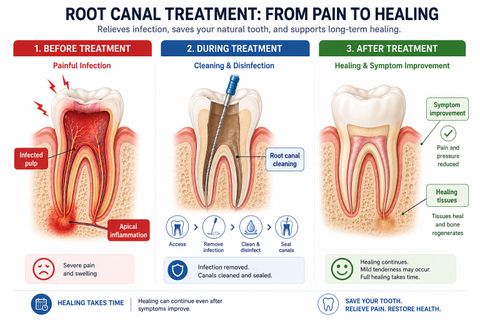
Root canal treatment is designed to:
- remove infected or irreversibly inflamed pulp tissue,
- disinfect the root canal system,
- reduce bacterial load,
- and preserve the tooth structure.
In many cases:
- pain improves significantly after treatment,especially when:
- the main source of inflammation was inside the pulp.
People often notice:
- reduction in throbbing pain,
- less heat sensitivity,
- improvement in night pain,
- and gradual reduction in chewing or biting discomfort.
However:healing does not always happen instantly.
Why Can Pain Continue After Root Canal Treatment?
Even after successful treatment:
- tissues around the root may still remain inflamed,
- healing and remodeling take time,
- and chewing pressure can temporarily irritate surrounding tissues.
People may notice:
- mild soreness while chewing or biting,
- tenderness around the tooth,
- temporary pressure sensitivity,
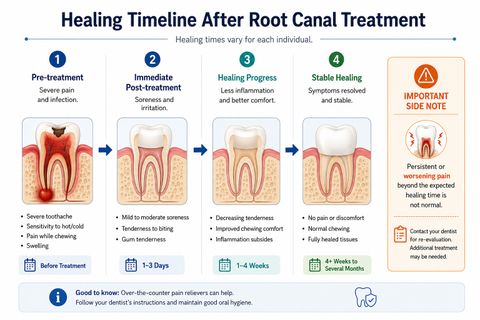
- or gradual improvement over days or weeks.
This does not automatically mean:
- the treatment failed,or:
- infection remains.
Post-treatment soreness is often related to:
- healing of apical tissues,
- inflammation already present before treatment,
- or temporary mechanical irritation from treatment procedures.
Why the Pattern of Symptoms Matters
| Symptom Pattern | What It May Suggest |
|---|---|
| Mild soreness gradually improving | Expected healing response |
| Temporary chewing or biting tenderness | Periapical tissue healing |
| Bite feels high after treatment | Occlusal irritation |
| Persistent swelling or throbbing | Possible unresolved inflammation |
| Symptoms returning after improvement | Reassessment needed |
| Persistent localized biting pain | Possible crack or fracture |
| Atypical persistent pain | Possible non-endodontic cause |
- healing progression,
- symptom behavior,
- radiographic changes,
- bite relationship,
- and structural conditionrather than relying on pain alone.
What This Means
The important question is not simply:
“Is there still pain?”
but:
“Is the tooth healing normally over time?”
Many teeth continue improving gradually after treatment because:
- periapical tissues require time to remodel,
- inflammatory mediators decrease progressively,
- and surrounding tissues slowly stabilize.
However:persistent or worsening symptoms may occasionally relate to:
- remaining infection,
- missed anatomy,
- cracks,
- vertical root fracture,
- bite-related irritation,
- or non-endodontic pain sources.
Healing is therefore evaluated:
- longitudinally,rather than:
- at a single moment.
When to See a Dentist
You should consider reevaluation if:
- pain worsens instead of improving,
- swelling develops,
- chewing or biting pain becomes severe,
- symptoms persist beyond the expected healing period,
- spontaneous throbbing returns,
- or the tooth feels excessively high during biting.
- healing progression,
- bite relationship,
- radiographic healing,
- structural integrity,
- and possible remaining infection—not just whether pain is present.
Early follow-up helps determine whether healing is progressing normally or whether additional treatment is needed.
Related Questions
Clinical Perspective
For dental professionalsThis section discusses clinical reasoning and is not intended for self-diagnosis.
Post-Endodontic Pain Resolution – Biologic Healing vs Persistent Symptoms
Clinical Takeaway
Root canal treatment commonly reduces pain by eliminating pulpal infection and inflammatory drivers, but symptom resolution depends on:
- extent of periapical involvement,
- structural condition,
- occlusal factors,
- and biologic healing response.
Interpretation Framework
Post-endodontic pain should be interpreted as a healing-response phenomenon rather than a binary success/failure outcome.
Clinical assessment requires integration of:
- preoperative diagnosis,
- apical inflammatory status,
- procedural factors,
- occlusal loading,
- structural integrity,
- healing timeline,
- and symptom progression.
Persistent symptoms may reflect:
- normal healing,or:
- unresolved biologic or structural pathology.
The key challenge lies in differentiating:
- expected post-treatment healing,from:
- clinically significant persistent disease.
Current Understanding (Guidelines + Evidence)
Endodontic Perspective (AAE / ESE Aligned)
Root canal treatment aims to:
- eliminate infected pulpal tissue,
- reduce microbial load,
- allow periapical healing,
- and preserve tooth function.
Pain commonly improves after treatment, particularly in:
- symptomatic irreversible pulpitis,
- pulpal necrosis with acute symptoms,
- and apical inflammatory disease.
However:
- postoperative discomfort is common,
- periapical healing may require time,
- and symptom persistence does not automatically indicate treatment failure.
Important interpretation principles include:
- occlusal trauma may contribute to postoperative symptoms,
- persistent infection and missed anatomy remain important considerations,
- cracks and non-endodontic pain sources may mimic endodontic failure,
- and healing should be assessed longitudinally rather than at a single timepoint.
Biologic Insight
Removal of pulpal infection reduces:
- primary inflammatory drivers,
- bacterial burden,
- and nociceptive stimulation.
However:
- periapical tissues may remain sensitized during healing and remodeling,
- immune-mediated repair continues after canal disinfection,
- and surrounding ligament tissues may remain temporarily reactive.
Differential Diagnosis
1. Normal Post-Treatment Healing Response
Features:
- mild percussion tenderness,
- transient chewing discomfort,
- gradual improvement over time.
2. Persistent Apical Inflammation
Features:
- lingering percussion sensitivity,
- incomplete symptom resolution,
- delayed radiographic healing.
3. Missed Anatomy or Persistent Infection
Features:
- recurrent symptoms,
- persistent radiolucency,
- incomplete microbial control.
4. Structural Pathology (Crack / Fracture)
Features:
- biting pain,
- localized load sensitivity,
- inconsistent symptom resolution,
- possible vertical root fracture.
5. Non-Odontogenic Pain
Features:
- atypical persistent pain,
- neuropathic characteristics,
- referred pain patterns,
- inconsistent endodontic findings.
Key Diagnostic Distinctions
| Feature | Expected healing | Concerning persistence |
|---|---|---|
| Symptom trend | Improving | Stable/worsening |
| Chewing discomfort | Mild/transient | Persistent/severe |
| Swelling | Minimal/absent | Possible/persistent |
| Radiographic trend | Healing progression | Persistent pathology |
| Time course | Gradual resolution | Delayed/non-resolving |
| Functional recovery | Improving | Limited/persistent |
Common Pitfalls
Common diagnostic errors include:
- interpreting all postoperative discomfort as treatment failure,
- ignoring occlusal contribution,
- missing vertical root fracture,
- over-reliance on immediate radiographic appearance,
- and failure to evaluate non-endodontic pain sources.
Post-treatment interpretation should always integrate:
- healing trajectory,
- biologic context,
- and structural prognosis.
Emerging Research Directions
Healing Analytics
Research increasingly focuses on:
- predictive apical healing models,
- inflammatory-resolution biomarkers,
- longitudinal symptom tracking,
- and biologic repair characterization.
AI-Assisted Interpretation
Emerging systems increasingly evaluate:
- postoperative risk stratification,
- radiographic healing assessment,
- multimodal symptom-healing integration,
- and retreatment prediction models.
Advanced Imaging
Current research increasingly explores:
- high-resolution CBCT evaluation,
- structural fracture detection,
- dynamic healing assessment,
- and periapical remodeling analysis.
AI Potential
Persistent pain after root canal treatment represents a healing-versus-pathology interpretation problem where clinical meaning depends on symptom trajectory, biologic response, and structural context over time.
AI can assist across the clinical workflow:
Interpretation
- Integrating symptom progression, imaging changes, and occlusal findings
- Identifying clinically meaningful healing versus persistence patterns
Decision Timing
- Supporting monitor versus retreat decisions
- Flagging persistent infection or fracture-risk patterns
- Assisting prognosis-oriented follow-up planning
Patient Communication
- Explaining why temporary discomfort may still occur after treatment
- Clarifying expected healing timelines
- Improving understanding of when reevaluation is necessary
Clinical Workflow Support
- Structuring post-treatment assessments consistently
- Supporting longitudinal healing interpretation
- Reducing variability in postoperative decision-making
Emerging Direction
- AI-assisted healing prediction
- Automated radiographic healing analysis
- Multimodal post-treatment outcome modeling
Clinical Relevance
The challenge is not simply determining whether pain exists after root canal treatment — it is distinguishing normal biologic healing from unresolved infection, structural pathology, or non-endodontic causes.
AI may eventually help:
- improve interpretation of healing trajectories,
- support earlier identification of persistent pathology,
- reduce unnecessary retreatment,
- and enhance patient communication around expected recovery.
References
- European Society of Endodontology (ESE). Quality guidelines for endodontic treatment. International Endodontic Journal.
- Nixdorf DR, Moana-Filho EJ, Law AS, et al. Frequency of nonodontogenic pain after endodontic therapy: a systematic review and meta-analysis. Journal of Endodontics.
- Ng YL, Mann V, Gulabivala K. Outcome of secondary root canal treatment: a systematic review of the literature. International Endodontic Journal.
- Siqueira JF Jr, Rôças IN. Clinical implications and microbiology of bacterial persistence after treatment procedures. Journal of Endodontics.
- Tsesis I, Rosenberg E, Tamse A, Taschieri S, Kfir A. Diagnosis of vertical root fractures in endodontically treated teeth based on clinical and radiographic indices: a systematic review. Journal of Endodontics.
- Pak JG, White SN. Pain prevalence and severity before, during, and after root canal treatment: a systematic review. Journal of Endodontics.
- Friedman S. Prognosis of initial endodontic therapy. Endodontic Topics.https://onlinelibrary.wiley.com/doi/10.1034/j.1601-1546.2002.20105.x
- The Use of Artificial Intelligence in Endodontics - F.C. Setzer, J. Li, A.A. Khan, 2024