
Why Does My Tooth Feel Pressure After Root Canal Treatment?
A tooth may sometimes feel pressure-sensitive after root canal treatment because the tissues around the root are still healing or reacting to inflammation.



Short Answer
Pressure or soreness after root canal treatment can occur because the tissues around the tooth root remain inflamed temporarily even after the infected pulp has been removed. Bite irritation, healing changes, residual inflammation, or structural stress may also contribute to pressure sensations.
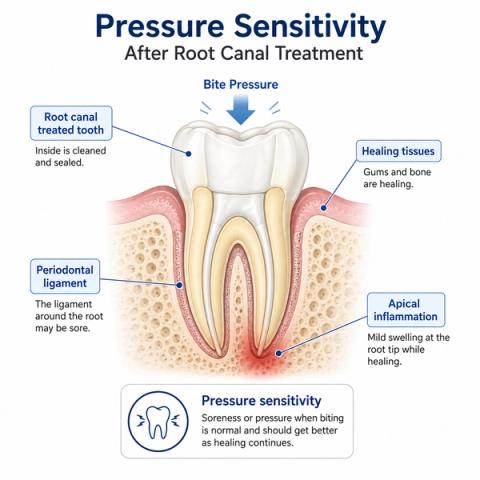
Why Can a Tooth Feel Pressure After Root Canal Treatment?
Even after the nerve inside the tooth is removed:
- the tissues around the root may still remain irritated temporarily.
This can create:
- pressure sensitivity,
- soreness while chewing or biting,
- awareness of the tooth during biting,
- or mild tenderness around the area.
People commonly describe:
- “The tooth feels bruised.”
- “I feel pressure when biting.”
- “The tooth feels slightly raised.”
- “Chewing feels uncomfortable.”
- “The area feels sore when tapped.”
In many cases:
- this improves gradually as healing progresses.
Why Does This Happen?
Pressure sensation commonly occurs because:
- inflammation already existed around the root before treatment,
- surrounding ligament tissues remain temporarily sensitive,
- healing and bone remodeling require time,
- or the bite may feel slightly high after the procedure.
Chewing and biting forces can temporarily compress:
- inflamed periodontal ligament tissues,
- healing apical tissues,
- and surrounding bone structures.
This is different from:
- hot or cold nerve pain,because:
- the pulp has already been removed.
Why the Pattern of Symptoms Matters
| Symptom Pattern | What It May Suggest |
|---|---|
| Mild pressure gradually improving | Expected healing response |
| Temporary soreness while chewing or biting | Ligament/apical healing |
| Tooth feels slightly “high” | Occlusal irritation |
| Persistent percussion tenderness | Delayed inflammatory resolution |
| Pressure worsening over time | Reassessment needed |
| Swelling with pressure pain | Persistent infection concern |
| Localized biting pain | Possible crack or structural stress |
- pressure behavior,
- bite response,
- radiographic healing,
- restoration status,
- and apical findingstogether rather than assuming all post-treatment soreness is abnormal.
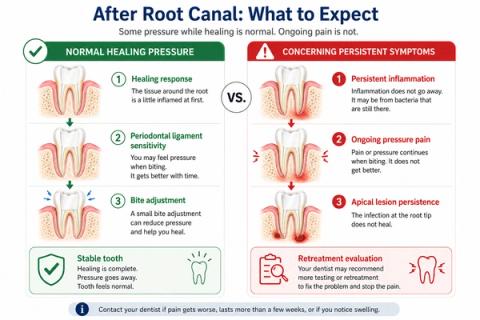
What This Means
The important question is not simply:
“Does the tooth feel pressure?”
but:
“Is the surrounding tissue healing normally over time?”
After root canal treatment:
- periapical tissues may still contain inflammatory mediators,
- bone remodeling may still be occurring,
- and periodontal ligament tissues may remain mechanically sensitive.
This means:
- chewing or biting pressure can temporarily trigger discomforteven while healing progresses normally.
However:persistent or worsening pressure may sometimes indicate:
- unresolved inflammation,
- bite imbalance,
- crack-related stress,
- persistent infection,
- or delayed healing around the root.
Modern follow-up evaluation focuses on:
- healing trajectory,
- structural stability,
- and long-term biologic resolution.
When to See a Dentist
You should consider evaluation if:
- pressure sensitivity worsens,
- chewing becomes increasingly painful,
- swelling develops,
- symptoms persist for an extended period,
- the bite feels uneven,
- or pressure returns after initial improvement.
Persistent pressure may indicate:
- ongoing inflammation,
- structural instability,
- or delayed healing around the treated tooth.
- apical healing,
- bite alignment,
- structural integrity,
- restoration condition,
- and signs of reinfection—not just whether the root canal was completed.
Follow-up evaluation may help identify delayed healing or retreatment needs early.
Related Questions
Clinical Perspective
For dental professionalsThis section discusses clinical reasoning and is not intended for self-diagnosis.
Post-Endodontic Pressure Sensation – Apical Inflammation and Periodontal Ligament Response
Clinical Takeaway
Pressure sensation after root canal treatment commonly reflects:
- residual apical inflammation,
- periodontal ligament sensitization,
- or transient occlusal loading during healing,but:persistent symptoms require evaluation for:
- unresolved infection,
- structural pathology,
- delayed healing,
- or occlusal overload.
Interpretation Framework
Post-endodontic pressure symptoms should be interpreted as a:
- healing-versus-persistence assessment probleminvolving:
- apical tissue response,
- occlusal loading,
- microbial control,
- structural integrity,
- and periodontal ligament inflammation.
Clinical assessment requires integration of:
- symptom trajectory,
- percussion response,
- occlusal findings,
- radiographic healing,
- restoration quality,
- structural stability,
- and preoperative lesion severity.
The key challenge is distinguishing:
expected healing-related tenderness
from:
unresolved biologic or structural failure.
Current interpretation increasingly emphasizes:
- longitudinal healing behavior,
- inflammatory-resolution dynamics,
- and functional loading analysis.
Current Understanding (Guidelines + Evidence)
Endodontic Perspective (AAE / ESE Aligned)
Pressure sensitivity after RCT may occur due to:
- persistent periodontal ligament inflammation,
- instrumentation-related apical irritation,
- pre-existing apical periodontitis,
- or transient occlusal overload.
Important interpretation principles include:
- mild post-treatment tenderness is common initially,
- improving trajectory supports healing interpretation,
- worsening or persistent symptoms increase concern for unresolved pathology,
- and percussion sensitivity alone does not define treatment failure.
Biologic Insight
Periapical tissues require time for:
- inflammatory resolution,
- ligament recovery,
- and bone remodeling.
Residual inflammatory mediators may temporarily maintain:
- mechanosensory sensitivity,
- pressure responsiveness,
- and ligament tenderness.
Occlusal loading may amplify:
- periodontal ligament compression,
- nociceptive signaling,
- and localized inflammatory stress.
Differential Diagnosis
1. Normal Healing Response
Features:
- mild pressure sensitivity,
- gradual improvement,
- stable healing trajectory.
2. High Occlusion
Features:
- chewing discomfort,
- ligament tenderness,
- localized pressure pain,
- occlusal contact sensitivity.
3. Persistent Apical Inflammation
Features:
- delayed healing,
- percussion sensitivity,
- radiographic lesion persistence.
4. Structural Pathology / Crack
Features:
- localized bite pain,
- inconsistent symptoms,
- compromised structural prognosis.
Key Diagnostic Distinctions
| Feature | Expected Healing | Persistent Pathology Concern |
|---|---|---|
| Symptom trend | Improving | Persistent/worsening |
| Swelling | Minimal/absent | Possible |
| Bite discomfort | Mild/transient | Increasing/persistent |
| Radiographic healing | Progressive improvement | Persistent lesion |
| Percussion response | Gradually reducing | Ongoing/intensifying |
Common Pitfalls
Common diagnostic errors include:
- over-reassuring worsening pressure symptoms,
- missing high occlusal contacts,
- ignoring structural fracture risk,
- over-interpreting early radiographic persistence,
- and failure to correlate symptom trajectory with biologic healing timelines.
Interpretation should always integrate:
- healing progression,
- occlusal loading,
- and structural prognosis.
Emerging Research Directions
Apical Healing Analytics
Research increasingly focuses on:
- inflammatory-resolution modeling,
- bone-remodeling assessment,
- ligament-recovery dynamics,
- and post-treatment healing trajectories.
AI-Assisted Interpretation
Emerging systems increasingly evaluate:
- healing-versus-failure prediction,
- post-endodontic symptom analytics,
- retreatment-risk modeling,
- and longitudinal healing assessment.
Advanced Diagnostics
Current research increasingly explores:
- CBCT healing-pattern assessment,
- physiologic inflammatory monitoring,
- structural fatigue analysis,
- and dynamic occlusal analytics.
AI Potential
Pressure sensation after root canal treatment represents a:
- longitudinal healing interpretation problemwhere:
- inflammatory resolution,
- occlusal loading,
- and structural stabilityevolve dynamically over time.
AI can assist across the clinical workflow:
Interpretation
- Integrating symptom trajectory, percussion findings, imaging, and occlusal behavior
- Identifying clinically meaningful healing versus persistence patterns
Decision Timing
- Supporting monitor versus retreatment decisions
- Flagging delayed-healing or overload-risk presentations
- Assisting follow-up planning
Patient Communication
- Explaining why pressure sensitivity may persist temporarily after treatment
- Clarifying differences between healing discomfort and recurrent infection
- Improving understanding of biologic healing timelines
Clinical Workflow Support
- Structuring post-endodontic reassessment consistently
- Supporting longitudinal healing tracking
- Reducing variability in post-treatment interpretation
Emerging Direction
- AI-assisted apical-healing prediction
- Integrated occlusal-load and inflammatory analytics
- Predictive post-endodontic outcome modeling
Clinical Relevance
The challenge is not simply identifying pressure after root canal treatment — it is determining whether:
- surrounding tissues are progressing through normal biologic healing,or:
- persistent inflammatory or structural instability remains present.
AI may eventually help:
- improve interpretation of post-endodontic healing behavior,
- support earlier recognition of persistent pathology,
- reduce variability in retreatment assessment,
- and enhance patient communication regarding healing expectations.
References
- American Association of Endodontists (AAE). Endodontic Diagnosis. AAE Clinical Resources.
- Pak JG, White SN. Pain prevalence and severity before, during, and after root canal treatment: a systematic review. Journal of Endodontics.
- Sathorn C, Parashos P, Messer HH. The prevalence of postoperative pain and flare-up in single- and multiple-visit endodontic treatment: a systematic review. International Endodontic Journal.
- Tsesis I, Faivishevsky V, Fuss Z, Zukerman O. Flare-ups after endodontic treatment: a meta-analysis of literature. Quintessence International.
- Ørstavik D. Time-course and risk analyses of the development and healing of chronic apical periodontitis in man. International Endodontic Journal.
- Fouad AF. Endodontic interappointment flare-ups: a prospective study of incidence and related factors. Journal of Endodontics.
- Manfredi M, Figini L, Gagliani M, Lodi G. Single versus multiple visits for endodontic treatment of permanent teeth: a Cochrane systematic review. Journal of Endodontics.
- Aminoshariae A, Kulild J, Nagendrababu V. Artificial Intelligence in Endodontics: Current Applications and Future Directions. J Endod.