
Why does my tooth hurt when I bite down or release?
The timing of pain during biting and release gives important clues — but the pattern is not always absolute



Short Answer
Pain when biting down or releasing pressure usually means the tooth is reacting to mechanical stress or inflammation. Pain during pressure is commonly linked to irritation around the root or supporting tissues, while sharp pain during release is more suggestive of a crack in the tooth. However, both patterns can overlap, so dentists evaluate the full behavior of the tooth under load rather than relying on one symptom alone.
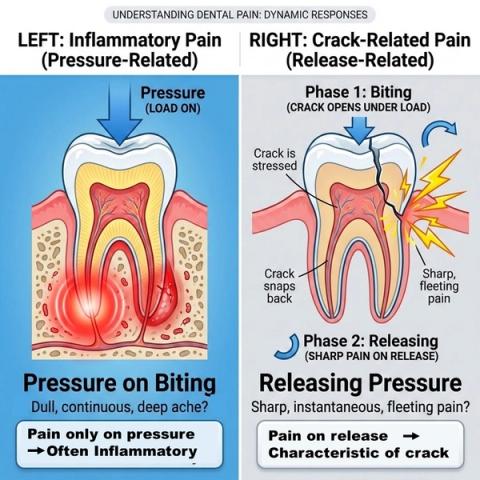
What Does Pain While Biting or Releasing Mean?
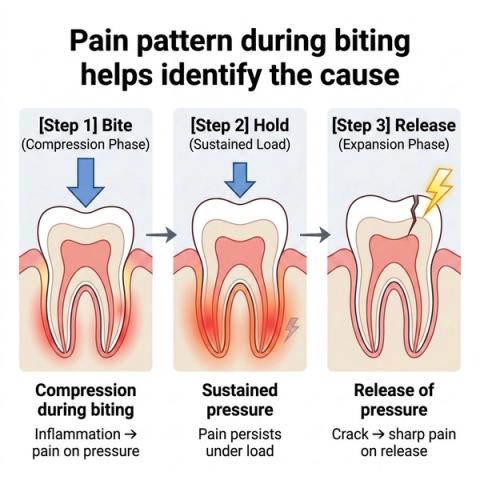
When you bite down, pressure travels through the tooth and surrounding tissues. When you release the bite, the pressure changes suddenly.
Pain can happen during different parts of this process.
People commonly describe it as:
- “My tooth hurts when I bite down.”
- “I feel sharp pain when I let go after biting.”
- “The pain happens only with pressure.”
- “Chewing or biting on one side hurts.”
- “The pain is quick and sharp.”
- “I avoid biting on that tooth.”
The timing of pain often helps dentists understand whether the problem may be:
- inflammation around the root,
- a crack in the tooth,
- bite-force stress,
- or a combination of these factors.
Pain While Biting Down
Pain during pressure or biting is commonly associated with:
- irritation around the root,
- inflammation of supporting tissues,
- early infection,
- or excessive bite pressure.
Some cracked teeth can also hurt during biting because pressure causes the tooth structure to flex under load.
The pain may feel:
- dull,
- sore,
- pressure-related,
- or uncomfortable while chewing or biting.
Pain When Releasing the Bite
Sharp pain when releasing pressure is more characteristic of a cracked tooth.
This can happen when:
- pressure temporarily compresses the crack,
- and release causes slight movement or separation within the tooth structure.
People often describe this as:
- a sudden sharp pain,
- a quick “zing” sensation,
- or pain that disappears immediately after release.
Cracks may not always be visible on X-rays, especially in early stages.
Why the Pattern of Pain Matters
| Pain Pattern | What It May Suggest |
|---|---|
| Pain while biting down | Root inflammation or pressure irritation |
| Sharp pain on release | Possible cracked tooth |
| Pain during chewing or biting | Load-related tooth stress |
| Intermittent pressure pain | Early crack or inflammation |
| Diffuse soreness | Bite imbalance or overload |
| Sharp localized pain | Structural crack |
Dentists evaluate:
- when the pain occurs,
- how sharp or diffuse it feels,
- whether it is repeatable,
- and whether the symptoms change over time.
What This Means
Pain while chewing, biting, or releasing pressure does not automatically mean the tooth needs root canal treatment — but it often indicates that the tooth is under structural or inflammatory stress.
Even if:
- no crack is visible,
- the pain comes and goes,
- or the X-ray appears normal,the underlying problem may still be progressing.
Early evaluation often improves:
When to See a Dentist
You should consider evaluation if:
- pain is sharp and repeatable,
- pain consistently occurs on one tooth,
- chewing or biting becomes uncomfortable,
- you avoid chewing on one side,
- pain occurs after releasing pressure,
- or symptoms are worsening over time.
Cracks and early inflammation may not always be visible clinically or radiographically but can worsen if left untreated.
Related Questions
Clinical Perspective
For dental professionalsThis section discusses clinical reasoning and is not intended for self-diagnosis.
Pain on Biting vs Release – Crack vs Apical Pathology
Clinical Takeaway
Timing of pain under functional load is diagnostically significant. Differentiation between crack-related pathology and apical inflammation depends on symptom behavior during compression and release phases rather than pain presence alone.
Interpretation Framework
Pain on biting and release represents a load-dependent structural and inflammatory response requiring integration of:
- pulpal status,
- periodontal ligament response,
- structural integrity,
- and occlusal loading dynamics.
Clinical interpretation depends on how the tooth behaves during different phases of mechanical load rather than the isolated presence of pain.
Current understanding increasingly recognizes:load-response behavior as a functional biomechanical assessment rather than a purely symptomatic phenomenon.
Current Understanding (Guidelines + Evidence)
Endodontic Perspective (AAE / ESE Aligned)
Pain on biting is commonly associated with:
- apical inflammation,
- periodontal ligament involvement,
- and load-sensitive periapical tissues.
Interpretation requires correlation with:
- thermal response,
- symptom history,
- pulpal testing,
- and temporal progression.
Mechanical testing is informative, but interpretation of the overall response pattern remains critical.
Crack-Related Pathology
Cracks may remain:
Typical symptom characteristics include:
- pain during compression,
- sharper pain on release,
- intermittent localization,
- and variable thermal response.
Release pain may occur secondary to crack segment rebound and transient structural separation under unloading.
Differential Diagnosis
1. Cracked Tooth Syndrome
Features:
- pain on biting and release,
- sharp localized discomfort,
- more pronounced release pain,
- intermittent symptom fluctuation.
Radiographic findings are frequently absent.
2. Early Apical Periodontitis
Features:
- pain on pressure,
- periodontal ligament inflammation,
- pulpal inflammation or necrosis,
- percussion sensitivity.
Less commonly associated with sharp release-specific pain.
3. Occlusal Trauma
Features:
- diffuse load-related discomfort,
- force sensitivity,
- periodontal stress response,
- muscular adaptation patterns.
Key Diagnostic Distinctions
| Feature | Crack | Apical pathology |
|---|---|---|
| Pain on pressure | Present (variable) | Common |
| Pain on release | More characteristic | Rare |
| Localization | Sharp | Diffuse |
| Radiographic signs | Often absent | May develop |
| Thermal variability | Common | Variable |
| Bite-test response | Highly informative | Less specific |
Common Pitfalls
- Common diagnostic errors include:
- assuming pressure pain excludes cracks,
- overdiagnosing endodontic disease in structurally compromised teeth,
- missing incomplete cracks,
- ignoring occlusal loading contribution,
- and over-reliance on radiographs.
Structural cracks may remain radiographically invisible until advanced propagation occurs.
Emerging Research Directions
Crack Detection Advancements
Research increasingly focuses on:
- AI-assisted imaging,
- optical coherence tomography,
- enhanced transillumination,
- and multimodal crack-detection systems.
Biomechanical Modeling
Emerging biomechanical research evaluates:
- stress distribution in cracked teeth,
- force concentration zones,
- and load-dependent crack propagation behavior.
Current direction increasingly emphasizes structural behavior under functional loading.
AI Potential
Pain on biting and release represents a load-dependent interpretation problem, where clinical meaning depends on how the tooth responds during different phases of mechanical stress.
AI can assist across the clinical workflow:
Interpretation
- Integrating load-response patterns(compression vs release), symptom history, and thermal testing
- Identifying clinically relevant distinctions(structural compromise vs inflammatory pathology)
Decision Timing
- Supporting decisions in borderline presentations(monitor vs intervene; restorative vs endodontic approach)
- Highlighting patterns suggestive of progressive structural failure
Patient Communication
- Explaining load-related pain mechanisms clearly
- Helping patients understand why specific interventions are recommended
- Addressing uncertainty in cases without clear radiographic findings
Clinical Workflow Support
- Structuring mechanical test findings systematically
- Supporting consistent interpretation across clinicians
- Reducing variability in load-based diagnostic reasoning
Emerging Direction
- AI-assisted crack detection
- Integration of mechanical testing patterns with imaging
- Predictive modeling of structural compromise
Clinical Relevance
The challenge is not detecting pain — it is interpreting load-dependent patterns, distinguishing structural vs inflammatory causes, and selecting the appropriate intervention.
AI may eventually help:
- improve interpretation of load-response patterns,
- support decision-making in ambiguous cases,
- reduce misdiagnosis (e.g., crack vs apical pathology),
- and enhance clarity in patient communication.
References
- American Association of Endodontists (AAE). Cracked Teeth: Clinical Diagnosis and Treatment Recommendations.
- European Society of Endodontology (ESE). Quality Guidelines for Endodontic Treatment. International Endodontic Journal. 2023.
- Kahler W. The cracked tooth conundrum: terminology, classification, diagnosis, and management. Am J Dent.
- Krell KV, Rivera EM. A six-year evaluation of cracked teeth diagnosed with reversible pulpitis: treatment and prognosis. Journal of Endodontics.
- Hilton TJ, Funkhouser E, Ferracane JL, Gilbert GH, Baltuck C, Benjamin P, Louis D, Mungia R, Meyerowitz C; National Dental Practice-Based Research Network Collaborative Group. Correlation between symptoms and external characteristics of cracked teeth: Findings from The National Dental Practice-Based Research Network. J Am Dent Assoc.
- Tsesis I, Rosen E, Tamse A, Taschieri S, Kfir A. Diagnosis of vertical root fractures in endodontically treated teeth based on clinical and radiographic indices: a systematic review. Journal of Endodontics.
- Schmitter M, Rammelsberg P, Gabbert O, Ohlmann B. Influence of clinical baseline findings on the decision-making process for cracked teeth. Journal of Oral Rehabilitation.
- Guo, J., Wu, Y., Chen, L., Long, S., Chen, D., Ouyang, H., Zhang, C., Tang, Y., & Wang, W. (2022). A perspective on the diagnosis of cracked tooth: imaging modalities evolve to AI-based analysis. BioMedical Engineering