
Implant Patient Selection and Risk Assessment
Patient Selection, Site Evaluation, and Referral Decisions
🧭 Clinical Decision Snapshot
Clinical confidence begins with the right question: not "Can an implant be placed?" but "Can this patient predictably benefit from implant treatment over the long term?"
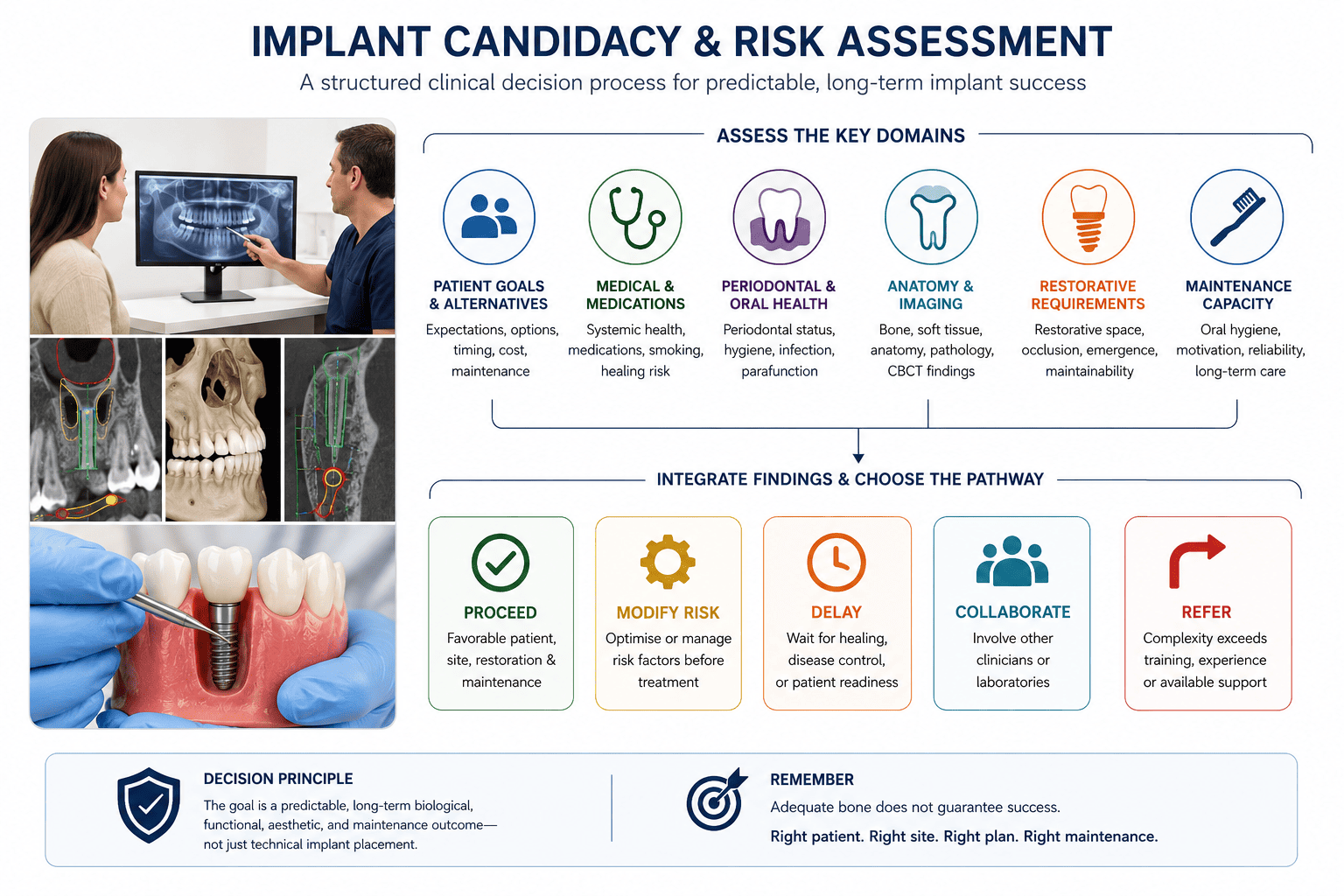
Implant candidacy is a clinical risk assessment, not a simple eligibility checklist. The decision should integrate medical, periodontal, anatomical, restorative, and patient-related factors to determine whether treatment should proceed, be modified, delayed, or referred.
Successful implant treatment depends on selecting the right patient and the right site, not simply placing an implant where bone happens to be available.
Key Clinical Takeaways
🔍 Clinical Assessment
Evaluate patient, site, restorative, and maintenance factors that influence implant candidacy.
What Domains Determine Implant Candidacy?
Individual findings rarely determine candidacy in isolation. A reliable recommendation depends on evaluating patient goals, medical risk, periodontal and oral health, anatomy, restorative requirements, and maintenance capacity together, and recognizing where these factors converge or conflict.
Clinical Assessment Framework
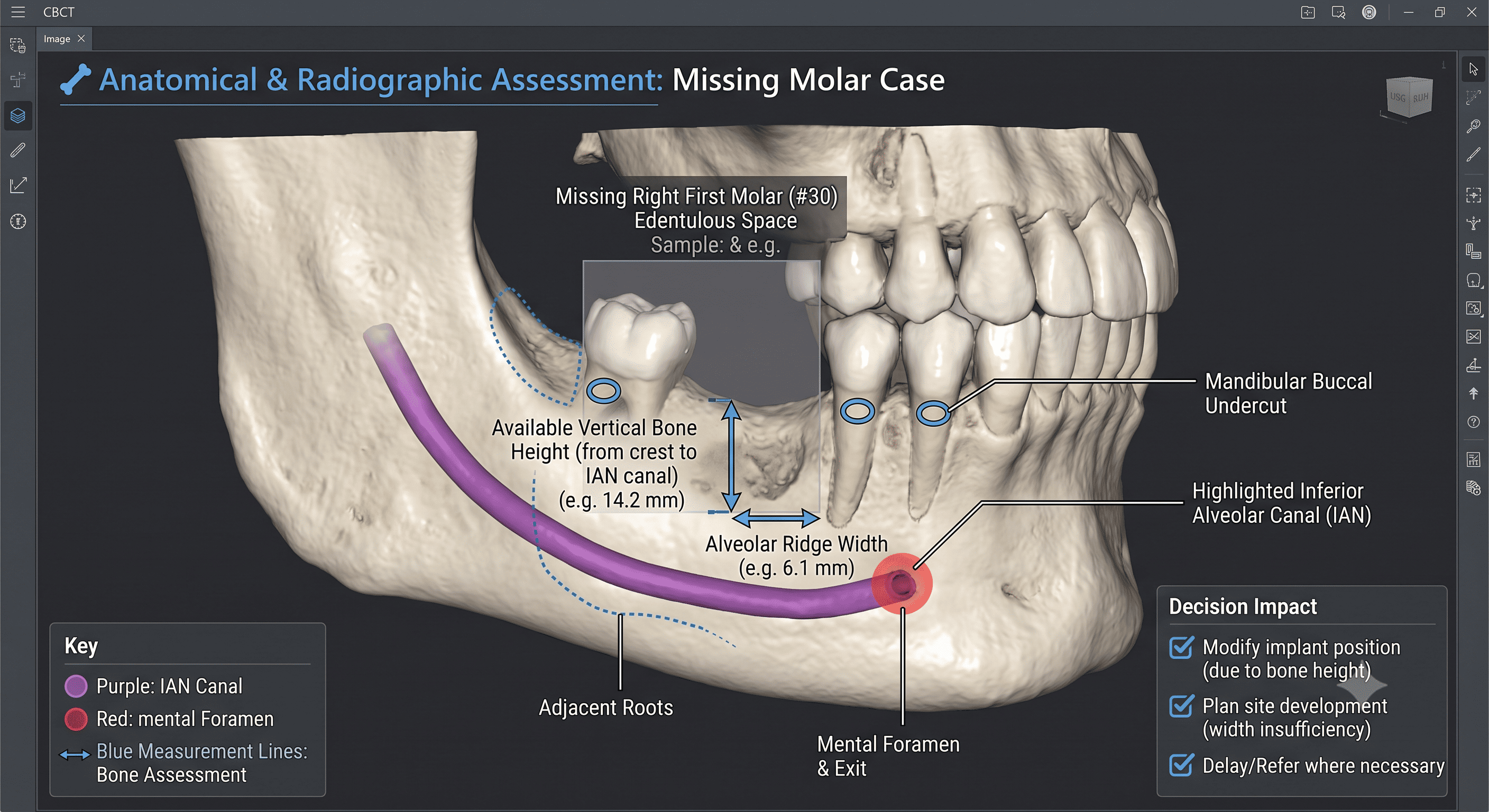
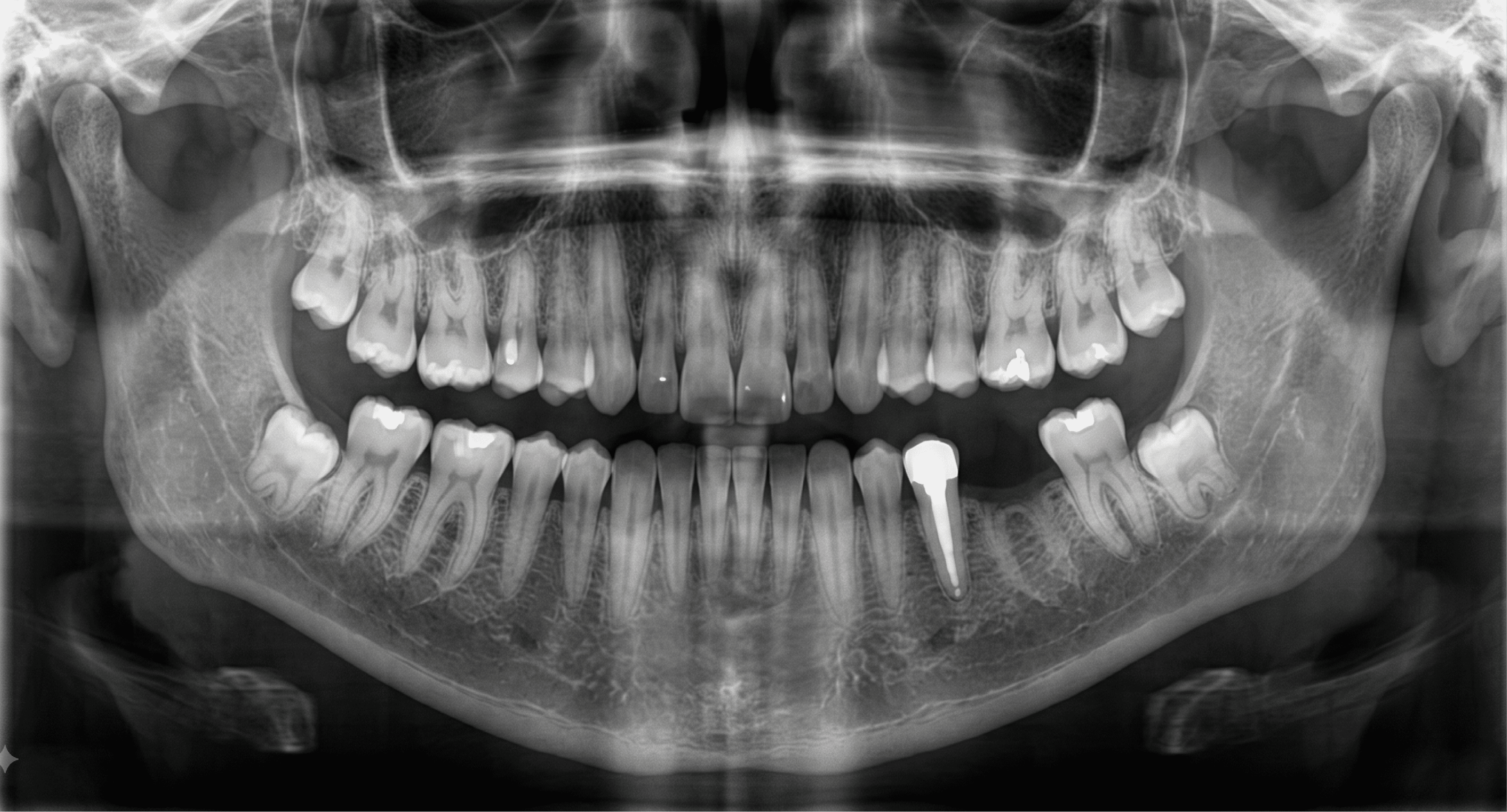
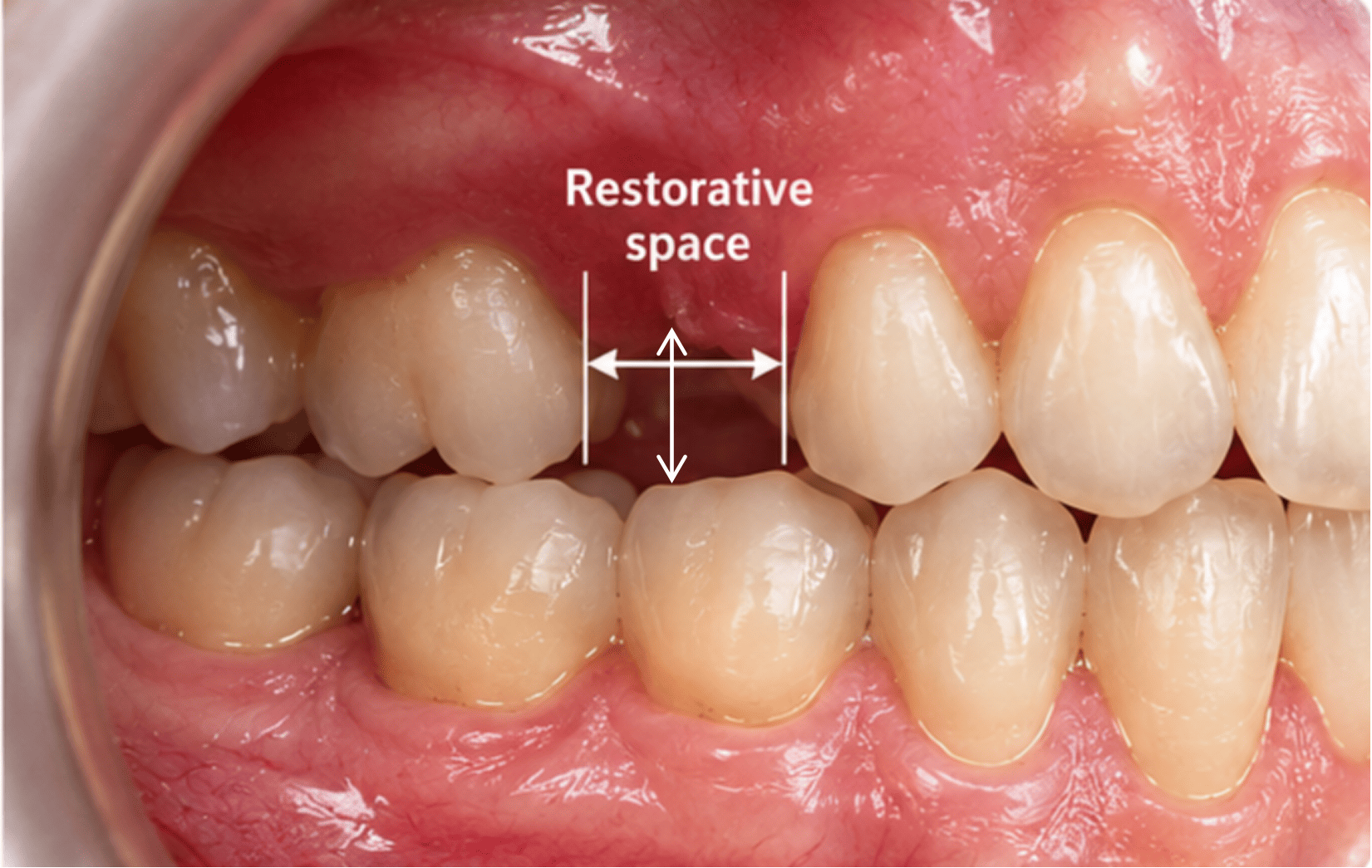
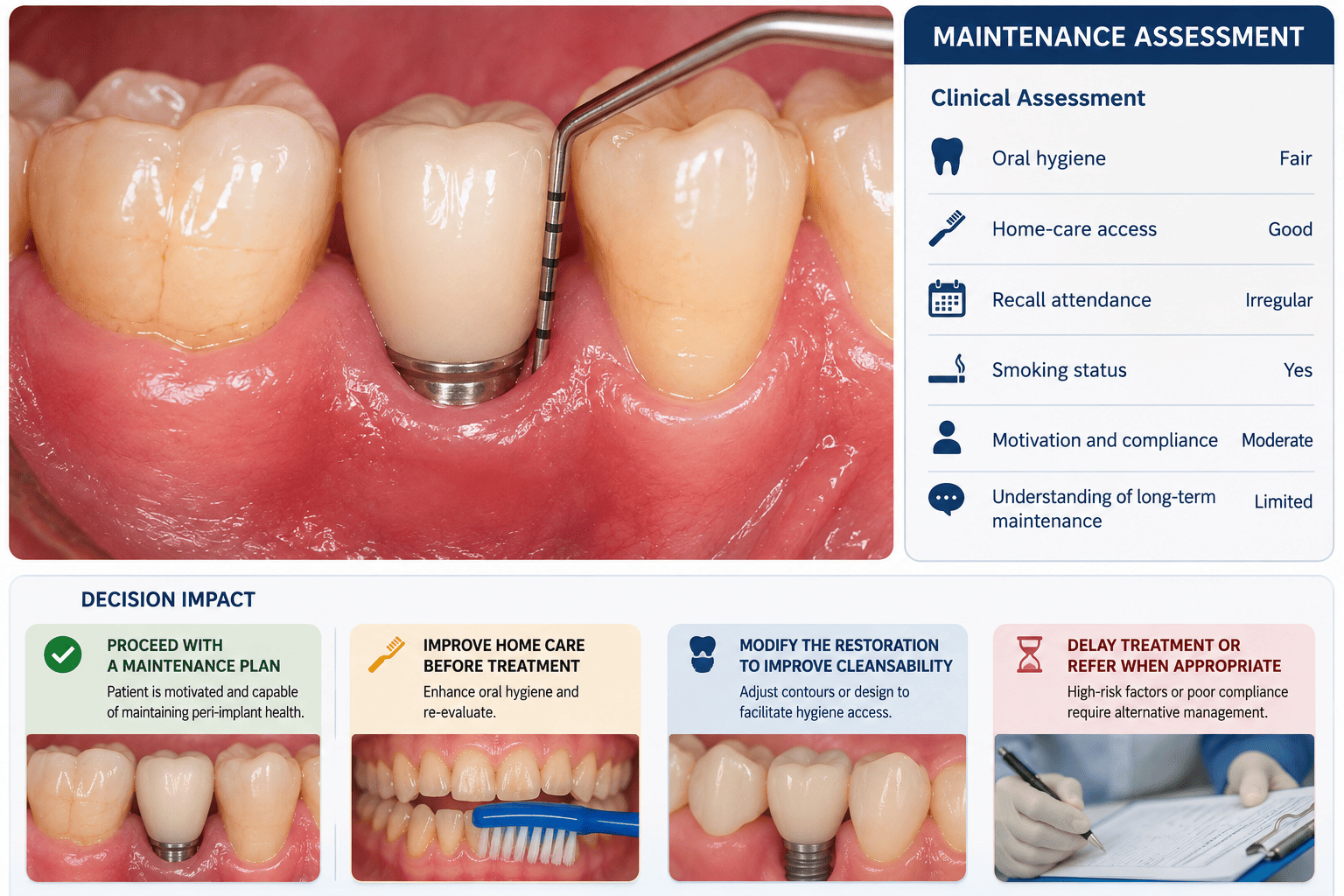
Clinical Assessment
Evaluate:
- Chief concern and desired outcome
- Functional and aesthetic priorities
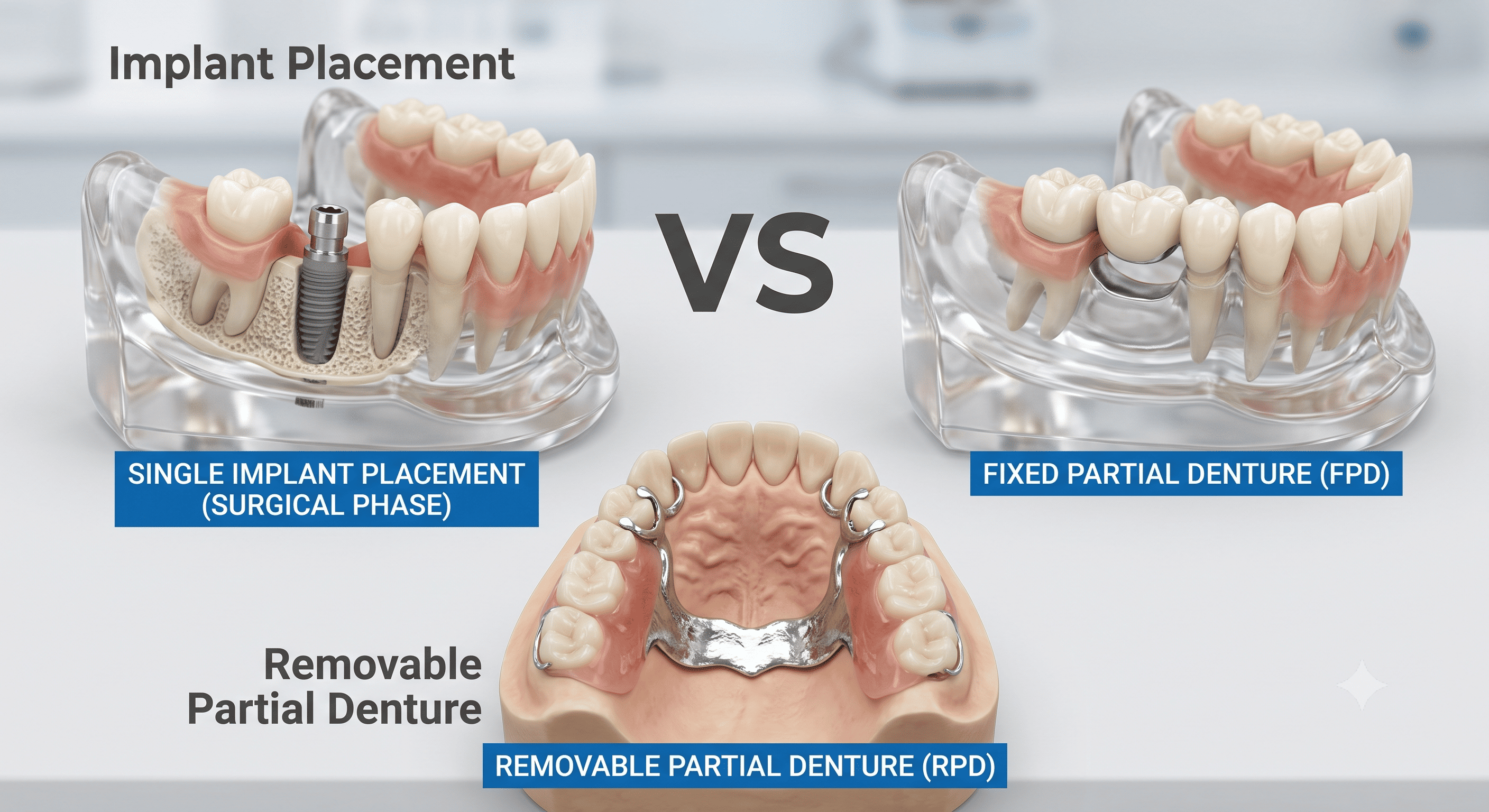
- Fixed, removable, orthodontic, and no-treatment alternatives
- Financial and practical considerations
- Willingness to undergo surgery and long-term maintenance
Clinical Reasoning
Findings here can support proceeding with implant planning, prompt a discussion of alternative treatment options, or indicate that expectations should be clarified before treatment begins.
When a patient's priorities point toward a fixed, removable, or orthodontic alternative, or maintenance capacity is doubtful, modifying, delaying, or referring may be the more appropriate pathway.
Clinical Pearl
Successful implant treatment depends on combining findings, not isolating them.
Success depends on the combination of patient factors, site conditions, restorative planning, and long-term maintenance, not on any single finding. The most predictable treatment decisions arise when these factors are considered together rather than in isolation.
⚖️ Clinical Decision-Making
A defensible recommendation emerges when independent findings converge on the same pathway.
What Should I Do After Completing the Assessment?
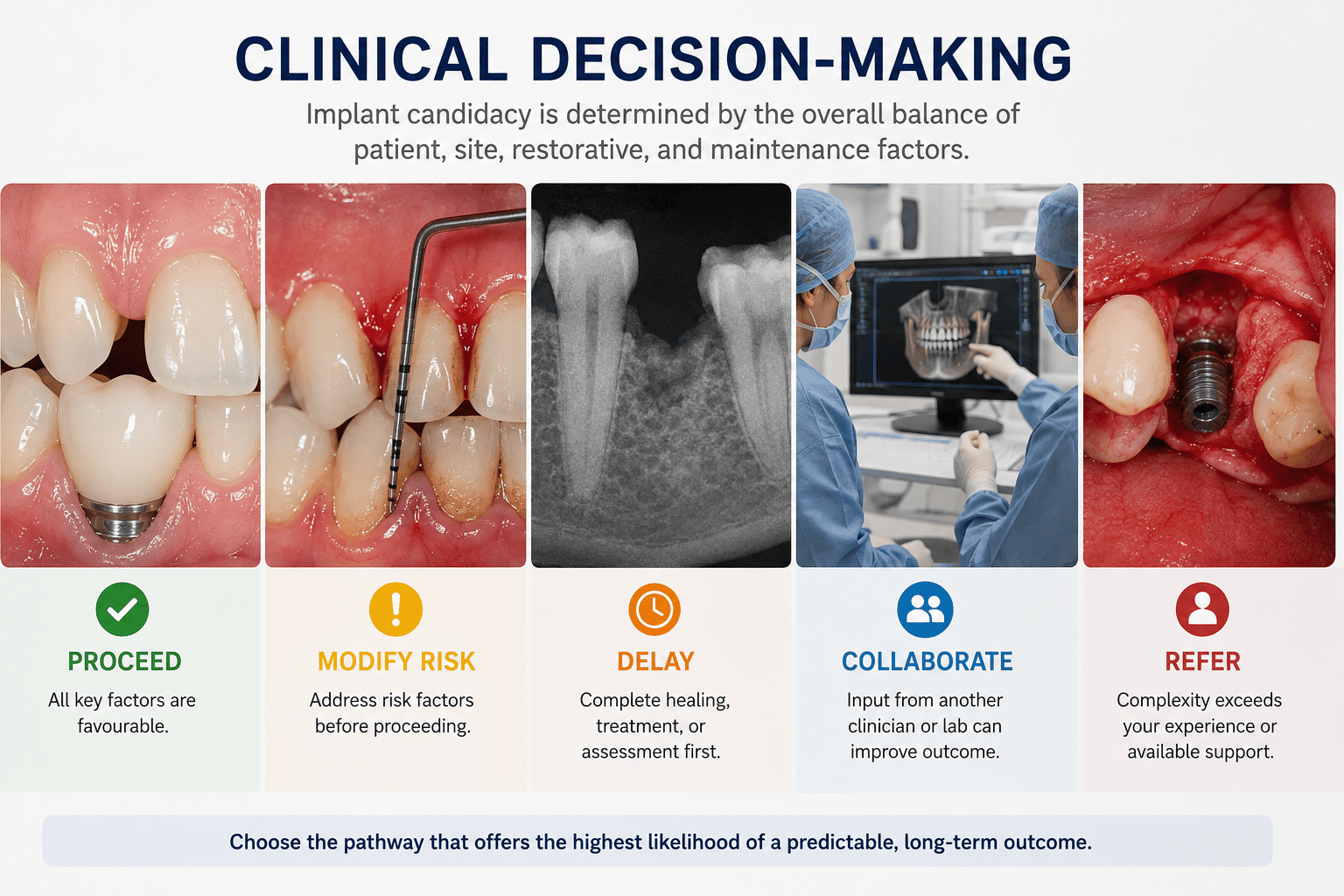
Implant candidacy is determined by the overall balance of patient, site, restorative, and maintenance factors, not by any single finding. The goal is to choose the management pathway most likely to achieve a predictable long-term outcome.
Clinical Decision Framework
How do individual findings become one implant treatment recommendation?
Proceed With Implant Treatment
Clinical Decision Factors
Typical features include:
- Realistic patient goals matched to a feasible restorative plan
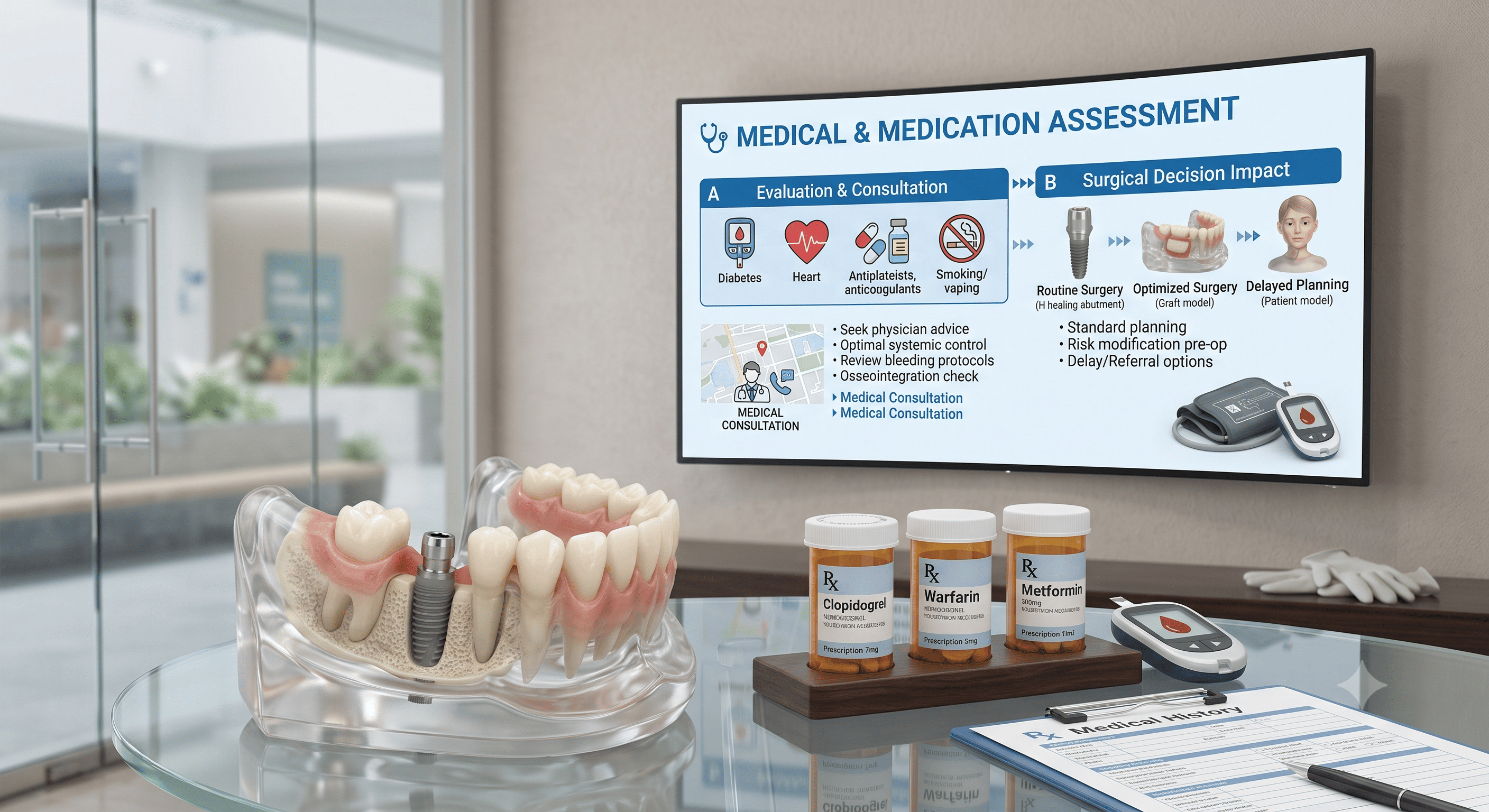
- Medical history and medications posing no significant surgical risk
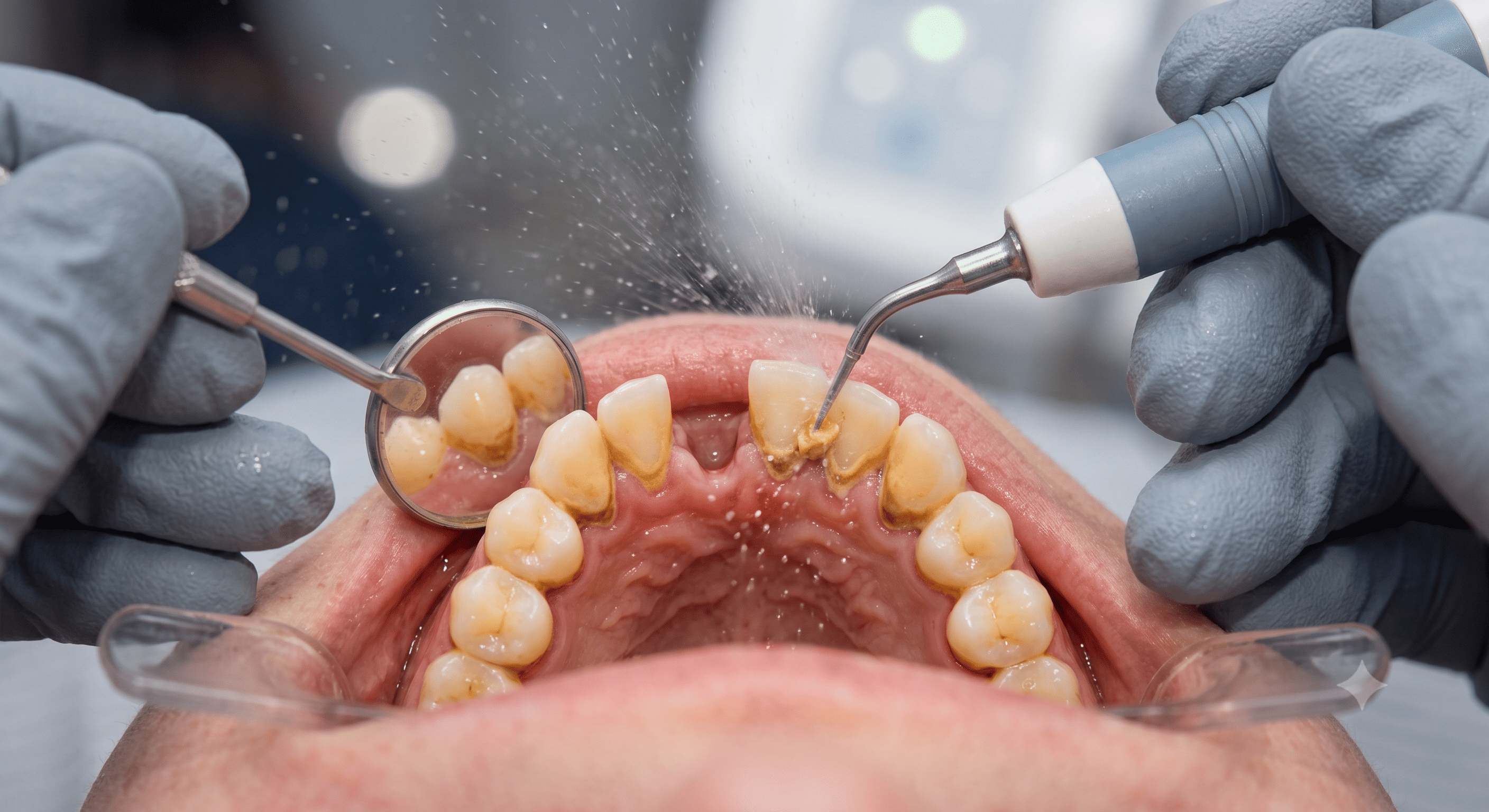
- Stable periodontal health and good plaque control
- Adequate bone, soft tissue, and restorative space at the planned site
- A patient able and willing to maintain long-term peri-implant health
Clinical Reasoning
When these factors align, implant treatment can proceed as planned, supported by a clear maintenance and review schedule.
The goal is not simply successful surgery. It is a restoration that remains functional, cleansable, and maintainable over the long term.
Clinical Pearl
The strongest decisions occur when multiple findings agree.
The strongest implant decisions are made when multiple independent findings point toward the same management pathway. When important findings conflict, the safest decision is often to modify risk, delay treatment, collaborate, or refer rather than proceed immediately.
📝 Clinical Documentation
Another clinician should be able to understand the reasoning behind the treatment plan.
How Should Implant Candidacy Be Documented?
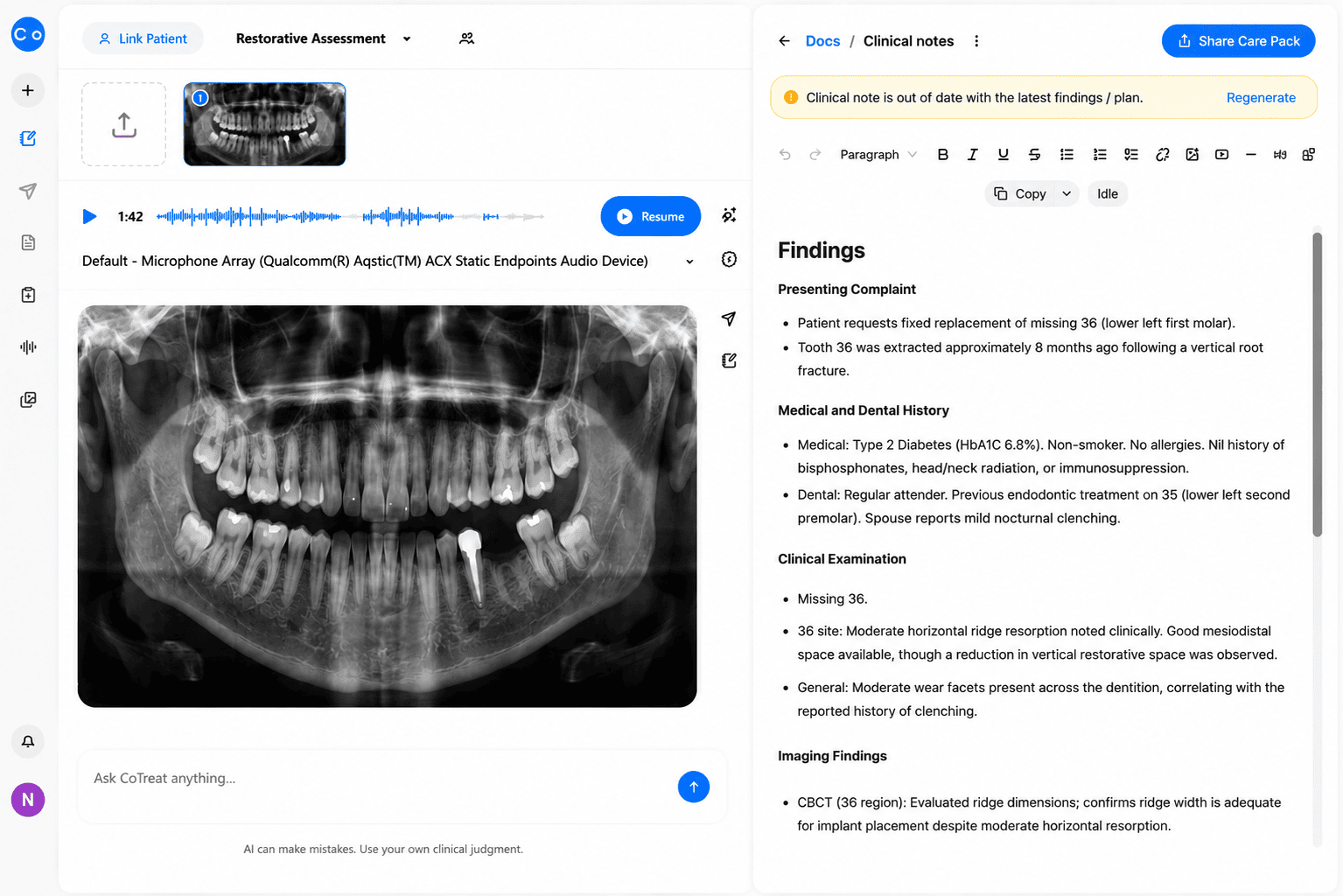
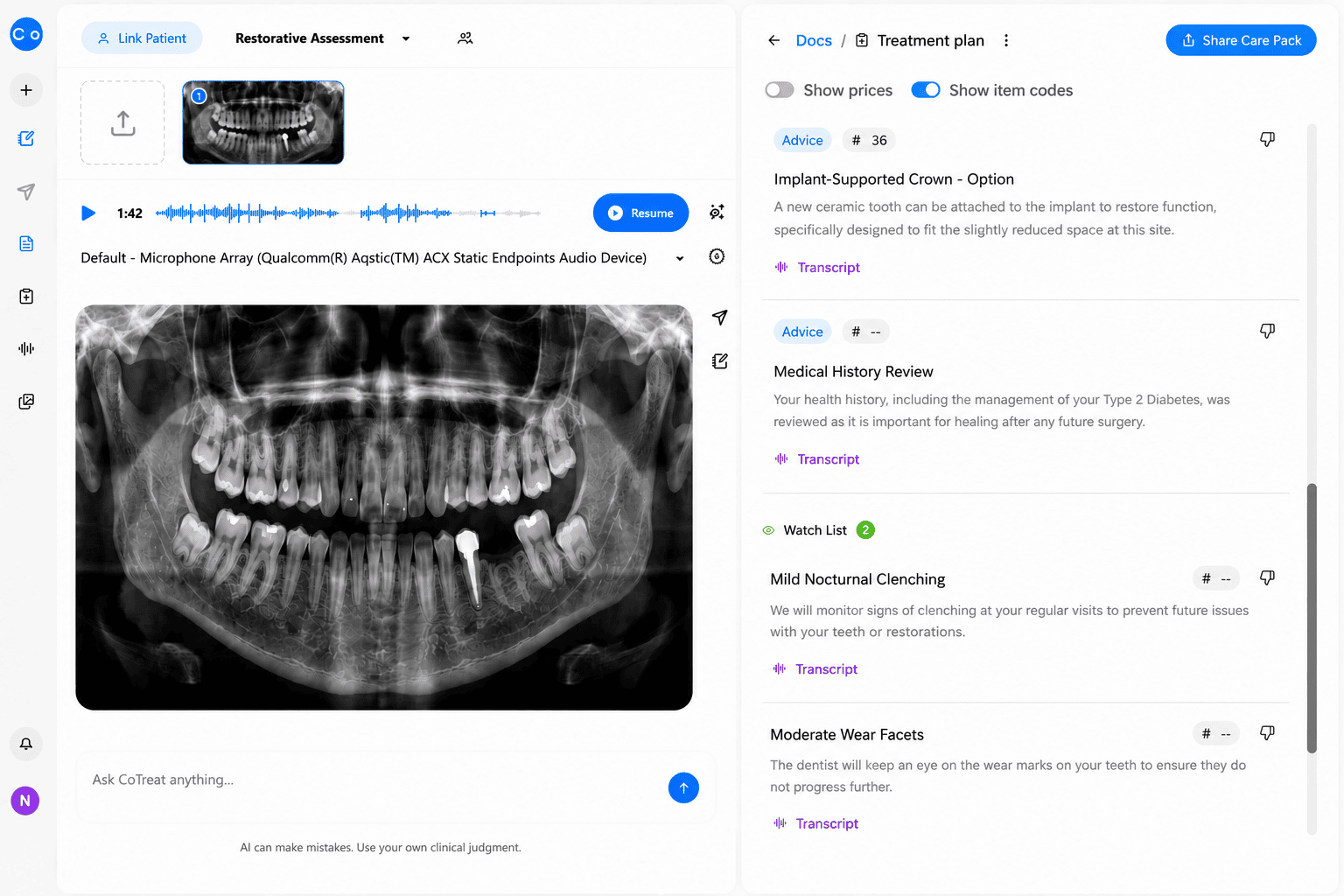
Clinical records should explain why implant treatment was recommended, modified, delayed, or referred. Documentation should preserve the reasoning, the alternatives considered, the uncertainty present, and the basis on which the final plan was agreed.
Clinical Documentation Framework
What should every structured clinical record contain?
Clinical Documentation
Record:
- Patient concerns, goals, and expectations
- Treatment options and alternatives discussed
- Relevant medical history and medications
- Periodontal, restorative, and occlusal findings
- Clinical and radiographic assessment
- Bone and soft-tissue evaluation
- Identified risk factors
- Maintenance considerations
- Informed consent discussions
Clinical Reasoning
A recommendation is only as defensible as the findings that support it. If the decisive findings are missing from the record, the decision becomes difficult to justify later.
See this workflow in CoTreat Chairside
Explore how consultation, documentation and treatment planning are generated in a real clinical workflow.
Clinical Pearl
Good documentation is not simply a treatment record.
Well-documented clinical reasoning is often more valuable than a detailed list of findings. The record should clearly explain how the assessment led to the final treatment recommendation.
💬 Patient Communication
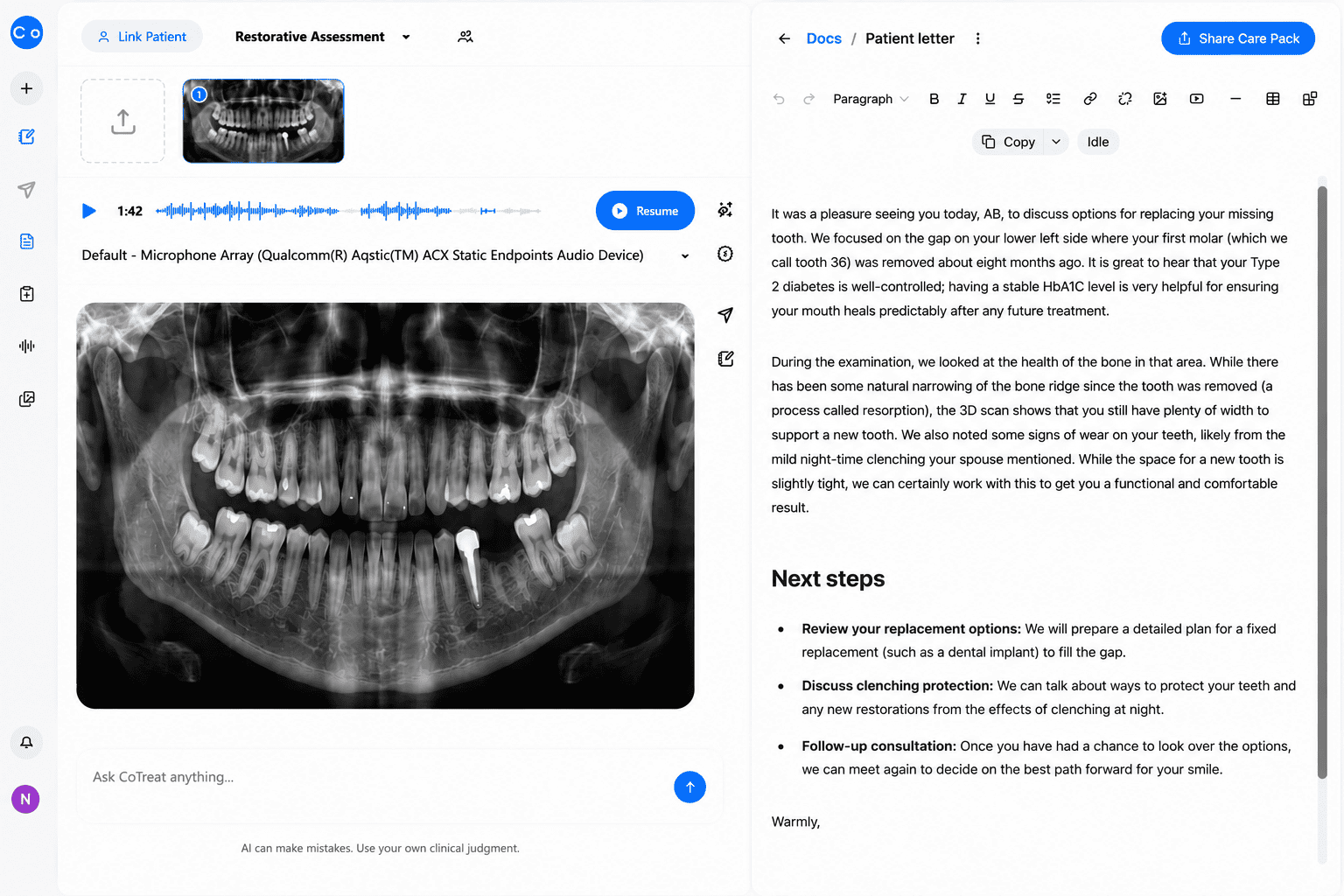
Patients should understand why implant treatment is or is not the most predictable option.
How Should Implant Suitability Be Explained?
Communication should support informed, shared decision-making rather than simply explain the surgical procedure. Patients should understand why implant treatment is or is not the most predictable option, what alternatives are available, and what the next steps involve.
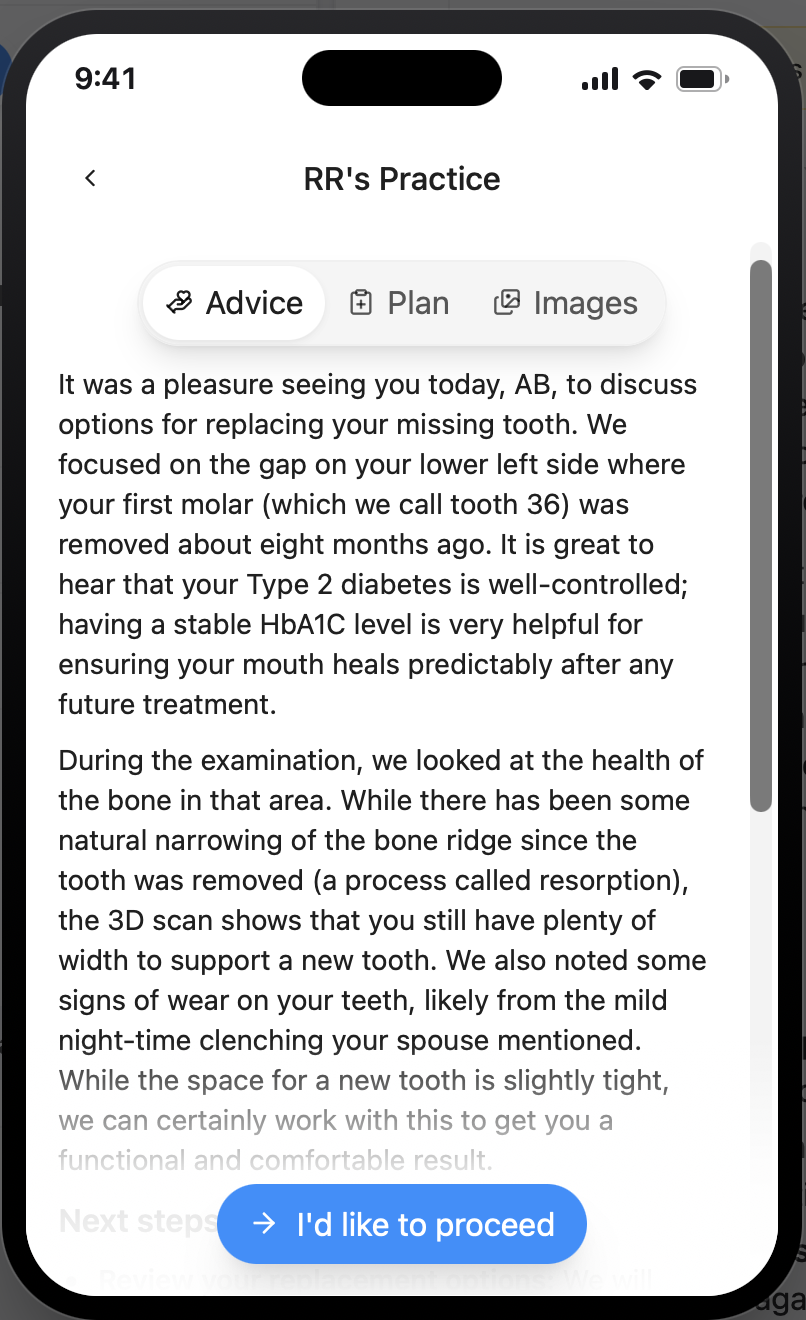
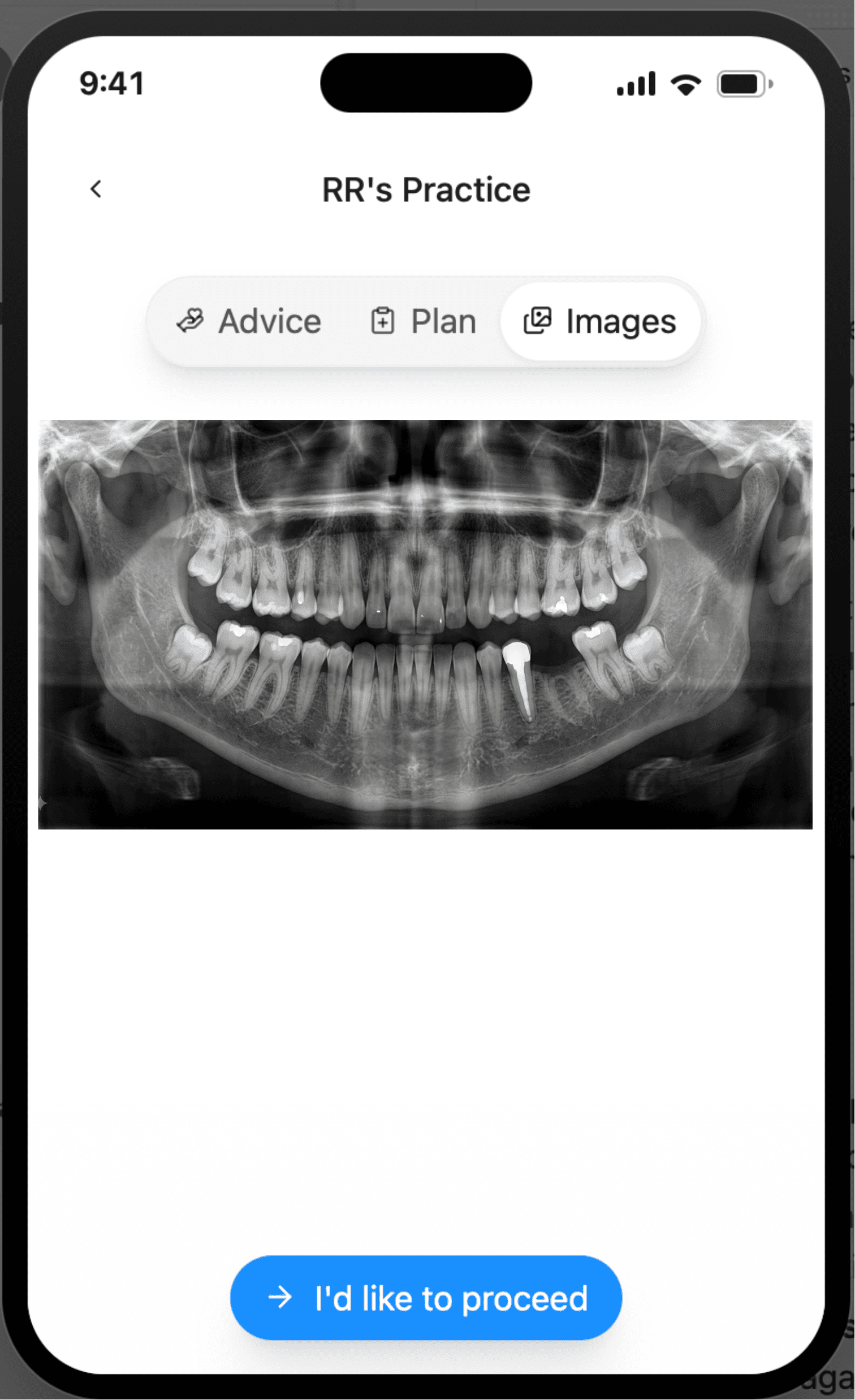
Patient Communication Framework
How can clinical reasoning be translated into patient understanding?
See this workflow in CoTreat Chairside
Explore how consultation, documentation and treatment planning are generated in a real clinical workflow.
Clinical Pearl
Good communication does not oversimplify implant dentistry.
Clear communication builds realistic expectations, supports informed consent, and improves long-term adherence to maintenance, whether treatment proceeds now, is modified, delayed, or referred.
🌍 CoDL Learning
Implant candidacy is the first step in the implant treatment pathway.
Continue Learning
Explore related topics to support treatment planning, complication management, restoration, and long-term maintenance.
Learning Pathways
Clinical Pearl
Implant candidacy is the gateway to the entire implant treatment pathway.
A structured assessment provides the foundation for planning, surgery, restoration, maintenance, and long-term clinical success.



CoTreat is building the AI colleague for dentists.
CoTreat makes it easy to go above and beyond for your patient. An AI that supports you in clinic.