
What happens if root canal treatment is delayed?
Delaying treatment may allow inflammation or infection inside the tooth to progress beyond the pulp into the surrounding bone and tissues



Short Answer
If root canal treatment is delayed, pulpal inflammation or infection may continue progressing over time. This can lead to worsening pain, swelling, abscess formation, bone involvement, structural weakening of the tooth, or reduced long-term prognosis. In some cases, symptoms may temporarily decrease even while infection silently progresses around the root.
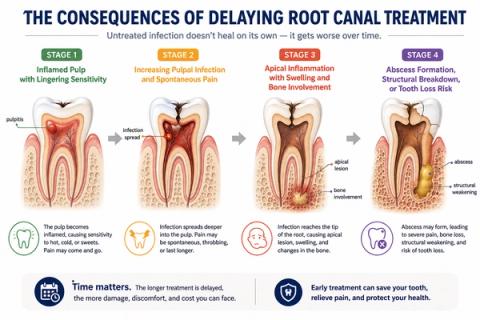
What Happens When an Infected Tooth Is Left Untreated?
When the pulp inside a tooth becomes irreversibly inflamed or infected, the condition usually does not remain completely stable indefinitely.
Without treatment:
- inflammation may continue progressing,
- bacteria may spread beyond the root,
- and surrounding bone and tissues may become involved.
People may notice:
- increasing pain,
- night pain,
- swelling,
- chewing or biting discomfort,
- bad taste or drainage,
- or pain that later disappears as the nerve loses vitality.
In some situations:
- symptoms may temporarily improve,while:
- infection continues progressing silently around the root.
Why Can Pain Sometimes Disappear Without Healing?
Some people assume:
- if pain disappears,the tooth is improving.
However:pain may decrease because:
- the nerve inside the tooth loses vitality,not because the infection has resolved.
This means:
- the tooth may become less sensitive,while:
- inflammatory disease continues developing around the root.
Silent progression may still lead to:
- apical infection,
- swelling,
- bone loss,
- structural weakening,
- and eventual tooth loss if untreated.
Why the Pattern of Symptoms Matters
| Symptom Pattern | What It May Suggest |
|---|---|
| Lingering cold or heat pain | Progressive pulpal inflammation |
| Spontaneous throbbing pain | Irreversible pulpal disease |
| Swelling or drainage | Infection extending beyond the root |
| Pain while chewing or biting | Apical inflammation or structural stress |
| Pain suddenly disappears | Possible pulpal necrosis |
| Recurrent flare-ups | Chronic apical disease progression |
| Increasing tooth weakness | Structural compromise over time |
- vitality status,
- apical involvement,
- structural condition,
- symptom progression,
- and restorabilityrather than relying on pain intensity alone.
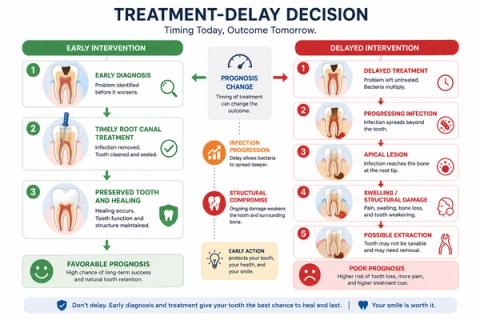
What This Means
The important question is not simply:
“Does the tooth still hurt?”
but:
“How is the disease progressing biologically over time?”
As untreated disease progresses:
- microbial burden may increase,
- inflammation may spread beyond the pulp,
- structural fatigue may worsen,
- and long-term restorability may become less predictable.
Some teeth remain relatively stable for periods of time.
Others progress more rapidly depending on:
- bacterial activity,
- structural condition,
- crack formation,
- host immune response,
- and apical involvement.
Delaying treatment may therefore reduce:
- long-term treatment predictability,
- preservation potential,
- and structural prognosis.
When to See a Dentist
You should consider evaluation if:
- lingering sensitivity develops,
- spontaneous pain occurs,
- swelling appears,
- chewing or biting becomes painful,
- symptoms worsen over time,
- or a previously painful tooth suddenly becomes quiet.
- pulpal vitality,
- apical status,
- infection extent,
- structural integrity,
- and restorability—not just whether severe pain is currently present.
Early evaluation may help prevent:
- more advanced infection,
- structural breakdown,
- and reduced long-term prognosis.
Related Questions
Clinical Perspective
For dental professionalsThis section discusses clinical reasoning and is not intended for self-diagnosis.
Progression of Untreated Pulpal and Apical Disease
Clinical Takeaway
Delaying indicated root canal treatment may allow:
- pulpal and apical disease progression,
- increasing microbial burden,
- structural compromise,
- inflammatory extension,
- and worsening long-term prognosis predictability.
Interpretation Framework
Untreated endodontic disease should be interpreted as a:
- dynamic biologic progression processrather than:
- a static symptom state.
Clinical assessment requires integration of:
- pulpal vitality status,
- apical tissue involvement,
- microbial progression,
- structural integrity,
- symptom trajectory,
- restorability over time,
- and patient-specific risk factors.
The key issue is not simply symptom persistence, but:
“How ongoing inflammatory and infectious processes alter future treatment predictability.”
Current interpretation increasingly emphasizes:
- progression-risk analysis,
- structural prognosis deterioration,
- and timing-sensitive intervention planning.
Current Understanding (Guidelines + Evidence)
Endodontic Perspective (AAE / ESE Aligned)
Untreated irreversible pulpal disease may progress toward:
- pulpal necrosis,
- apical periodontitis,
- abscess formation,
- cortical or soft-tissue spread,
- and increasing structural compromise.
Important interpretation principles include:
- symptom disappearance does not necessarily indicate healing,
- chronic apical disease may progress asymptomatically,
- prolonged infection increases risk of structural weakening and restorative limitations,
- and progression rate varies according to:
- host factors,
- anatomy,
- microbial burden,
- and structural condition.
Biologic Insight
Untreated pulpal infection permits:
- sustained microbial colonization of the root canal system,
- persistent inflammatory mediator activity,
- and progressive apical tissue involvement.
Inflammatory extension beyond the apex contributes to:
- periapical bone remodeling,
- lesion formation,
- and long-term biologic instability.
Structural fatigue and crack propagation may additionally worsen:
- restorability,
- fracture resistance,
- and long-term survival potential.
Differential Diagnosis
1. Symptomatic Irreversible Pulpitis
Features:
- escalating spontaneous symptoms,
- lingering thermal response,
- progression toward necrosis possible.
2. Asymptomatic Pulpal Necrosis
Features:
- silent apical progression,
- altered vitality status,
- delayed detection risk.
3. Chronic Apical Periodontitis
Features:
- long-standing inflammatory lesion,
- intermittent symptom behavior,
- gradual periapical remodeling.
4. Acute Apical Abscess
Features:
- swelling,
- drainage,
- acute inflammatory escalation,
- possible systemic spread risk.
Key Diagnostic Distinctions
| Feature | Early intervention | Delayed treatment |
|---|---|---|
| Infection extent | More localized | More advanced |
| Structural integrity | Better preserved | Increased compromise |
| Apical involvement | Limited/absent | More likely |
| Prognosis predictability | Higher | Reduced |
| Extraction risk | Lower | Increased |
| Restorability potential | More favorable | More uncertain |
Common Pitfalls
Common diagnostic errors include:
- assuming absence of pain indicates biologic stability,
- delaying treatment despite progressive apical findings,
- underestimating structural deterioration over time,
- failure to reassess restorability during prolonged delay,
- and confusing symptom fluctuation with biologic recovery.
Progression assessment should always integrate:
- microbial activity,
- apical status,
- and structural prognosis.
Emerging Research Directions
Progression Modeling
Research increasingly focuses on:
- apical lesion growth analytics,
- microbial progression prediction,
- structural fatigue assessment,
- and timing-sensitive prognosis modeling.
AI-Assisted Prognosis
Emerging systems increasingly evaluate:
- treatment-delay risk stratification,
- progression forecasting,
- multimodal disease-severity interpretation,
- and restorability deterioration prediction.
Outcome Analytics
Current research increasingly explores:
- timing-sensitive survival prediction,
- longitudinal healing-risk assessment,
- and progression-oriented treatment optimization.
AI Potential
Delayed root canal treatment represents a progression-risk interpretation problem where clinical meaning depends on how:
- inflammatory,
- microbial,
- structural,
- and apical changesevolve over time.
AI can assist across the clinical workflow:
Interpretation
- Integrating symptom progression, imaging changes, vitality findings, and structural condition
- Identifying clinically meaningful progression-risk patterns
Decision Timing
- Supporting urgency assessment
- Flagging high-risk progression scenarios
- Assisting prognosis-sensitive intervention planning
Patient Communication
- Explaining why symptoms may temporarily improve despite ongoing disease
- Clarifying how delay can influence long-term prognosis
- Improving understanding of progression risk and structural consequences
Clinical Workflow Support
- Structuring progression assessment consistently
- Supporting longitudinal disease tracking
- Reducing variability in urgency interpretation
Emerging Direction
- AI-assisted progression forecasting
- Predictive apical disease modeling
- Integration of symptom behavior, vitality testing, and imaging analytics
Clinical Relevance
The challenge is not simply identifying endodontic disease — it is determining how ongoing biologic progression may alter:
- future restorability,
- healing predictability,
- and long-term tooth survival.
AI may eventually help:
- improve progression-risk interpretation,
- support earlier intervention decisions,
- reduce delayed-treatment complications,
- and enhance patient communication regarding prognosis changes over time.
References
- European Society of Endodontology (ESE). Quality guidelines for endodontic treatment. International Endodontic Journal.
- Kakehashi S, Stanley HR, Fitzgerald RJ. The effects of surgical exposures of dental pulps in germ-free and conventional laboratory rats. Oral Surgery, Oral Medicine, Oral Pathology.
- Ricucci D, Siqueira JF Jr. Apical actinomycosis as a continuum of intraradicular and extraradicular infection: case report and critical review. Journal of Endodontics.
- Nair PNR. Pathogenesis of apical periodontitis and the causes of endodontic failures. Critical Reviews in Oral Biology & Medicine.
- Sjögren U, Hägglund B, Sundqvist G, Wing K. Factors affecting the long-term results of endodontic treatment. Journal of Endodontics.
- Ørstavik D. Time-course and risk analyses of the development and healing of chronic apical periodontitis in man. International Endodontic Journal.
- Siqueira JF Jr, Rôças IN. Microbiology and treatment of endodontic infections. In: Cohen’s Pathways of the Pulp. Elsevier.
- The Use of Artificial Intelligence in Endodontics - F.C. Setzer, J. Li, A.A. Khan, 2024