
What causes sharp vs dull tooth pain?
The type of pain matters — sharp pain and dull pain often reflect different tissues, different triggers, and different stages of disease



Short Answer
Sharp tooth pain is often associated with sudden nerve stimulation, cracks, exposed sensitive areas, or early irritation, while dull tooth pain more commonly reflects deeper inflammation, pressure, or irritation around the root and supporting tissues. The way pain feels can provide important clues, but dentists interpret pain quality together with timing, triggers, and progression rather than relying on one symptom alone.
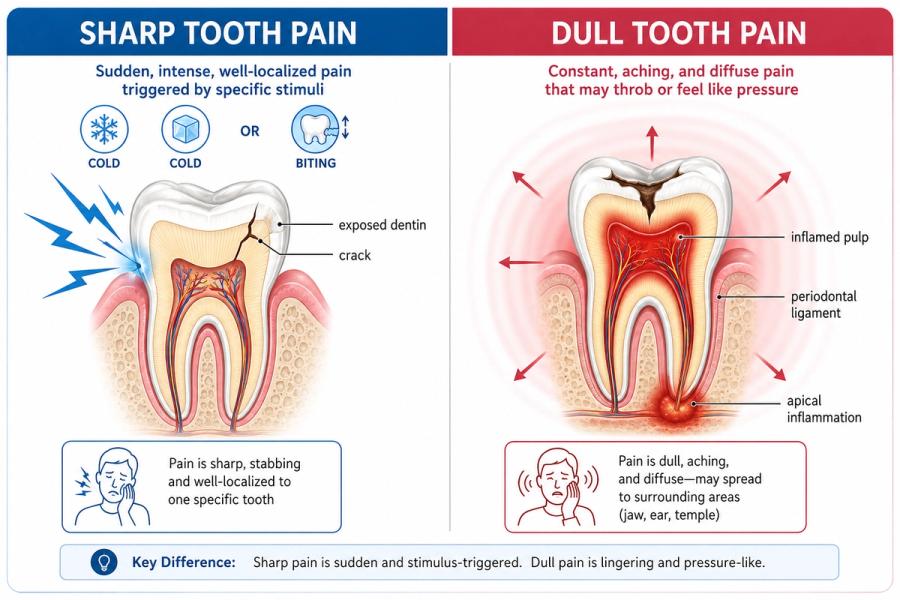
What Does Sharp Tooth Pain Mean?
Sharp tooth pain is usually:
- sudden,
- quick,
- intense,
- or triggered by specific stimuli.
People commonly describe it as:
- “A sharp zing in my tooth.”
- “Pain when drinking something cold.”
- “Sharp pain while biting or chewing.”
- “Pain that disappears quickly.”
- “A sudden stabbing tooth pain.”
Sharp pain is commonly associated with:
- cold sensitivity,
- exposed dentin,
- small cracks,
- early nerve irritation,
- or pressure changes during biting or chewing.
In many cases, sharp pain occurs when the nerve inside the tooth reacts suddenly to stimulation.
What Does Dull Tooth Pain Mean?
Dull tooth pain is more commonly:
- aching,
- heavy,
- pressure-like,
- persistent,
- or difficult to localize.
People commonly describe it as:
- “A constant dull toothache.”
- “Pressure around the tooth.”
- “A heavy feeling in the tooth.”
- “Soreness while chewing or biting.”
- “A throbbing pain that builds gradually.”
Dull pain is more often associated with:
- deeper inflammation,
- irritation around the root,
- gum or ligament involvement,
- progressing infection,
- or prolonged inflammatory pressure.
Why the Pattern of Pain Matters
| Pain Pattern | What It May Suggest |
|---|---|
| Sharp pain to cold | Early nerve irritation |
| Sharp pain while biting or releasing | Possible crack |
| Brief pain that disappears quickly | Mild reversible irritation |
| Dull throbbing pain | Deeper inflammation |
| Pressure-like discomfort | Root or ligament irritation |
| Pain that becomes more constant | Disease progression |
| Diffuse aching pain | Spreading inflammation |
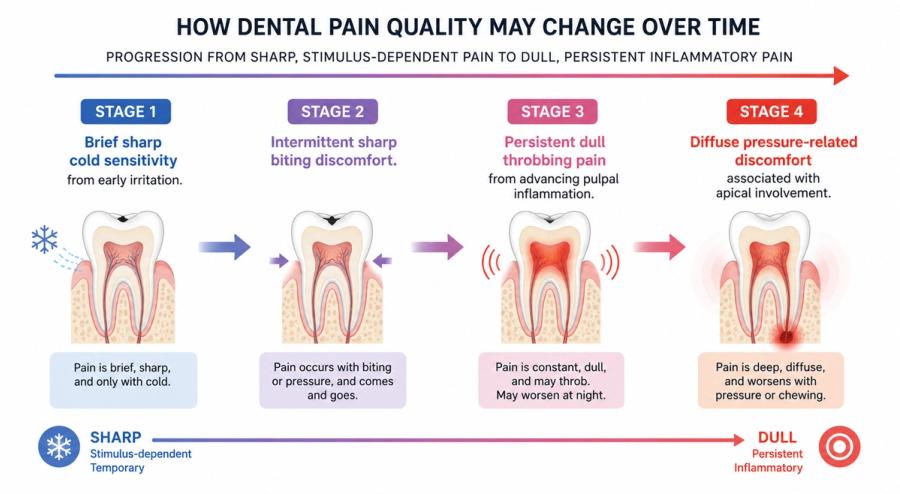
The same tooth may produce:
- sharp pain early,and later:
- dull throbbing discomfort as inflammation progresses.
Dentists therefore evaluate:
- pain quality,
- timing,
- triggers,
- progression,
- and tissue response together.
What This Means
Pain quality alone does not confirm the exact diagnosis.
For example:
- sharp pain does not always mean the problem is minor,
- and dull pain does not always mean severe infection.
Pain patterns can also change over time as inflammation progresses.
Changes in pain quality may indicate:
- worsening inflammation,
- structural crack progression,
- increasing pressure around the root,
- or changing nerve response.
Early evaluation helps identify whether the pain is:
- structural,
- inflammatory,
- pressure-related,
- or a combination of these factors.
When to See a Dentist
You should consider evaluation if:
- sharp pain becomes frequent or reproducible,
- dull pain persists or worsens,
- pain begins occurring spontaneously,
- chewing or biting becomes uncomfortable,
- pain starts waking you at night,
- or swelling or prolonged sensitivity develops.
Dentists evaluate:
- thermal response,
- biting response,
- percussion findings,
- structural integrity,
- and progression pattern—not just pain intensity alone.
Related Questions
Clinical Perspective
For dental professionalsThis section discusses clinical reasoning and is not intended for self-diagnosis.
Pain Quality in Dental Disease – Pulpal and Periodontal Interpretation
Clinical Takeaway
Sharp versus dull dental pain reflects differing patterns of neural stimulation, inflammatory progression, and tissue involvement. Interpretation requires integration with:
- timing,
- triggers,
- localization,
- progression,
- and structural findingsrather than pain quality alone.
Interpretation Framework
Pain quality represents a perceptual expression of underlying biologic and structural processes.
Interpretation requires correlating:
- stimulus dependency,
- inflammatory status,
- structural integrity,
- localization characteristics,
- pulpal response,
- and periodontal involvement.
Sharp pain is more commonly associated with:
- rapid nociceptive activation,
- exposed dentin,
- crack-related stress concentration,
- and early pulpal irritation.
Dull pain more commonly reflects:
- sustained inflammatory activity,
- pressure-related tissue response,
- periodontal ligament sensitization,
- and progressing pulpal or apical involvement.
Current Understanding (Guidelines + Evidence)
Endodontic Perspective (AAE / ESE Aligned)
Sharp pain is commonly associated with:
- exposed dentin,
- reversible pulpal irritation,
- acute stimulus activation,
- and structural crack behavior.
Dull or throbbing pain is more commonly associated with:
- irreversible pulpal inflammation,
- apical involvement,
- sustained inflammatory mediator activity,
- and periodontal ligament sensitization.
Important interpretation principles:
- pain quality is supportive rather than independently diagnostic,
- disease progression may alter pain character over time,
- and mixed pain presentations are common.
Neurophysiologic Insight
Sharp pain often reflects:
- rapid A-delta fiber activation,
- hydrodynamic dentinal stimulation,
- and acute nociceptive signaling.
Dull throbbing pain is more associated with:
- sustained C-fiber inflammatory activity,
- neurovascular sensitization,
- and ongoing inflammatory mediator release.
Differential Diagnosis
1. Reversible Pulpitis
Features:
- brief sharp stimulus-dependent pain,
- cold sensitivity,
- non-lingering response.
2. Symptomatic Irreversible Pulpitis
Features:
- dull throbbing discomfort,
- spontaneous pain,
- lingering thermal response,
- possible nocturnal exacerbation.
3. Cracked Tooth Syndrome
Features:
- sharp pain during biting/release,
- intermittent symptoms,
- localized load-related discomfort.
4. Symptomatic Apical Periodontitis
Features:
- dull pressure-like discomfort,
- percussion sensitivity,
- biting pain,
- localized inflammatory loading.
Key Diagnostic Distinctions
| Feature | Sharp pain | Dull pain |
|---|---|---|
| Onset | Sudden | Gradual |
| Duration | Brief/intermittent | Persistent |
| Trigger dependency | Strong | Variable |
| Localization | More localized | More diffuse |
| Common association | Early irritation/crack | Inflammatory progression |
| Fiber predominance | A-delta | C-fiber |
Common Pitfalls
Common diagnostic errors include:
- assuming sharp pain always indicates reversible disease,
- underestimating dull intermittent pain,
- ignoring progression in pain character,
- over-reliance on subjective descriptors alone,
- and missing crack-related pain without radiographic findings.
Pain character should always be interpreted within broader clinical context.
Emerging Research Directions
Pain Characterization Modeling
Research increasingly focuses on:
- symptom-pattern analytics,
- temporal pain-quality mapping,
- neuroinflammatory correlation studies,
- and longitudinal pain-transition behavior.
AI-Assisted Interpretation
Emerging systems increasingly evaluate:
- integration of symptom descriptors with clinical findings,
- probabilistic classification of pain behavior,
- and multimodal diagnostic support.
Neurosensory Research
Current research explores:
- pulpal nociception profiling,
- inflammatory mediator mapping,
- fiber-specific pain behavior,
- and pain-transition dynamics.
AI Potential
Sharp versus dull dental pain represents a pattern-interpretation problem where clinical meaning depends on how pain quality interacts with triggers, timing, progression, and tissue involvement.
AI can assist across the clinical workflow:
Interpretation
- Integrating pain quality with thermal response, load behavior, and symptom progression
- Identifying clinically meaningful inflammatory versus structural patterns
Decision Timing
- Supporting monitor vs intervene decisions
- Flagging progression patterns associated with worsening pulpal disease
- Assisting in ambiguous symptom presentations
Patient Communication
- Explaining why pain character changes over time
- Clarifying differences between nerve irritation and inflammatory pressure
- Improving understanding of disease progression
Clinical Workflow Support
- Structuring symptom descriptors consistently
- Reducing variability in interpretation of subjective pain reports
- Supporting longitudinal symptom tracking
Emerging Direction
- AI-assisted pain-pattern classification
- Symptom-behavior predictive modeling
- Integration of patient-reported pain quality with imaging and vitality testing
Clinical Relevance
The challenge is not simply identifying dental pain — it is interpreting what the quality of pain suggests about tissue involvement, inflammatory progression, and structural compromise.
AI may eventually help:
- improve interpretation of subjective pain descriptors,
- support earlier recognition of progression patterns,
- reduce variability in symptom assessment,
- and enhance patient communication and decision clarity.
References
- American Association of Endodontists (AAE). Endodontic Diagnosis. Colleagues for Excellence Newsletter. Fall 2013.
- Duncan HF, Galler KM, Tomson PL, et al. European Society of Endodontology position statement: management of deep caries and the exposed pulp. International Endodontic Journal.
- American Association of Endodontists (AAE). Cracked Teeth: Clinical Diagnosis and Treatment Recommendations. AAE Clinical Resources.
- Bender IB. Pulpal pain diagnosis — a review. International Endodontic Journal.
- Hargreaves KM, Berman LH. Cohen’s Pathways of the Pulp. Elsevier.
- Renton T, Durham J, Aggarwal VR. The classification and differential diagnosis of orofacial pain. Expert Rev Neurother.
- Rechenberg DK, Held U, Burgstaller JM, et al. Pain levels and typical symptoms of acute endodontic infections: a prospective observational study. Journal of Oral Rehabilitation.
- Cascella M, Leoni MLG, Shariff MN, Varrassi G. Artificial Intelligence-Driven Diagnostic Processes and Comprehensive Multimodal Models in Pain Medicine. J Pers Med.