
Why does tooth pain worsen at night?
Tooth pain often feels worse at night not because the tooth suddenly changes — but because inflammation, pressure, and perception become more noticeable during rest



Short Answer
Tooth pain that worsens at night is commonly associated with inflammation inside the tooth or around the root. Reduced distractions, changes in body position, increased awareness during rest, and progressing inflammation can make pain feel stronger or more persistent at night. Night-time throbbing pain is often linked to deeper irritation of the tooth nerve, but the pattern alone does not confirm the exact diagnosis.
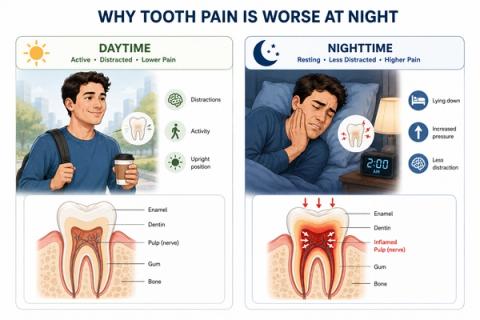
Why Does Tooth Pain Feel Worse at Night?
Tooth pain often becomes more noticeable at night because the body and environment become quieter.
People commonly describe it as:
- “My tooth throbs at night.”
- “The pain starts when I lie down.”
- “The tooth keeps me awake.”
- “The pain is worse in the evening.”
- “Cold sensitivity lingers longer at night.”
- “The tooth feels more intense during rest.”
This may happen because:
- inflammation inside the tooth increases pressure,
- lying down changes blood flow and pressure around the tooth,
- fewer daytime distractions make pain more noticeable,
- or the tooth nerve becomes more sensitive over time.
What Happens During Night-Time Tooth Pain?
The nerve inside the tooth reacts to inflammation, irritation, and pressure changes.
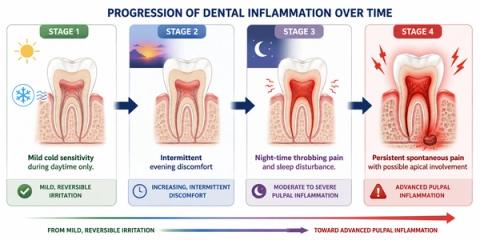
As inflammation progresses:
- pain may become more spontaneous,
- throbbing may increase,
- sensitivity may last longer,
- and symptoms may occur even without eating or drinking.
Night-time pain is commonly associated with:
- deeper tooth decay,
- progressing nerve inflammation,
- infection-related pressure changes,
- or irritation around the root.
However, symptom intensity alone does not confirm the exact cause.
Why the Pattern of Pain Matters
| Pain Pattern | What It May Suggest |
|---|---|
| Pain mainly at night | Progressing inflammation |
| Throbbing pain during rest | Increased pulpal irritation |
| Lingering pain after cold or hot drinks | Deeper nerve inflammation |
| Pain that wakes you from sleep | More advanced irritation |
| Pain while chewing or biting | Pressure-related inflammation or crack |
| Short cold sensitivity only | Mild reversible irritation |
Dentists evaluate:
- when the pain occurs,
- how long it lasts,
- whether it is spontaneous,
- and how symptoms are changing over time.
Night pain progression pattern
What This Means
Night-time tooth pain does not automatically mean root canal treatment is needed — but it often suggests that inflammation inside the tooth may be progressing.
Pain that:
- wakes you from sleep,
- becomes spontaneous,
- lingers longer,
- or worsens over timeusually deserves prompt evaluation.
Early assessment can help identify whether the tooth is:
- mildly irritated,
- reversibly inflamed,
- or progressing toward more advanced disease.
When to See a Dentist
You should consider evaluation if:
- pain wakes you from sleep,
- throbbing becomes persistent,
- pain occurs without eating or drinking,
- sensitivity lingers longer than before,
- swelling develops,
- or chewing or biting becomes uncomfortable.
- spontaneous pain,
- thermal response,
- progression over time,
- and biting or percussion sensitivity—not just pain intensity alone.
Related Questions
Clinical Perspective
For dental professionalsThis section discusses clinical reasoning and is not intended for self-diagnosis.
Nocturnal Dental Pain – Pulpal Inflammation Dynamics
Clinical Takeaway
Night-time worsening of dental pain commonly reflects progressing pulpal inflammation and spontaneous inflammatory activity, but temporal symptom amplification alone is insufficient for definitive pulpal diagnosis.
Interpretation Framework
Nocturnal pain represents a temporal amplification phenomenon rather than an isolated diagnostic entity.
Interpretation requires integration of:
- spontaneous pain behavior,
- pulpal inflammatory status,
- thermal response characteristics,
- positional influence,
- and progression pattern over time.
Pain that disrupts sleep increases suspicion for symptomatic irreversible pulpitis, particularly when associated with lingering thermal response or spontaneous episodes.
Current interpretation increasingly emphasizes:
- temporal progression,
- spontaneous symptom behavior,
- and contextual vitality assessmentrather than isolated symptom severity.
Current Understanding (Guidelines + Evidence)
Endodontic Perspective (AAE / ESE Aligned)
Night pain is frequently associated with:
- symptomatic irreversible pulpitis,
- spontaneous pulpal inflammation,
- and progressing intrapulpal pressure dynamics.
However:
- not all irreversible pulpitis presents with nocturnal pain,
- and not all night pain indicates irreversible disease.
Important interpretation principles include:
- spontaneous pain carries greater diagnostic significance,
- progression pattern outweighs isolated intensity,
- and symptom timing should be correlated with vitality testing and clinical examination.
Physiologic Contributors
Potential contributors to nocturnal pain amplification include:
- reduced external distraction,
- increased awareness during rest,
- positional vascular changes,
- neuroinflammatory sensitization,
- and cytokine-mediated inflammatory modulation.
Differential Diagnosis
1. Symptomatic Irreversible Pulpitis
Features:
- spontaneous throbbing pain,
- night awakening,
- lingering thermal response,
- increasing symptom frequency.
2. Acute Apical Inflammation
Features:
- dull continuous discomfort,
- pressure sensitivity,
- worsening during rest,
- possible percussion tenderness.
3. Cracked Tooth Syndrome
Features:
- intermittent night discomfort,
- thermal sensitivity,
- variable spontaneous symptoms,
- load-dependent symptom fluctuation.
4. Advanced Dentin Hypersensitivity
Features:
- stimulus-dependent pain,
- shorter duration,
- less spontaneous throbbing,
- minimal night awakening.
Key Diagnostic Distinctions
| Feature | Reversible irritation | Irreversible pulpitis |
|---|---|---|
| Night awakening | Less common | More characteristic |
| Spontaneous pain | Minimal | Common |
| Lingering thermal response | Limited | More typical |
| Progression pattern | Stable/intermittent | Increasing |
| Symptom intensity | Variable | Often escalating |
Common Pitfalls
Common diagnostic errors include:
- assuming all night pain requires endodontic treatment,
- over-reliance on pain intensity alone,
- ignoring crack-related symptom patterns,
- misinterpreting referred pain,
- and failure to correlate with thermal and percussion findings.
Temporal symptom amplification alone is not independently diagnostic.
Emerging Research Directions
Pain-Pattern Analytics
Current research increasingly uses AI to evaluate:
- temporal symptom modeling,
- spontaneous pain characterization,
- progression-based pulpal interpretation,
- and longitudinal symptom analytics.
Neuroinflammatory Research
Emerging work explores:
- cytokine-mediated pulpal sensitization,
- circadian influence on pain perception,
- neurovascular modulation,
- and inflammatory signaling dynamics.
Diagnostic Evolution
The field is progressively shifting toward AI based:
- pattern-based interpretation,
- temporal symptom integration,
- and biologic progression modelingrather than isolated symptom categorization.
AI Potential
Night-time dental pain represents a temporal interpretation problem, where clinical meaning depends on how symptoms evolve, intensify, and interact with inflammatory progression over time.
AI can assist across the clinical workflow:
Interpretation
- Integrating spontaneous pain timing, thermal response, and progression history
- Identifying clinically relevant patterns suggestive of evolving pulpal disease
Decision Timing
- Supporting urgency assessment
- Assisting monitor vs intervene decisions in borderline presentations
- Flagging progression-risk patterns
Patient Communication
- Explaining why symptoms worsen at night
- Clarifying why fluctuating pain still matters clinically
- Improving understanding of progression and treatment timing
Clinical Workflow Support
- Structuring longitudinal symptom history
- Supporting consistent temporal pain interpretation
- Reducing variability in symptom-based reasoning
Emerging Direction
- Temporal symptom-pattern modeling
- AI-assisted pulpal risk stratification
- Integration of symptom progression with vitality testing and imaging
Clinical Relevance
The challenge in nocturnal dental pain is not simply recognizing pain — it is interpreting whether the temporal pattern reflects transient irritation, progressing pulpal inflammation, or evolving apical disease.
AI may eventually help:
- improve interpretation of temporal pain behavior,
- support earlier recognition of progression,
- reduce variability in symptom interpretation,
- and enhance patient communication regarding disease progression.
References
- European Society of Endodontology (ESE). Quality Guidelines for Endodontic Treatment. International Endodontic Journal. 2023.
- American Association of Endodontists (AAE). Endodontic Diagnosis. AAE Clinical Resources.
- Hargreaves KM, Berman LH. Cohen’s Pathways of the Pulp. Elsevier.
- Ricucci D, Siqueira JF Jr, Rôças IN. Pulp Response to Periodontal Disease: Novel Observations Help Clarify the Processes of Tissue Breakdown and Infection. J Endod.
- Seltzer S, Bender IB, Ziontz M. The dynamics of pulp inflammation: correlations between diagnostic data and actual histologic findings. Oral Surgery, Oral Medicine, Oral Pathology.
- Caviedes-Bucheli J, Muñoz HR, Azuero-Holguín MM, et al. Neuropeptides in dental pulp: the role of substance P and calcitonin gene-related peptide in pulpal inflammation and pain. Journal of Endodontics.
- Nixdorf DR, Moana-Filho EJ, Law AS, et al. Frequency of nonodontogenic pain after endodontic therapy: a systematic review and meta-analysis. Journal of Endodontics.
- The Use of Artificial Intelligence in Endodontics - F.C. Setzer, J. Li, A.A. Khan, 2024