
Why does cold sensitivity linger?
Cold sensitivity that continues after the stimulus is removed often indicates that the nerve inside the tooth is struggling to recover from inflammation



Short Answer
Cold sensitivity that lingers usually means the nerve inside the tooth remains inflamed even after the cold stimulus is gone. Brief sensitivity can occur with mild irritation or exposed dentin, but prolonged lingering pain is more commonly associated with progressing pulpal inflammation. The duration of the response is often more clinically important than the presence of sensitivity alone.
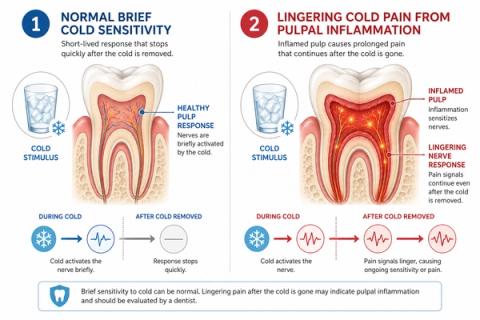
What Does Lingering Cold Sensitivity Mean?
Teeth normally react briefly to cold temperatures such as:
- cold water,
- ice cream,
- cold air,
- or chilled drinks.
The sensation should usually stop quickly after the cold stimulus is removed.
People commonly describe lingering sensitivity as:
- “My tooth keeps hurting after cold drinks.”
- “The pain lingers for several seconds.”
- “Cold sensitivity is getting worse over time.”
- “The tooth throbs after drinking something cold.”
- “The pain stays even after I stop eating or drinking.”
Lingering cold sensitivity often means:
- inflammation inside the tooth is becoming more significant,
- the tooth nerve remains activated longer than normal,
- or recovery after stimulation is delayed.
Why Does Cold Pain Continue After the Stimulus Is Gone?
The nerve inside the tooth reacts to temperature changes.
In mild irritation:
- the nerve usually recovers quickly after the cold is removed.
As inflammation progresses:
- the nerve may stay activated longer,
- inflammatory pressure increases,
- and the tooth becomes slower to recover after stimulation.
People may notice:
- pain lasting several seconds or minutes,
- throbbing after cold drinks,
- increasing sensitivity over time,
- or discomfort becoming more frequent.
In more advanced inflammation:
- spontaneous pain,
- night pain,
- or chewing and biting discomfortmay also begin developing.
Why the Pattern of Sensitivity Matters
| Pain Pattern | What It May Suggest |
|---|---|
| Brief cold sensitivity | Mild irritation or exposed dentin |
| Lingering cold pain | Progressing nerve inflammation |
| Increasing duration over time | Disease progression |
| Throbbing after cold drinks | Sustained pulpal inflammation |
| Cold sensitivity with biting pain | Possible crack involvement |
| Spontaneous pain with lingering cold | More advanced pulpal disease |
- how long the pain lasts,
- whether symptoms are progressing,
- accompanying triggers,
- and the overall symptom patternrather than relying on cold sensitivity alone.
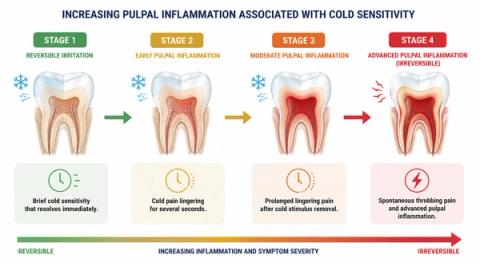
What This Means
Lingering cold sensitivity does not automatically mean root canal treatment is required — but it often indicates that inflammation inside the tooth is progressing rather than remaining stable.
The important distinction is not simply:
“Does cold hurt?”
but:
“How long does the tooth continue reacting after the cold is removed?”
As inflammation advances, symptoms may gradually shift from:
- short stimulus-dependent pain,to:
- lingering discomfort,
- spontaneous pain,
- or night-time throbbing.
Early evaluation can help determine whether the condition is:
- mild and reversible,
- progressing,
- or approaching irreversible pulpal disease.
When to See a Dentist
You should consider evaluation if:
- cold sensitivity lingers repeatedly,
- the duration is increasing over time,
- pain becomes spontaneous,
- night pain develops,
- chewing or biting becomes uncomfortable,
- or heat sensitivity also appears.
- duration of response,
- vitality testing,
- symptom history,
- structural condition,
- and radiographic findings—not just whether sensitivity exists.
Related Questions
Clinical Perspective
For dental professionalsThis section discusses clinical reasoning and is not intended for self-diagnosis.
Lingering Cold Response – Pulpal Inflammation Progression
Clinical Takeaway
Lingering cold sensitivity is a clinically significant indicator of sustained pulpal inflammatory activity and commonly increases suspicion for irreversible pulpal involvement when interpreted alongside progression pattern and symptom history.
Interpretation Framework
Cold sensitivity represents a dynamic neuroinflammatory response rather than a binary vital/non-vital phenomenon.
Interpretation requires integrating:
- duration of response,
- intensity,
- spontaneous pain behavior,
- progression pattern,
- restorative status,
- and structural integrity.
The critical distinction is not whether cold elicits pain, but whether pulpal recovery after stimulus removal becomes delayed or prolonged.
Current interpretation increasingly emphasizes:
- temporal response dynamics,
- progression behavior,
- and contextual vitality assessmentrather than isolated stimulus positivity.
Current Understanding (Guidelines + Evidence)
Endodontic Perspective (AAE / ESE Aligned)
Brief cold sensitivity may occur with:
- exposed dentin,
- reversible pulpitis,
- and mild transient inflammation.
Lingering cold pain is more commonly associated with:
- symptomatic irreversible pulpitis,
- sustained inflammatory mediator activity,
- increased intrapulpal pressure,
- and prolonged neural sensitization.
Important interpretation principles include:
- duration of response is clinically significant,
- progression pattern outweighs isolated episodes,
- lingering response should be correlated with spontaneous pain history,
- and restorative status or cracks may alter presentation.
Neurophysiologic Insight
Exaggerated or prolonged cold response reflects:
- sustained pulpal nociceptive activation,
- inflammatory sensitization,
- and reduced recovery threshold after thermal stimulation.
Inflammatory progression may therefore alter both:
- intensity,and
- recovery duration.
Differential Diagnosis
1. Reversible Pulpitis
Features:
- short non-lingering cold response,
- stimulus-dependent pain,
- absence of spontaneous symptoms.
2. Symptomatic Irreversible Pulpitis
Features:
- lingering cold pain,
- spontaneous discomfort,
- increasing symptom duration,
- possible nocturnal pain.
3. Cracked Tooth Syndrome
Features:
- cold sensitivity with variable lingering,
- load-related symptoms,
- intermittent presentation,
- structural stress sensitivity.
4. Exposed Dentin / Dentin Hypersensitivity
Features:
- sharp brief response,
- rapid recovery after stimulus removal,
- localized trigger dependence,
- minimal lingering behavior.
Key Diagnostic Distinctions
| Feature | Brief sensitivity | Lingering sensitivity |
|---|---|---|
| Duration | Short | Prolonged |
| Recovery after stimulus | Rapid | Delayed |
| Common association | Mild irritation | Pulpal inflammation |
| Spontaneous pain | Less common | More common |
| Progression concern | Lower | Higher |
| Clinical significance | Often reversible | Greater suspicion for irreversible involvement |
Common Pitfalls
Common diagnostic errors include:
- overdiagnosing irreversible pulpitis from isolated cold sensitivity alone,
- ignoring progression in response duration,
- missing crack-related thermal symptoms,
- failure to correlate with spontaneous pain history,
- and over-reliance on single-timepoint testing.
Thermal response should always be interpreted within broader symptom progression context.
Emerging Research Directions
Thermal Response Analytics
Research increasingly focuses on:
- quantitative cold-response profiling,
- temporal pain-response analysis,
- objective pulpal recovery assessment,
- and longitudinal thermal-behavior modeling.
AI-Assisted Interpretation
Emerging systems increasingly evaluate:
- integration of thermal behavior with symptom history,
- predictive modeling of pulpal progression,
- and multimodal diagnostic classification.
Vitality Assessment Evolution
Current research increasingly explores:
AI Potential
Lingering cold sensitivity represents a temporal interpretation problem where clinical meaning depends on recovery dynamics, progression behavior, and inflammatory context rather than stimulus response alone.
AI can assist across the clinical workflow:
Interpretation
- Integrating duration, progression, and spontaneous symptom patterns
- Identifying clinically meaningful pulpal inflammation profiles
Decision Timing
- Supporting monitor vs intervene decisions
- Flagging patterns suggestive of progressing irreversible disease
- Assisting in borderline vitality presentations
Patient Communication
- Explaining why lingering response differs from normal sensitivity
- Clarifying why progression matters clinically
- Improving understanding of treatment timing
Clinical Workflow Support
- Structuring thermal response documentation consistently
- Supporting longitudinal symptom tracking
- Reducing variability in thermal test interpretation
Emerging Direction
- AI-assisted thermal response modeling
- Quantitative pulpal recovery analysis
- Integration of symptom timelines with vitality testing and imaging
Clinical Relevance
The challenge is not simply identifying cold sensitivity — it is determining whether the response reflects transient irritation, progressing pulpal inflammation, or evolving irreversible disease.
AI may eventually help:
- improve interpretation of thermal response behavior,
- support earlier recognition of progression,
- reduce variability in vitality interpretation,
- and enhance patient communication around pulpal disease progression.
References
- American Association of Endodontists (AAE). Endodontic Diagnosis. Colleagues for Excellence Newsletter. Fall 2013. .
- Duncan HF, Galler KM, Tomson PL, et al. European Society of Endodontology position statement: management of deep caries and the exposed pulp. International Endodontic Journal.
- Hargreaves KM, Berman LH. Cohen’s Pathways of the Pulp. Elsevier.
- Ricucci D, Siqueira JF Jr, Rôças IN. Pulp Response to Periodontal Disease: Novel Observations Help Clarify the Processes of Tissue Breakdown and Infection. J Endod.
- Mejàre IA, Axelsson S, Davidson T, et al. Diagnosis of the condition of the dental pulp: a systematic review. International Endodontic Journal.
- Yu C, Abbott PV. An overview of the dental pulp: its functions and responses to injury. Australian Dental Journal.
- Hashem D, Mannocci F, Patel S, et al. Clinical and radiographic assessment of the efficacy of different diagnostic tests used for pulpal diagnosis. Journal of Endodontics.
- Chen Z, Huang H, Pan X, et al. Artificial intelligence in pulpal and periapical diagnosis: current status and future directions. International Endodontic Journal.