
Why does hot sensitivity indicate severe damage?
Heat sensitivity is often a later and more significant warning sign because it commonly appears when inflammation inside the tooth has progressed beyond early irritation



Short Answer
Hot sensitivity is more concerning because it is commonly associated with advanced inflammation or degeneration of the tooth nerve. While mild cold sensitivity is relatively common, pain triggered by heat often suggests deeper pulpal involvement or reduced ability of the nerve to recover normally. Lingering pain after hot foods or drinks may indicate that inflammation inside the tooth has progressed beyond early reversible irritation.
What Does Heat Sensitivity Mean?
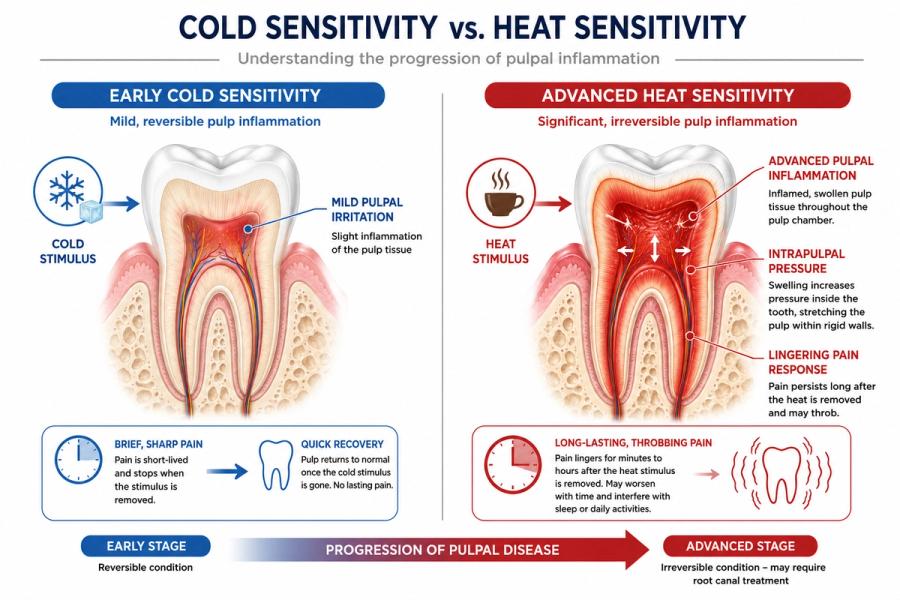
Teeth commonly react more to cold than heat during early irritation.
Heat sensitivity becomes more concerning because it often appears later as inflammation progresses inside the tooth.
People commonly describe it as:
- “Hot coffee causes tooth pain.”
- “The pain throbs after warm foods.”
- “Heat makes the tooth ache longer.”
- “Cold water briefly relieves the pain.”
- “The pain feels worse at night.”
- “Hot drinks trigger lingering pain.”
This pattern may happen because:
- inflamed tissue inside the tooth becomes increasingly pressure-sensitive,
- heat may intensify inflammatory expansion inside the pulp,
- or the nerve becomes less able to recover normally.
In some cases:
- cold may temporarily relieve pressure-related pain,while:
- heat worsens it.
This may suggest more advanced pulpal involvement.
Why Does Heat Trigger More Severe Pain?
The nerve inside the tooth reacts differently as inflammation progresses.
In early irritation:
- cold sensitivity is more common,
- and symptoms are often brief.
As inflammation advances:
- pressure inside the tooth increases,
- recovery after stimulation becomes slower,
- and heat may trigger stronger or longer-lasting pain.
People may notice:
- lingering throbbing after hot foods or drinks,
- spontaneous pain,
- worsening night pain,
- or chewing and biting discomfort.
In some advanced cases:
- cold temporarily reduces pressure-related pain,creating a pattern where:
- heat worsens symptoms,but:
- cold provides brief relief.
Why the Pattern of Sensitivity Matters
| Pain Pattern | What It May Suggest |
|---|---|
| Brief cold sensitivity | Early irritation |
| Lingering heat pain | Advanced pulpal inflammation |
| Heat sensitivity with throbbing | Sustained inflammatory pressure |
| Temporary relief with cold | Advanced inflammatory involvement |
| Night pain with heat sensitivity | Progressing pulpal disease |
| Heat plus chewing or biting pain | Combined inflammatory or structural involvement |
- heat response,
- lingering behavior,
- symptom progression,
- cold-relief patterns,
and overall vitality behaviorrather than relying on heat sensitivity alone.
What This Means
Heat sensitivity does not automatically mean root canal treatment is required — but it often suggests that inflammation inside the tooth has progressed beyond mild irritation.
The important question is not simply:
“Does heat hurt?”
but:
“How does the tooth behave after heat exposure?”
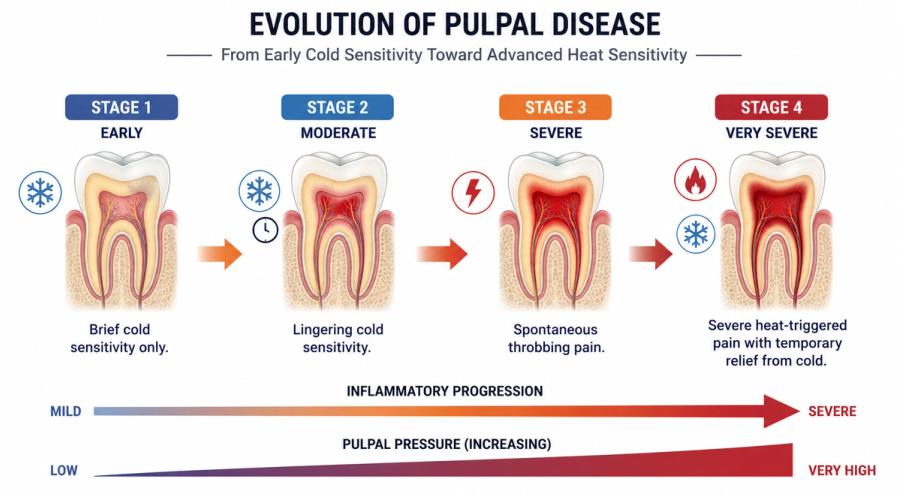
As pulpal disease progresses, symptoms may shift from:
- brief cold sensitivity,to:
- lingering heat pain,
- spontaneous throbbing,
- night pain,
- or temporary cold relief.
These progression patterns are often more clinically important than isolated symptoms alone.
Early evaluation can help determine whether the tooth is:
- mildly inflamed,
- progressing toward irreversible inflammation,
- or developing vitality compromise.
When to See a Dentist
You should consider evaluation if:
- heat consistently triggers pain,
- pain lingers after hot foods or drinks,
- cold temporarily relieves discomfort,
- spontaneous throbbing develops,
- night pain occurs,
- or chewing or biting becomes uncomfortable.
Dentists evaluate:
- thermal response behavior,
- vitality status,
- symptom progression,
- percussion findings,
- and radiographic changes—not just heat sensitivity alone.
Related Questions
Clinical Perspective
For dental professionalsThis section discusses clinical reasoning and is not intended for self-diagnosis.
Heat Sensitivity in Advanced Pulpal Disease
Clinical Takeaway
Heat sensitivity is commonly associated with advanced pulpal inflammatory change, particularly when accompanied by lingering pain, spontaneous symptoms, or temporary relief with cold stimulation.
Interpretation Framework
Heat sensitivity represents a late-stage thermal response pattern often reflecting altered pulpal physiology and impaired inflammatory regulation.
Interpretation requires integration of:
- thermal response dynamics,
- spontaneous pain behavior,
- lingering characteristics,
- vitality status,
- symptom progression,
- and structural integrity.
The clinical significance lies less in heat response alone and more in its relationship to:
- advanced inflammatory progression,
- altered pulpal recovery behavior,
- and evolving vitality compromise.
Current interpretation increasingly emphasizes:
- progression behavior,
- thermal-pattern evolution,
- and contextual vitality interpretationrather than isolated heat positivity.
Current Understanding (Guidelines + Evidence)
Endodontic Perspective (AAE / ESE Aligned)
Cold sensitivity is more common in:
- reversible pulpitis,
- early inflammatory states,
- and exposed dentin conditions.
Heat sensitivity is more commonly associated with:
- symptomatic irreversible pulpitis,
- degenerative pulpal changes,
- increased intrapulpal pressure,
- and advanced inflammatory sensitization.
Important interpretation principles include:
- heat sensitivity often reflects more advanced disease,
- temporary relief with cold is clinically significant,
- symptom progression outweighs isolated episodes,
- and heat response should be interpreted alongside vitality testing and structural assessment.
Pathophysiologic Insight
Thermal expansion and vascular pressure changes may intensify nociceptive activation within inflamed pulpal tissue.
Advanced inflammatory states may also demonstrate:
- altered tissue compliance,
- impaired vascular regulation,
- and prolonged painful response after thermal stimulation.
Differential Diagnosis
1. Symptomatic Irreversible Pulpitis
Features:
- lingering heat pain,
- spontaneous throbbing,
- nocturnal symptoms,
- temporary cold relief possible.
2. Partial Pulpal Necrosis
Features:
- altered thermal behavior,
- inconsistent vitality response,
- progressing inflammatory or apical involvement.
3. Cracked Tooth Syndrome
Features:
- thermal sensitivity,
- variable heat response,
- load-related symptoms,
- structural stress sensitivity.
4. Deep Carious Pulpal Irritation
Features:
- heat-triggered discomfort,
- progressing inflammatory symptoms,
- structural compromise,
- lingering thermal behavior.
Key Diagnostic Distinctions
| Feature | Early pulpal irritation | Advanced pulpal involvement |
|---|---|---|
| Cold sensitivity | More common | Variable |
| Heat sensitivity | Less characteristic | More characteristic |
| Lingering response | Mild/brief | Prolonged |
| Spontaneous pain | Less common | Common |
| Cold relief | Rare | More clinically significant |
| Vitality behavior | Stable | Altered/progressing |
Common Pitfalls
Common diagnostic errors include:
- assuming absence of heat sensitivity excludes advanced disease,
- over-reliance on thermal response alone,
- missing partial necrosis presentations,
- ignoring cold-relief patterns,
- and failure to correlate with progression and vitality findings.
Thermal behavior should always be interpreted within broader inflammatory and structural context.
Emerging Research Directions
Thermal Behavior Modeling
Research increasingly focuses on:
- pulpal thermal-response analytics,
- dynamic inflammatory-response characterization,
- progression-based symptom mapping,
- and objective thermal recovery analysis.
AI-Assisted Thermal Interpretation
Emerging systems increasingly evaluate:
- integration of heat/cold response patterns with imaging and symptom history,
- predictive pulpal status modeling,
- and multimodal diagnostic support.
Pulp Vitality Research
Current research increasingly explores:
- physiologic vitality assessment,
- inflammatory biomarker correlation,
- objective thermal recovery measurement,
- and vascular vitality monitoring.
AI Potential
Heat sensitivity represents a progression-interpretation problem where clinical meaning depends on how thermal behavior interacts with inflammatory status, vitality changes, and symptom evolution over time.
AI can assist across the clinical workflow:
Interpretation
- Integrating heat response, lingering behavior, spontaneous pain, and cold-relief patterns
- Identifying clinically meaningful advanced inflammatory profiles
Decision Timing
- Supporting urgency assessment
- Flagging progression toward irreversible or necrotic states
- Assisting treatment-planning decisions in borderline vitality presentations
Patient Communication
- Explaining why heat sensitivity is often more clinically significant
- Clarifying progression from early irritation toward advanced inflammation
- Improving understanding of why symptoms may worsen over time
Clinical Workflow Support
- Structuring thermal-response findings consistently
- Supporting longitudinal symptom interpretation
- Reducing variability in thermal testing assessment
Emerging Direction
- AI-assisted thermal-pattern analysis
- Predictive pulpal progression modeling
- Integration of vitality testing, symptom behavior, and imaging interpretation
Clinical Relevance
The challenge is not simply detecting heat sensitivity — it is determining whether the response reflects advanced inflammatory change, altered vitality status, or progression toward irreversible pulpal damage.
AI may eventually help:
- improve interpretation of advanced thermal-response patterns,
- support earlier recognition of disease progression,
- reduce variability in pulpal assessment,
- and enhance patient communication regarding treatment urgency.
References
- Seltzer S, Bender IB, Ziontz M. The dynamics of pulp inflammation: correlations between diagnostic data and actual histologic findings. Oral Surgery, Oral Medicine, Oral Pathology
- American Association of Endodontists (AAE). Endodontic Diagnosis. AAE Clinical Resources.
- Yu C, Abbott PV. An overview of the dental pulp: its functions and responses to injury. Australian Dental Journal.
- Bergenholtz G. Inflammatory response of the dental pulp to bacterial irritation. Journal of Endodontics.
- Hargreaves KM, Goodis HE, Tay FR. Seltzer and Bender’s Dental Pulp. Quintessence Publishing.
- Wolters WJ, Duncan HF, Tomson PL, et al. Minimally invasive endodontics: a new diagnostic system for assessing pulpitis and subsequent treatment needs. International Endodontic Journal.
- Lin J, Chandler NP. Electric pulp testing: a review. International Endodontic Journal.
- Aminoshariae A, Kulild J, Nagendrababu V. Artificial Intelligence in Endodontics: Current Applications and Future Directions. J Endod.