
Why does tooth pain come and go?
Pain that comes and go is often not random — it reflects how the tooth is responding to irritation over time



Short Answer
Tooth pain that comes and goes usually means the tooth is irritated or inflamed but not constantly active. Common causes include early tooth decay, nerve irritation inside the tooth, cracks, bite-related stress, or early infection. Pain may temporarily settle between episodes, but the underlying problem can still continue progressing over time.
What Does Tooth Pain That Comes and Goes Mean?
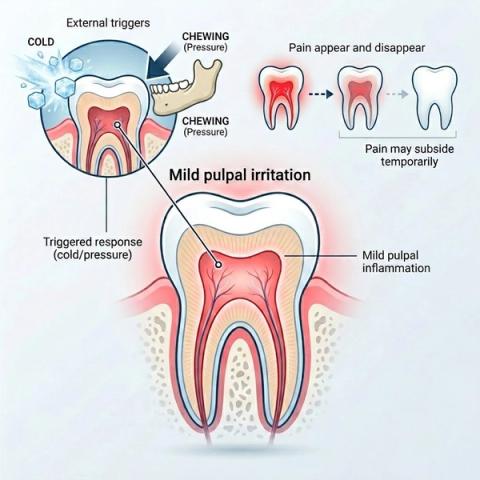
Tooth pain is not always constant. In many cases, the irritation inside the tooth changes over time, causing symptoms to appear and disappear.
People commonly describe it as:
- “My tooth hurts sometimes but not always.”
- “The pain disappeared and then came back.”
- “My tooth hurts only when eating or drinking something cold.”
- “The pain comes for a few seconds and then settles.”
- “The tooth hurts on some days but feels normal on others.”
This type of pain can happen because:
- the inside of the tooth is mildly inflamed,
- the tooth reacts to cold, chewing, or biting,
- pressure irritates the surrounding tissues,
- or the nerve temporarily calms between episodes.
Why Can Tooth Pain Come and Go?
The inside of the tooth contains nerves and blood vessels that respond to irritation.
Pain may become intermittent when:
- inflammation is still mild or fluctuating,
- certain triggers activate the nerve temporarily,
- or the tooth adapts between painful episodes.
Common triggers include:
- cold drinks,
- sweet foods,
- chewing or biting,
- pressure,
- or temperature changes.
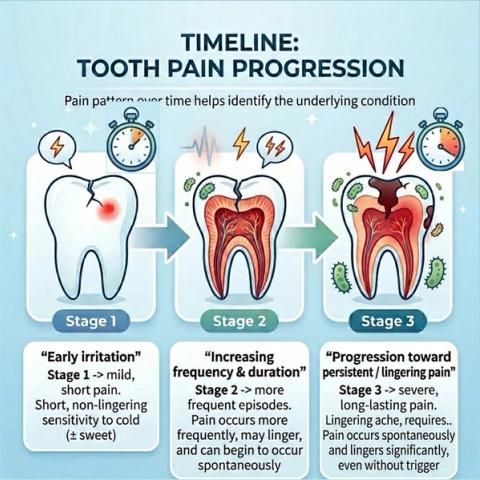
In early stages, the pain may stop quickly after the trigger disappears. As the condition progresses, pain may:
- happen more often,
- last longer,
- become spontaneous,
- or start occurring without triggers.
Why the Pattern of Pain Matters
| Pain Pattern | What It May Suggest |
|---|---|
| Short pain to cold | Early irritation |
| Pain that disappears quickly | Mild inflammation |
| Lingering pain after cold | Progressing nerve inflammation |
| Pain becoming more frequent | Disease progression |
| Pain during chewing or biting | Crack or pressure-related irritation |
| Pain that starts spontaneously | More advanced inflammation |
Dentists often focus on:
- how long the pain lasts,
- what triggers it,
- how often it happens,
- and whether the pattern is changing over time.
What this means
A tooth that stops hurting is not always healing.
Sometimes pain temporarily decreases because:
- inflammation fluctuates,
- the nerve adapts,
- or the tooth enters a different stage of disease progression.
Even if symptoms improve temporarily, the underlying problem may still be present.
Early evaluation can help identify whether the tooth is:
- stable,
- improving,
- or slowly progressing toward more serious inflammation or infection.
When to See a Dentist
You should consider evaluation if:
- pain repeatedly occurs with cold, chewing, or biting,
- pain episodes are becoming more frequent,
- pain lasts longer after triggers,
- new heat sensitivity appears,
- symptoms wake you at night,
- or pain returns after disappearing.
Dentists evaluate:
- pain pattern,
- duration,
- triggers,
- and progression over time —not just whether pain is present during the appointment.
Related Questions
Clinical Perspective
For dental professionalsThis section discusses clinical reasoning and is not intended for self-diagnosis.
Intermittent Dental Pain – Pulpal Progression
Clinical Takeaway
Intermittent pain reflects dynamic pulpal response and requires integration of:
- symptom history,
- stimulus response,
- temporal progression,
- and evolving inflammatory behavior rather than isolated time-point assessment.
Interpretation Framework
Intermittent dental pain reflects a dynamic pulpal state rather than a stable pathological endpoint.
It commonly represents a transition phase between:
- reversible pulpal inflammation,
- progressing irreversible pathology,
- and evolving periapical involvement.
Pain variability may be influenced by:
- inflammatory mediator fluctuation,
- stimulus dependency,
- vascular changes,
- and neural adaptation.
Current interpretation increasingly emphasizes longitudinal symptom behavior rather than isolated symptom presence.
Current Understanding (Guidelines + Evidence)
From European Society of Endodontology (2023)
The ESE emphasizes that pulpal diagnosis should integrate:
- response to stimuli,
- symptom duration,
- progression pattern,
- and clinical context.
Intermittent pain should therefore be interpreted within temporal progression rather than as an isolated event.
Pulpitis classification insight
Reversible pulpitis commonly demonstrates:
- short,
- stimulus-dependent,
- non-lingering pain.
Early irreversible pulpitis may present with:
- increasing frequency,
- lingering thermal response,
- emerging spontaneous pain,
- while still appearing clinically intermittent.
Transition between these states is biologically gradual rather than sharply discrete.
Differential Diagnosis
Primary considerations:
1. Reversible pulpitis
Features:
- stimulus-triggered pain,
- short duration,
- non-lingering response,
- absence of spontaneous pain.
2. Early irreversible pulpitis
Features:
- increasing symptom frequency,
- lingering response,
- prolonged discomfort,
- emerging spontaneity.
Symptoms may still fluctuate intermittently during early progression.
3. Occlusal stress sensitivity
Features:
- mechanical trigger dependency,
- chewing or biting discomfort,
- minimal thermal correlation,
- variable localization.
Often clinically underestimated.
Key Diagnostic Distinctions
| Feature | Reversible | Early Irreversible |
|---|---|---|
| Pain duration | Short | Prolonged |
| Trigger dependency | Strong | Reducing |
| Lingering response | Minimal | Increasing |
| Pattern | Stable | Progressive |
| Spontaneous pain | Absent | Emerging |
Common Pitfalls
Common diagnostic errors include:
- assuming pain resolution equals healing,
- underestimating early irreversible pulpitis,
- over-reliance on isolated thermal testing,
- and failure to evaluate symptom progression longitudinally.
Symptom-free intervals do not necessarily indicate biologic recovery.
Emerging Research Directions
Neuroinflammatory modulation
The field is progressively moving toward:
- pattern-based diagnosis,
- longitudinal interpretation,
- and trajectory-focused assessment rather than isolated symptom snapshots.
Diagnostic shift
- Movement toward pattern-based diagnosis rather than symptom snapshot
AI Potential
Intermittent pain represents a temporal interpretation problem, where clinical meaning depends on how symptoms evolve over time rather than a single presentation.
AI can assist across the clinical workflow:
Interpretation
- Mapping symptom history longitudinally (frequency, duration, triggers, stimulus response)
- Identifying clinically relevant progression patterns (reversible → early irreversible → advanced states)
Decision Timing
- Supporting decisions in transition phases (monitor vs intervene)
- Flagging progression risk based on symptom trajectory and history
Patient Communication
- Explaining why intermittent pain may still indicate progression
- Addressing misconceptions (“pain comes and goes, so it’s not serious”)
Clinical Workflow Support
- Structuring symptom timelines across visits
- Highlighting changes that may otherwise be overlooked
- Supporting consistent interpretation over time
Emerging Direction
- Machine learning models trained on symptom timelines
- Integration of patient-reported data with clinical tests
- Predictive analytics for pulp vitality outcomes
Clinical Relevance
The challenge in intermittent pain is not identifying symptoms — it is interpreting progression, determining when reversibility is being lost, and communicating that clearly.
AI may eventually help:
- support interpretation of symptom trajectories,
- improve timing of intervention,
- reduce delayed treatment in evolving cases,
- and enhance patient understanding.
References
- European Society of Endodontology (ESE). Quality Guidelines for Endodontic Treatment. International Endodontic Journal. 2023.
- American Association of Endodontists (AAE). Endodontic Diagnosis. AAE Clinical Resources.
- Ricucci D, Siqueira JF Jr, Rôças IN. Pulp Response to Periodontal Disease: Novel Observations Help Clarify the Processes of Tissue Breakdown and Infection. J Endod.
- Bender IB. Pulpal pain diagnosis — a review. Journal of Endodontics.
- Seltzer S, Bender IB, Ziontz M. The dynamics of pulp inflammation: correlations between diagnostic data and actual histologic findings. Oral Surgery, Oral Medicine, Oral Pathology.
- Hargreaves KM, Berman LH. Cohen’s Pathways of the Pulp. Elsevier.
- Caviedes-Bucheli J, Muñoz HR, Azuero-Holguín MM, Ulate E. Neuropeptides in dental pulp: the silent protagonists. J Endod.
- Setzer FC, Li J, Khan AA. The Use of Artificial Intelligence in Endodontics. J Dent Res.