
Why Does My Tooth Hurt When I Lie Down?
Tooth pain that worsens while lying down is often related to inflammatory pressure changes inside or around the tooth.



Short Answer
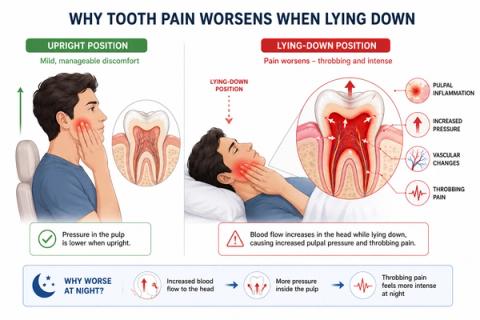
Tooth pain may worsen while lying down because changes in blood flow and tissue pressure can increase inflammation inside the tooth or surrounding tissues. This pattern is commonly associated with deeper pulpal inflammation, advanced sensitivity, or irritation around the root. Pain that becomes more noticeable at night or while resting may indicate progressing inflammatory activity inside the tooth.
Why Does Tooth Pain Feel Worse When Lying Down?
Some tooth pain changes depending on body position.
When lying down:
- blood flow and tissue pressure patterns may shift slightly,which can:
- intensify inflammation-related pressure inside the tooth or surrounding tissues.
People commonly describe it as:
- “My tooth throbs when I lie down.”
- “The pain feels worse in bed.”
- “The tooth hurts more at night.”
- “Sitting upright feels better.”
- “The pain starts while resting.”
- “The tooth throbs without eating or drinking.”
This pattern is commonly associated with:
- deeper pulpal inflammation,
- advanced pulpitis,
- irritation around the root,
- or pressure-sensitive tissues surrounding the tooth.
What Happens When You Lie Down?
The nerve and surrounding tissues inside the tooth exist in a confined space.
As inflammation progresses:
- pressure regulation becomes more difficult,
- inflammatory tissue becomes more sensitive,
- and changes in vascular behavior may intensify pain perception.
People may notice:
- throbbing pain at night,
- lingering sensitivity,
- spontaneous discomfort,
- or worsening pain during rest.
In some cases:
- heat sensitivity,
- chewing or biting discomfort,
- or pressure sensitivitymay also occur together.
However:
- not all positional tooth pain means severe infection,and:
- sinus pressure or surrounding facial inflammation can sometimes produce similar symptoms.
Why the Pattern of Pain Matters
| Pain Pattern | What It May Suggest |
|---|---|
| Throbbing pain while lying down | Advancing pulpal inflammation |
| Pain worse at night | Increased inflammatory activity |
| Relief while sitting upright | Pressure-related inflammatory behavior |
| Lingering hot or cold sensitivity | Pulpal inflammation |
| Pain while chewing or biting | Root-area or structural irritation |
| Facial pressure with upper tooth pain | Possible sinus involvement |
- positional behavior,
- thermal response,
- spontaneous pain,
- vitality findings,
and structural conditionrather than relying on one symptom alone.
What This Means
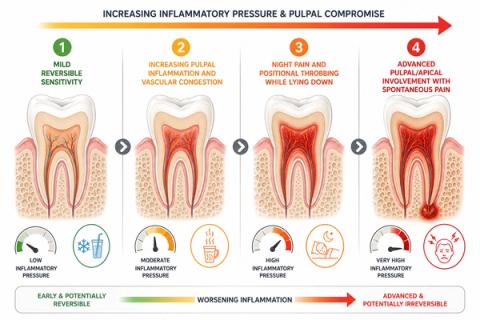
Positional tooth pain does not automatically mean severe infection — but it often suggests that inflammatory pressure inside or around the tooth is becoming more significant.
The important question is not simply:
“Does the tooth hurt?”
but:
“How does the pain change during rest, pressure changes, and over time?”
As inflammation progresses, symptoms may shift from:
- mild intermittent sensitivity,to:
- throbbing night pain,
- spontaneous pain,
- lingering sensitivity,
- or pressure-related discomfort.
Early evaluation can help determine whether the pain is related to:
- pulpal inflammation,
- apical irritation,
- sinus-related pressure,
- or non-dental causes.
When to See a Dentist
You should consider evaluation if:
- tooth pain worsens at night,
- lying down increases throbbing pain,
- sensitivity lingers after hot or cold exposure,
- spontaneous pain develops,
- swelling or chewing discomfort appears,
- or symptoms are worsening over time.
- vitality response,
- thermal behavior,
- apical involvement,
- structural integrity,
- and symptom progression—not just pain intensity alone.
Early evaluation may help prevent progression toward more advanced inflammatory disease.
Related Questions
Clinical Perspective
For dental professionalsThis section discusses clinical reasoning and is not intended for self-diagnosis.
Positional Tooth Pain – Pulpal Pressure and Inflammatory Vascular Changes
Clinical Takeaway
Tooth pain that worsens while lying down commonly reflects inflammatory vascular and pressure-related changes within pulpal or periapical tissues, particularly in advanced pulpal inflammatory states.
Interpretation Framework
Positional dental pain should be interpreted as a hemodynamic and inflammatory-response phenomenon rather than an isolated symptom category.
Clinical assessment requires integration of:
- positional symptom behavior,
- thermal response characteristics,
- spontaneous pain patterns,
- apical findings,
- vitality status,
- and sinus or referred-pain considerations.
The key challenge is distinguishing:
- pulpal inflammatory congestion,from:
- non-odontogenic positional facial pain sources.
Current interpretation increasingly emphasizes:
- inflammatory-pressure behavior,
- temporal symptom evolution,
- and contextual vitality assessmentrather than positional symptoms alone.
Current Understanding (Guidelines + Evidence)
Endodontic Perspective
Pain worsening while supine is commonly associated with:
- symptomatic irreversible pulpitis,
- advanced pulpal inflammation,
- and apical inflammatory sensitization.
Important interpretation principles include:
- increased vascular congestion may intensify intrapulpal pressure dynamics,
- nocturnal throbbing increases suspicion for irreversible inflammatory progression,
- positional worsening alone is not independently diagnostic,
- and symptom integration remains essential.
Biologic Insight
The pulp exists within a confined low-compliance chamber.
Inflammatory vascular changes may:
- increase tissue pressure,
- alter perfusion behavior,
- and intensify nociceptive signaling.
Supine positioning may alter local hemodynamic behavior sufficiently to intensify symptoms in sensitized tissues.
Differential Diagnosis
1. Symptomatic Irreversible Pulpitis
Features:
- throbbing night pain,
- spontaneous symptoms,
- positional worsening common,
- lingering thermal response.
2. Symptomatic Apical Periodontitis
Features:
- pressure sensitivity,
- positional discomfort possible,
- percussion tenderness,
- apical inflammatory loading.
3. Maxillary Sinus-Related Pain
Features:
- positional facial pressure,
- multiple posterior teeth involved,
- sinus symptom overlap,
- diffuse localization.
4. Non-Odontogenic Facial Pain
Features:
- atypical positional symptom behavior,
- inconsistent dental findings,
- variable localization,
- non-correlating vitality behavior.
Key Diagnostic Distinctions
| Feature | Pulpal Positional Pain | Non-Odontogenic Positional Pain |
|---|---|---|
| Thermal sensitivity | More common | Less characteristic |
| Night throbbing | More characteristic | Variable |
| Localized tooth findings | Often present | Less consistent |
| Sinus symptoms | Usually absent | Possible |
| Vitality changes | More relevant | Often normal |
| Pain progression | More inflammatory | More variable |
Common Pitfalls
Common diagnostic errors include:
- assuming all night pain is endodontic,
- missing sinus-related referral patterns,
- overlooking apical inflammatory contribution,
- over-reliance on positional symptoms alone,
- and failure to correlate vitality findings with pain behavior.
Positional worsening should always be interpreted within broader inflammatory and diagnostic context.
Emerging Research Directions
Pulpal Hemodynamics
Research increasingly focuses on:
- intrapulpal pressure modeling,
- vascular inflammatory dynamics,
- nociceptive threshold analytics,
- and inflammatory perfusion behavior.
AI-Assisted Interpretation
Emerging systems increasingly evaluate:
- symptom-pattern classification,
- positional-pain differential modeling,
- and multimodal inflammatory-risk analysis.
Advanced Vitality Diagnostics
Current research increasingly explores:
- physiologic pulpal perfusion assessment,
- inflammatory-state characterization,
- and dynamic vascular-response measurement.
AI Potential
Positional tooth pain represents a dynamic inflammatory interpretation problem where vascular behavior, pulpal confinement, and nociceptive sensitization interact over time.
AI can assist across the clinical workflow:
Interpretation
- Integrating positional symptoms, thermal response, vitality findings, and imaging
- Identifying clinically meaningful inflammatory-pressure patterns
Decision Timing
- Supporting urgency assessment
- Flagging progression-risk inflammatory states
- Assisting pulpal versus non-odontogenic differentiation
Patient Communication
- Explaining why tooth pain may worsen while lying down
- Clarifying the relationship between inflammation and pressure
- Improving understanding of symptom progression
Clinical Workflow Support
- Structuring positional symptom assessment consistently
- Supporting longitudinal pain-pattern tracking
- Reducing variability in inflammatory interpretation
Emerging Direction
- AI-assisted inflammatory-pressure modeling
- Predictive pulpal congestion analytics
- Integrated symptom-behavior interpretation systems
Clinical Relevance
The challenge is not simply identifying positional pain — it is determining whether changing inflammatory pressure dynamics indicate progressing pulpal compromise or alternative non-odontogenic causes.
AI may eventually help:
- improve interpretation of inflammatory pain behavior,
- support earlier recognition of advanced pulpal disease,
- reduce variability in positional pain assessment,
- and enhance patient communication regarding symptom mechanisms.
References
- Seltzer S, Bender IB. The dental pulp: biologic considerations in dental procedures. Lippincott Williams & Wilkins.
- Torabinejad M, Walton RE, Fouad AF. Endodontics: Principles and Practice. Elsevier.
- Nixdorf DR, Moana-Filho EJ, Law AS, et al. Frequency of nonodontogenic pain after endodontic therapy: a systematic review and meta-analysis. Journal of Endodontics.
- American Association of Endodontists (AAE). Endodontic Diagnosis. AAE Clinical Resources.
- Rechenberg DK, Held U, Burgstaller JM, et al. Pain levels and typical symptoms of acute endodontic infections: a prospective observational study. Journal of Oral Rehabilitation.
- Abbott PV. Classification, diagnosis and clinical manifestations of apical periodontitis. Endodontic Topics.
- Caviedes-Bucheli J, Moreno GC, López MP, et al. The effect of experimentally induced occlusal trauma on substance P expression in human dental pulp and periodontal ligament. Journal of Endodontics.
- Aminoshariae A, Kulild J, Nagendrababu V. Artificial Intelligence in Endodontics: Current Applications and Future Directions. J Endod.