
Why Does One Tooth Hurt Randomly?
Pain that seems random often still follows an underlying biologic or structural pattern that is not immediately obvious.



Short Answer
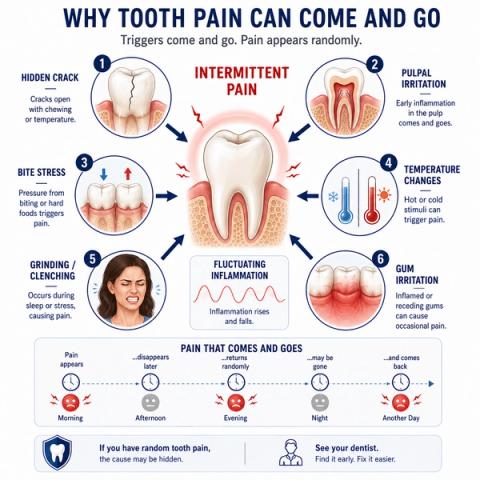
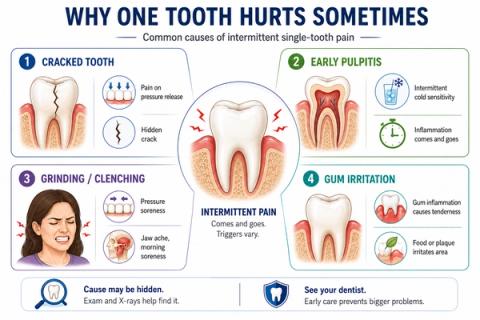
A single tooth may hurt intermittently due to fluctuating inflammation, cracks, bite stress, early pulpitis, grinding, gum irritation, or temperature-related triggers. The pain may feel random because the irritation is not active continuously or because triggers are subtle and inconsistent. Intermittent pain can still represent an evolving dental problem even when symptoms disappear between episodes.
Why Can One Tooth Hurt Randomly?
Some tooth pain happens:
- only occasionally,
- without obvious patterns,
- or during activities that are easy to overlook.
People commonly describe it as:
- “One tooth hurts sometimes but not always.”
- “The pain comes and goes randomly.”
- “Chewing or biting hurts occasionally.”
- “Cold sensitivity happens only sometimes.”
- “The tooth feels normal for days and then hurts again.”
- “The pain is hard to predict.”
This may happen because:
- inflammation fluctuates,
- cracks open under pressure,
- bite forces change,
- or surrounding tissues become temporarily irritated.
What Causes Intermittent Tooth Pain?
A tooth does not always hurt continuously even when a problem is developing.
Common causes include:
- early pulpitis,
- cracked tooth syndrome,
- grinding or clenching,
- bite imbalance,
- gum irritation,
- or food impaction between teeth.
Some triggers may only occur:
- during certain chewing or biting patterns,
- after temperature exposure,
- during stress-related clenching,
- or when inflammation temporarily becomes more active.
In some cases:
- the tooth may feel completely normal between episodes,which can make the problem seem unpredictable.
However:intermittent pain does not necessarily mean the condition is minor.
Why the Pattern of Pain Matters
| Pain Pattern | What It May Suggest |
|---|---|
| Intermittent biting pain | Possible crack or bite overload |
| Occasional cold sensitivity | Early pulpal irritation |
| Pain that disappears and returns | Fluctuating inflammation |
| Random sharp discomfort | Structural stress activation |
| Pressure sensitivity while chewing or biting | Ligament or crack-related irritation |
| Pain becoming more frequent | Disease progression |
- trigger patterns,
- thermal behavior,
- bite response,
- crack risk,
- vitality findings,
- and symptom progressionrather than relying on symptom frequency alone.
What This Means
Pain that feels random often still follows an underlying biologic or structural pattern.
The important question is not simply:
“How often does the tooth hurt?”
but:
“What causes the tooth to become painful during certain moments?”
Intermittent pain may occur because:
- structural stress changes dynamically,
- inflammation fluctuates,
- triggers are subtle,
- or the tooth is in an early evolving stage of disease.
Some early pulpal or structural conditions behave unpredictably before becoming:
- more frequent,
- more prolonged,
- or more constant over time.
Early evaluation may help identify problems before symptoms become more severe.
When to See a Dentist
You should consider evaluation if:
- one tooth repeatedly hurts,
- pain episodes become more frequent,
- chewing or biting triggers discomfort,
- sensitivity lingers,
- night pain develops,
- or swelling or visible structural changes appear.
- vitality response,
- crack patterns,
- bite forces,
- gum condition,
- radiographic findings,
- and symptom progression—not just whether the pain is constant.
Intermittent symptoms may still represent early progression of pulpal or structural disease.
Related Questions
Clinical Perspective
For dental professionalsThis section discusses clinical reasoning and is not intended for self-diagnosis.
Intermittent Localized Tooth Pain – Fluctuating Pulpal and Structural Triggers
Clinical Takeaway
Intermittent single-tooth pain commonly reflects fluctuating biomechanical, inflammatory, or nociceptive activation rather than continuous tissue instability, making early diagnosis particularly challenging.
Interpretation Framework
Random-appearing tooth pain should be interpreted as a dynamic trigger-dependent phenomenon requiring correlation between:
- pulpal behavior,
- structural loading,
- periodontal response,
- parafunctional stress,
- and inflammatory fluctuation.
Clinical assessment requires integration of:
- trigger specificity,
- symptom duration,
- thermal response,
- bite-loading behavior,
- crack-risk findings,
- vitality status,
- and temporal progression.
The key challenge is distinguishing:
- early evolving odontogenic pathology,from:
- transient overload or referred pain patterns.
Current interpretation increasingly emphasizes:
- temporal symptom behavior,
- load-response dynamics,
and fluctuating nociceptive thresholdsrather than static symptom presence.
Current Understanding (Guidelines + Evidence)
Endodontic / Restorative Perspective
Intermittent localized pain commonly occurs with:
- cracked tooth syndrome,
- early reversible or irreversible pulpitis,
- occlusal overload,
- parafunctional stress,
- and localized periodontal irritation.
Important interpretation principles include:
- symptom intermittency does not exclude significant pathology,
- crack-related symptoms often fluctuate with loading direction and cusp flexure,
- early pulpal inflammation may produce inconsistent thermal responses,
- and temporal symptom evolution is clinically meaningful.
Biomechanical Insight
Repetitive occlusal microstrain may transiently activate:
- periodontal ligament nociception,
- pulpal inflammatory response,
- and structural fatigue behavior.
Microcrack propagation may also:
- alter stress distribution unpredictably,
- change symptom reproducibility,
- and create variable load-response behavior over time.
Differential Diagnosis
1. Cracked Tooth Syndrome
Features:
- intermittent bite pain,
- release sensitivity,
- inconsistent thermal findings,
- variable localization.
2. Early Pulpal Inflammation
Features:
- fluctuating thermal sensitivity,
- intermittent spontaneous discomfort,
- evolving inflammatory behavior.
3. Occlusal Trauma
Features:
- pressure soreness,
- variable chewing discomfort,
- ligament sensitization,
- load-related symptom fluctuation.
4. Localized Periodontal Irritation
Features:
- food impaction,
- transient gingival inflammation,
- localized tenderness,
- variable discomfort.
Key Diagnostic Distinctions
| Feature | Structural/Occlusal Cause | Progressive Pulpal Cause |
|---|---|---|
| Bite-triggered pain | More characteristic | Variable |
| Thermal sensitivity | Inconsistent/limited | More common |
| Symptom unpredictability | Common | Possible early |
| Night pain | Less typical initially | More concerning |
| Crack findings | Often present | Variable |
| Spontaneous pain | Less common | More suggestive |
Common Pitfalls
Common diagnostic errors include:
- dismissing intermittent symptoms as insignificant,
- missing early crack-related pathology,
- overlooking occlusal overload,
- over-reliance on static radiographs,
- and failure to track symptom evolution longitudinally.
Fluctuating symptoms may still represent:
- progressing pulpal disease,
- structural fatigue,
- or evolving crack propagation.
Emerging Research Directions
Dynamic Pain Assessment
Research increasingly focuses on:
- temporal symptom analytics,
- occlusal-force mapping,
- microcrack propagation modeling,
- and fluctuating inflammatory-threshold behavior.
AI-Assisted Interpretation
Emerging systems increasingly evaluate:
- intermittent symptom-pattern classification,
- pulpal-risk forecasting,
- and biomechanical loading analytics.
Advanced Diagnostics
Current research increasingly explores:
- transillumination crack detection,
- occlusal stress analysis,
- physiologic vitality assessment,
- and multimodal symptom integration.
AI Potential
Random-seeming single-tooth pain represents a dynamic interpretation problem where structural loading, pulpal inflammation, and trigger-dependent nociception interact variably over time.
AI can assist across the clinical workflow:
Interpretation
- Integrating thermal behavior, bite response, symptom timing, and structural findings
- Identifying clinically meaningful fluctuating pain patterns
Decision Timing
- Supporting early intervention before progression stabilizes into persistent disease
- Flagging crack-risk and inflammatory-risk presentations
- Assisting monitor versus intervene decisions
Patient Communication
- Explaining why pain may seem random or inconsistent
- Clarifying how structural and inflammatory triggers fluctuate
- Improving understanding of early disease progression
Clinical Workflow Support
- Structuring intermittent symptom assessment consistently
- Supporting longitudinal pattern tracking
- Reducing variability in early-stage diagnostic interpretation
Emerging Direction
- AI-assisted fluctuating symptom analytics
- Predictive crack-progression modeling
- Integrated temporal pain-pattern interpretation systems
Clinical Relevance
The challenge is not simply identifying intermittent pain — it is determining whether fluctuating symptoms reflect early evolving pathology, biomechanical overload, or transient irritation before more definitive disease patterns emerge.
AI may eventually help:
- improve interpretation of inconsistent pain behavior,
- support earlier recognition of evolving pathology,
- reduce variability in intermittent symptom assessment,
- and enhance patient communication regarding fluctuating disease patterns.
References
- Rivera EM, Walton RE. Cracking the cracked tooth code: detection and treatment of various longitudinal tooth fractures. Endodontic Topics.
- American Association of Endodontists (AAE). Cracked Teeth: Clinical Diagnosis and Treatment Recommendations. AAE Clinical Resources.
- Banerji S, Mehta SB, Millar BJ. Cracked tooth syndrome. Part 1: aetiology and diagnosis. British Dental Journal.
- Abbott PV. Classification, diagnosis and clinical manifestations of apical periodontitis. Endodontic Topics.
- Rechenberg DK, Held U, Burgstaller JM, et al. Pain levels and typical symptoms of acute endodontic infections: a prospective observational study. Journal of Oral Rehabilitation.
- Krell KV, Rivera EM. A six-year evaluation of cracked teeth diagnosed with reversible pulpitis: treatment and prognosis. Journal of Endodontics.
- Manfredini D, Lombardo L, Siciliani G. Temporomandibular disorders and dental occlusion. A systematic review of association studies: endodontic and occlusal considerations. Minerva Stomatologica.
- Schwendicke F, Samek W, Krois J. Artificial intelligence in dentistry: chances and challenges. Journal of Dental Research.