
why does my tooth hurt when chewing or biting ?
Pain while chewing is often the first sign of deeper tooth damage but the pattern of pain tells the real story



Short Answer
Pain while chewing or biting usually means the tooth or surrounding tissues are irritated, inflamed, cracked, or under pressure. Common causes include tooth decay, inflammation inside the tooth, small cracks, infection near the root, or excessive biting forces. The pattern of pain — especially whether it happens during biting, after releasing pressure, or only sometimes — often helps dentists identify the cause.
What Does Tooth Pain While Chewing or Biting Mean?
Pain while chewing or biting can happen when pressure irritates a sensitive or damaged part of the tooth.
People commonly describe it as:
- “My tooth hurts when I bite down.”
- “Pain while eating.”
- “Sharp pain when I let go after biting.”
- “Pain when chewing on one side.”
- “My tooth hurts only with pressure.”
- “It feels sore when I bite food.”
This type of pain can happen because:
- the inside of the tooth is inflamed,
- the tooth has a small crack,
- the tissues around the root are irritated,
or the tooth is taking too much biting pressure.
What Happens When You Chew or Bite?
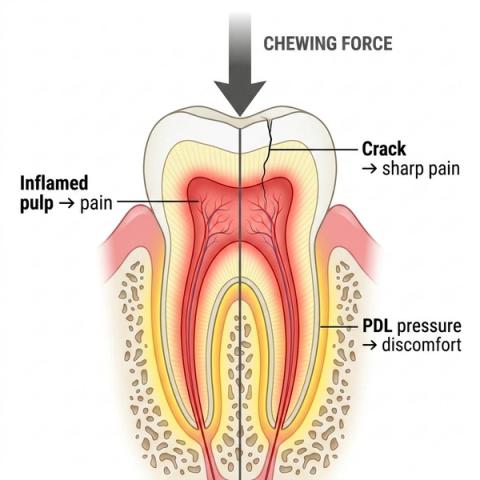
Every time you chew or bite, pressure travels through the tooth and into the surrounding tissues.
Pain may happen when:
- the inside of the tooth becomes inflamed,
- the tissues around the root become sensitive,
- or a crack changes how pressure moves through the tooth.
Sometimes the pain is:
- sharp,
- dull,
- intermittent,
- or only triggered by certain foods or pressure.
The timing and pattern of pain often help dentists understand what may be happening.
Why the Pattern of Pain Matters
| Pain Pattern | What It May Suggest |
|---|---|
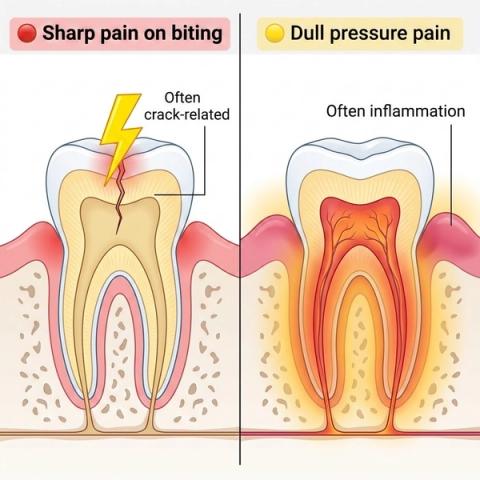
| Sharp pain while biting | Possible crack |
| Pain after releasing pressure | Possible cracked tooth |
| Dull pressure pain | Inflammation around the tooth |
| Pain that comes and goes | Early irritation or crack |
| Pain only when eating | Pressure-related tooth problem |
| General soreness while biting | Bite-force imbalance |
Pain after releasing pressure is especially important because it may happen when a cracked part of the tooth flexes and rebounds during biting.
What This Means
Pain while chewing or biting does not always mean you need a root canal treatment — but it usually means the tooth should be checked before the problem worsens.
Even mild or occasional pain can sometimes be an early sign of:
- inflammation,
- a developing crack,
- or irritation around the root.
Early evaluation often helps prevent more serious problems later.
When to See a Dentist
You should get the tooth checked if:
- pain happens repeatedly while chewing or biting,
- the pain feels localized to one tooth,
- the symptoms are worsening,
- pain happens after biting pressure is released,
- or chewing or biting becomes uncomfortable on one side.
Persistent pain during chewing or biting is usually not considered normal.
Related Questions
Clinical Perspective
For dental professionalsThis section discusses clinical reasoning and is not intended for self-diagnosis.
Pain on mastication (load-dependent dental pain)
Clinical Takeaway
Pain on mastication is fundamentally a load-response phenomenon requiring integration of:
pulpal status,
periodontal ligament mechanoreception,
structural integrity,
occlusal dynamics,
and symptom behavior under functional load.
Interpretation depends on correlating structural and inflammatory findings rather than relying on symptoms in isolation.
Interpretation Framework
Pain on mastication is not independently diagnostic.
It represents a functional load-response phenomenon involving:
- pulpal inflammation,
- periodontal ligament sensitization,
- structural compromise,
- and biomechanical stress redistribution.
Current understanding increasingly recognizes:Pain is a functional test of structural integrity combined with inflammatory status, and clinical interpretation depends on integrating these variables contextually rather than independently.
Current Understanding (Guidelines + Evidence)
From European Society of Endodontology (2023)
- Diagnosis must integrate:
- clinical tests
- patient-reported symptoms
- radiographic findings
Key implication:
Symptom-based diagnosis alone is insufficient
Apical Disease Progression
Bacterial invasion through caries or structural cracks may initiate: pulpal inflammation → pulpal necrosis → apical periodontitis.
Apical disease is biofilm-mediated and generally not self-resolving without intervention.
Differential Diagnosis
Core triad:
1. Cracked tooth syndrome
Features:
- pain on biting or release,
- intermittent symptoms,
- radiographic silence,
- variable thermal response.
Diagnosis often requires:
- magnification,
- transillumination,
- selective bite testing,
- and structural assessment.
2. Early apical periodontitis
Features:
- pain on pressure,
- localized tenderness,
- periodontal ligament inflammation,
- percussion sensitivity.
Radiographic findings may lag behind biologic disease progression.
3. Occlusal overload
Features:
- diffuse discomfort,
- force-related sensitivity,
- muscular adaptation,
- periodontal stress response.
Biomechanical force concentration contributes significantly to crack initiation and progression.
Key Diagnostic Distinctions
| Feature | Crack | Apical pathology |
|---|---|---|
| Pain on release | Strong indicator | Rare |
| Pain on pressure | Variable | Common |
| Radiographic signs | Often absent | May appear later |
| Localization | Sharp | Diffuse |
| Bite-test response | Highly useful | Less specific |
Common Pitfalls
Common errors include:
- over-reliance on radiographs,
- missing minimally restored cracked teeth,
- failure to assess release pain,
- and misclassifying structural pain as isolated pulpal disease.
Cracks remain difficult to diagnose because:
- symptoms fluctuate,
- imaging sensitivity is limited,
and structural separation may precede visible radiographic findings.
Emerging Research Directions
Crack detection research continues evolving toward image-assisted interpretation:
- CNN-based crack detection,
- optical imaging enhancement,
- quantitative light-induced fluorescence (QLF),
- and vibrothermographic analysis.
Current direction: transition from subjective interpretation toward probabilistic and image-assisted structural assessment.
Biomechanical research increasingly supports the role of occlusal force concentration in crack initiation and propagation.
Outcome studies suggest earlier intervention improves long-term structural prognosis.
AI Potential
Pain on chewing or biting represents a multi-factor interpretation problem, where meaning emerges from how symptoms behave under load rather than from a single isolated diagnostic signal.
AI systems may assist across the clinical workflow:
Interpretation
- Integrating multi-factor inputs (load response, thermal response, symptom history, imaging)
- Identifying clinically relevant patterns (structural vs inflammatory, early vs progressing disease)
Decision Timing
- Supporting decisions in borderline cases (intervene vs monitor)
- Flagging progression risk based on symptom behavior and history
Patient Communication
- Explaining load-related pain and biomechanical stress clearly
- Addressing misconceptions (“pain is mild, so the condition is minor”)
Clinical Workflow Support
- Structuring symptom history and examination findings
- Reducing variability in interpretation
- Supporting more consistent diagnostic reasoning
Emerging Direction
- Image-based crack detection
- Pattern-based symptom classification
- Probabilistic decision-support systems
- Integrated imaging + symptom-analysis workflows
Clinical Relevance
The challenge in chewing or biting pain is not simply detecting disease — it is interpreting biomechanical and inflammatory patterns, determining intervention timing, and communicating structural risk clearly.
AI may eventually help:
- support interpretation in ambiguous presentations,
- improve intervention timing,
- reduce diagnostic variability,
- and enhance patient understanding.
References
- European Society of Endodontology (ESE). Quality Guidelines for Endodontic Treatment. International Endodontic Journal. 2023.
- American Association of Endodontists (AAE). Cracked teeth and vertical root fractures
- Krell KV, Rivera EM. A six-year evaluation of cracked teeth diagnosed with reversible pulpitis: treatment and prognosis. Journal of Endodontics.
- Hilton TJ, Ferracane JL, Mancl L. Characteristics and treatment outcomes of cracked teeth. Journal of the American Dental Association (JADA).
- Abbott PV. Classification, diagnosis and clinical manifestations of cracks in teeth. Dental Clinics of North America.
- Ricucci D, Siqueira JF Jr. Apical periodontitis as a biofilm-based disease: pathogenesis and microbiologic considerations. Journal of Endodontics.https://pubmed.ncbi.nlm.nih.gov/20647081/
- Guo J, Wu Y, Chen L, Ge G, Tang Y, Wang W. Automatic Detection of Cracks in Cracked Tooth Based on Binary Classification Convolutional Neural Networks. Appl Bionics Biomech.
- Jun MK, Park SW, Lee ES, Kim BR, Kim BI. Diagnosis and management of cracked tooth by quantitative light-induced fluorescence technology. Photodiagnosis Photodyn Ther.
- Xie Z, Hu X, Guo L, Lin W, Liu J, Zhang C, Ge G, Tang Y, Wang W. A lightweight detection algorithm for tooth cracks in optical images. Comput Biol Med.
- Matsushita-Tokugawa M, Miura J, Iwami Y, Sakagami T, Izumi Y, Mori N, Hayashi M, Imazato S, Takeshige F, Ebisu S. Detection of dentinal microcracks using infrared thermography. J Endod.