
Can a Cracked Tooth Cause Pain Without Visible Damage?



Yes, a tooth can hurt from a crack even if it looks completely normal.
Small cracks may not be visible to the eye or on routine X-rays, but they can still affect how pressure moves through the tooth during chewing or biting.
Pain from a hidden crack is often sharp, intermittent, and difficult to reproduce consistently. Many people experience pain for weeks or months before any visible damage appears.
Yes. A cracked tooth can cause pain even when no visible damage appears on the tooth or on an X-ray.
Small cracks may change how force travels through the tooth, triggering pain during chewing or biting, when releasing pressure, or during temperature changes long before the crack becomes visible.
Cracks are often microscopic or hidden within the tooth structure. Pain may appear long before obvious damage can be seen.
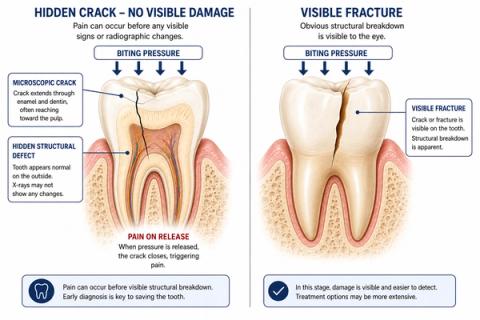
Can a Tooth Crack Without Looking Broken?
Yes.
A tooth does not need to visibly break to develop crack-related pain.
Small cracks may:
- Form inside the tooth structure.
- Remain invisible externally.
- Fail to appear on routine X-rays.
- Cause symptoms before visible damage develops.
People often describe it as:
- "Sharp pain when I bite down."
- "Pain when I let go after biting."
- "The tooth hurts but looks normal."
- "Cold sensitivity comes and goes."
- "The pain is difficult to reproduce."
- "One tooth feels strange while chewing."
This can be confusing because the symptoms are real even though the tooth appears normal.
Why Can Hidden Cracks Cause Pain?
A cracked tooth changes how stress travels through the tooth.
During chewing or biting:
- Pressure may cause tiny movements inside the crack.
- The tooth may flex slightly.
- The nerve inside the tooth may become irritated.
- Supporting tissues may react to the abnormal stress.
Pain may occur:
- During pressure
- When pressure is released
- With cold foods or drinks
- Intermittently throughout the day
As cracks progress deeper, inflammation, sensitivity, and discomfort may become more frequent.
Why the Pattern of Pain Matters
| Pain Pattern | What It May Suggest |
|---|---|
| Sharp pain while biting | Possible structural crack |
| Pain when releasing pressure | One of the most characteristic crack-related symptoms |
| Intermittent chewing pain | Early crack behaviour |
| Cold sensitivity with biting pain | Crack-related irritation inside the tooth |
| Tooth looks normal but hurts | Hidden structural problem |
| Symptoms difficult to reproduce | Early or hidden crack |
| Tooth pain comes and goes | Changing stress on the crack |
Dentists often focus on:
- When the pain occurs
- Whether it happens during pressure or release
- Whether symptoms come and go
- Whether temperature changes trigger symptoms
- How the pattern changes over time
A crack is often diagnosed from its behaviour before it is diagnosed from its appearance.
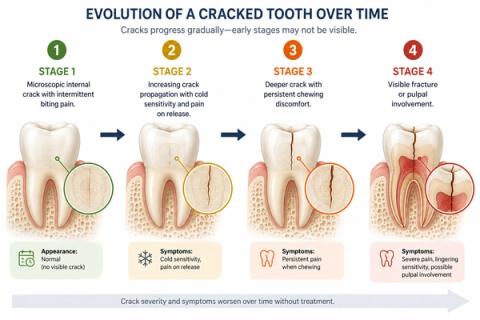
What This Usually Means
Crack-related pain is often a functional problem before it becomes a visible structural problem.
This means:
- The tooth may hurt before the crack can be seen.
- Symptoms may appear long before imaging shows anything unusual.
- Pain may come and go.
- The tooth may look completely normal.
A normal-looking tooth does not always rule out a crack.
Because cracks often worsen gradually, recurring symptoms deserve attention even when no obvious damage is visible.
What Should You Do Right Now?
If you suspect a cracked tooth:
- Avoid chewing hard foods on that side.
- Pay attention to whether pain occurs during pressure or release.
- Notice whether cold sensitivity is also present.
- Avoid repeatedly testing the tooth.
- Maintain good oral hygiene.
- Arrange a dental evaluation if symptoms continue.
These observations can help identify whether a crack may be involved.
When Should You See a Dentist?
You should arrange an examination if:
- Sharp pain occurs during chewing or biting.
- Pain appears when releasing pressure.
- Symptoms repeatedly come and go.
- Cold sensitivity develops.
- One tooth consistently feels uncomfortable.
- Chewing becomes difficult on one side.
- Symptoms are becoming more frequent.
Pain that repeatedly returns from the same tooth is generally not considered normal.
What Are Dentists Learning About Cracked Teeth?
Dentists are becoming better at identifying early cracks before major structural damage occurs.
Research suggests that pain patterns, especially pain during release of pressure, may provide important clues even when cracks are not visible. Advances in imaging, magnification, crack-detection methods, and AI-assisted diagnostic tools may help identify hidden cracks earlier and more accurately than in the past.
Related questions
Clinical interpretation
What this means from a clinical perspective.
This patient explanation is supported by a detailed professional review that examines:
- Cracked tooth syndrome
- Differential diagnosis
- Pain during pressure versus release
- Structural versus inflammatory causes
- Diagnostic testing
- Crack detection strategies
Related Professional Topics
Key terms
Cracked Tooth
A cracked tooth is a tooth with a small fracture that may not always be visible on examination or X-rays.
Structural Stress
Structural stress refers to the forces placed on a tooth during chewing, biting, clenching, or grinding.
Intermittent Pain
Intermittent pain is discomfort that comes and goes rather than remaining constant.
Cold Sensitivity
Cold sensitivity is pain or discomfort triggered by cold foods, drinks, or air exposure.
Hidden Crack
A hidden crack is a fracture that causes symptoms even though it cannot be easily seen during a routine examination.
CoTreat is building the AI colleague for dentists.
CoTreat makes it easy to go above and beyond for your patient. An AI that supports you in clinic.