
What Causes Sharp vs Dull Tooth Pain?



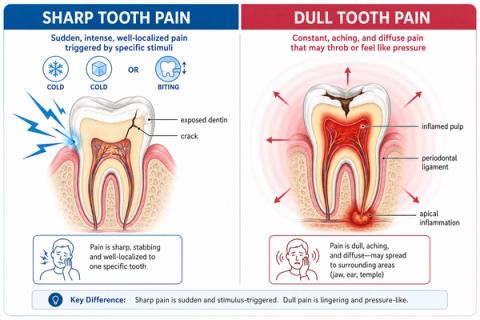
If your tooth pain is sharp, it is often sudden, intense, and triggered by something specific such as cold drinks, sweets, or chewing or biting. This type of pain often points to early irritation, a small crack, or a sensitive area of the tooth.
If your tooth pain is dull, it is often aching, heavy, pressure-like, persistent, and harder to pinpoint. This type of pain may be associated with deeper inflammation, irritation around the root, or infection-related pressure.
The quality of pain provides clues, but the overall pattern is usually more important than the sensation itself.
Sharp tooth pain is often associated with sudden nerve stimulation, small cracks, exposed sensitive areas, or early irritation inside the tooth. Dull tooth pain more commonly reflects deeper inflammation, pressure around the root, or irritation of the tissues supporting the tooth.
The way pain feels can provide important clues. However, dentists look at the full pattern of symptoms — including timing, triggers, and how the pain changes over time — rather than relying on pain quality alone.
Sharp pain and dull pain often involve different tissues, different triggers, and sometimes different stages of the same problem.
What Does Sharp Tooth Pain Usually Feel Like?
Sharp tooth pain is usually sudden, quick, intense, or triggered by something specific.
People often describe it as:
- "A sharp zing in my tooth."
- "Pain when drinking something cold."
- "Sharp pain while chewing."
- "Pain that disappears quickly."
- "A sudden stabbing sensation."
Sharp pain is commonly associated with:
- Cold sensitivity
- Exposed tooth surfaces
- Small cracks
- Early nerve irritation
- Pressure changes during chewing or biting
In many cases, sharp pain occurs because the nerve inside the tooth reacts suddenly to a stimulus. Once the trigger is removed, the pain often settles quickly.
What Does Dull Tooth Pain Usually Feel Like?
Dull tooth pain is more commonly described as aching, heavy, pressure-like, persistent, or difficult to locate.
People often describe it as:
- "A constant dull toothache."
- "Pressure around the tooth."
- "A heavy feeling in the tooth."
- "Soreness while chewing."
- "A throbbing pain that builds gradually."
Dull pain is more often associated with:
- Deeper inflammation
- Irritation around the root
- Gum or ligament involvement
- Progressing infection
- Long-standing pressure within tissues
Unlike sharp pain, dull pain may feel more constant and may be harder to ignore.
Why the Pattern of Pain Matters
| Pain Pattern | What It May Suggest |
|---|---|
| Sharp pain to cold | Early nerve irritation |
| Sharp pain during chewing or biting | Possible crack or structural stress |
| Brief pain that disappears quickly | Mild irritation |
| Dull throbbing pain | Deeper inflammation |
| Pressure-like discomfort | Root or ligament irritation |
| Pain that becomes more constant | Progressing disease |
| Diffuse aching pain | Spreading inflammation |
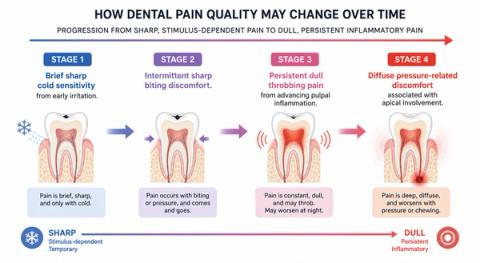
| Pain that changes from sharp to dull | A changing inflammatory process |
The same tooth can sometimes produce sharp pain early on and later develop dull throbbing discomfort as inflammation progresses.
Dentists pay close attention to:
- What triggers the pain
- How long it lasts
- Whether it is sharp or dull
- Whether the pattern is changing over time
Changes in pain quality can sometimes be more important than the intensity of the pain itself.
What This Usually Means
Pain quality alone does not reveal the exact cause of the problem.
For example:
- Sharp pain does not always mean the problem is minor.
- Dull pain does not always mean severe infection.
- Pain may change as inflammation progresses.
- Structural problems can sometimes create both sharp and dull symptoms.
The important point is not simply whether the pain is sharp or dull, but how the pattern behaves over time.
Because different problems can produce similar symptoms, persistent tooth pain should be evaluated rather than self-diagnosed.
What Should You Do Right Now?
If you are experiencing sharp or dull tooth pain:
- Pay attention to what triggers the pain.
- Notice whether cold, sweets, heat, or pressure make it worse.
- Observe whether the pain is becoming more frequent.
- Avoid repeatedly testing the tooth.
- Maintain good oral hygiene.
- Arrange a dental evaluation if symptoms continue.
These observations may help identify the cause more quickly.
When Should You See a Dentist?
You should arrange an examination if:
- Sharp pain becomes frequent or repeatable.
- Dull pain persists or worsens.
- Pain starts occurring without a trigger.
- Chewing or biting becomes uncomfortable.
- Pain begins waking you from sleep.
- Swelling develops.
- Cold sensitivity lingers longer than before.
Pain that continues to change or worsen is generally not considered normal.
What Are Dentists Learning About Sharp vs Dull Tooth Pain?
Dentists are learning more about how different types of pain reflect different stages and locations of inflammation.
Research suggests that changes in pain quality may sometimes help identify disease progression before major structural changes become visible. Improved imaging, vitality testing, and AI-assisted diagnostic tools may help clinicians understand pain patterns more accurately than in the past.
Related questions
Clinical interpretation
What this means from a clinical perspective.
This patient explanation is supported by a detailed professional review that examines:
- Pain quality interpretation
- Differential diagnosis
- Pulpal versus periodontal pain
- Cracked tooth assessment
- Disease progression
- Diagnostic testing
Related Professional Topics
Key terms
Sharp Pain
Sharp pain is sudden, intense discomfort that often occurs in response to a specific trigger such as cold, sweetness, or biting pressure.
Dull Pain
Dull pain is a persistent, aching, or pressure-like discomfort that may be harder to pinpoint than sharp pain.
Dental Pulp
The dental pulp is the soft tissue inside the tooth that contains nerves and blood vessels. Irritation of this tissue commonly causes tooth pain.
Structural Crack
A structural crack is a small fracture within a tooth. Some cracks cause sharp pain during chewing or when pressure is released.
Inflammation
Inflammation is the body's response to injury or irritation. In a tooth, inflammation can change both the intensity and quality of pain.
CoTreat is building the AI colleague for dentists.
CoTreat makes it easy to go above and beyond for your patient. An AI that supports you in clinic.