
Why Does My Tooth Hurt When Chewing or Biting?



If your tooth hurts when you chew, bite down, or put pressure on it, the tooth may be inflamed, cracked, overloaded, or affected by a problem near the root.
In many cases, the pattern of the pain provides the biggest clue about what is happening.
If your tooth hurts when you chew, bite down, or eat certain foods, it usually means that pressure is reaching an irritated part of the tooth or the tissues around it.
This is a common dental problem and does not automatically mean you need a root canal or extraction. However, it is often a sign that something inside or around the tooth needs attention.
Common causes include:
- Tooth decay.
- Inflammation inside the tooth.
- A small or hidden crack
- Irritation around the root.
- Excess biting force on one tooth.
- Clenching or grinding habits.
What matters most is not just that it hurts, but how it hurts. Pain while biting, pain when releasing pressure, and pain that comes and goes can point to different underlying problems.
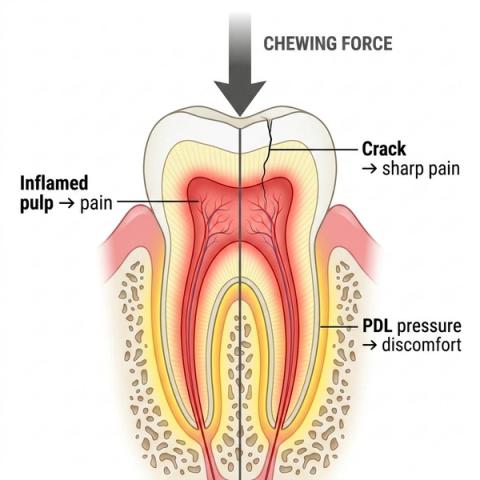
What Does Tooth Pain While Chewing Usually Mean?
Chewing puts pressure on your teeth and the tissues that support them.
If a tooth is irritated, inflamed, cracked, or under excessive force, that pressure can trigger pain.
Patients commonly describe it as:
- "My tooth hurts when I bite down."
- "I get pain when I chew on one side."
- "It feels sore when I eat."
- "My tooth hurts only with pressure."
- "I get a sharp pain when I let go after biting."
Sometimes the pain is obvious. Sometimes it only appears with certain foods or under certain conditions.
What Happens When You Chew?
Every time you chew, force travels through the tooth and into the supporting tissues around the root.
A healthy tooth handles this pressure comfortably.
A tooth that is inflamed, cracked, weakened, or overloaded may react with pain.
The pain may feel:
- Sharp.
- Dull.
- Sore or bruised.
- On and off.
- Worse with certain foods.
- Worse when biting down.
- Worse when releasing pressure.
This is why dentists pay close attention to when the pain occurs, not just how strong it is.
Why the Pattern of Pain Matters
| Pain Pattern | What It May Suggest |
|---|---|
| Sharp pain while biting | A small crack, cavity, or pressure on a damaged area |
| Pain when releasing pressure | A cracked tooth is one of the most common explanations |
| Dull or bruised pain with pressure | Irritation around the root or supporting ligament |
| Pain that comes and goes | Early inflammation, a small crack, or a problem that flares up intermittently |
| Pain only when eating | A pressure-related problem rather than constant irritation |
| Soreness on one side | Uneven bite force or a problem affecting one tooth |
One pattern deserves special attention:
Pain when you let go after biting.
This can happen when a small crack flexes under pressure and then springs back when the pressure is released. Dentists often consider this one of the most useful clues when evaluating chewing-related tooth pain.
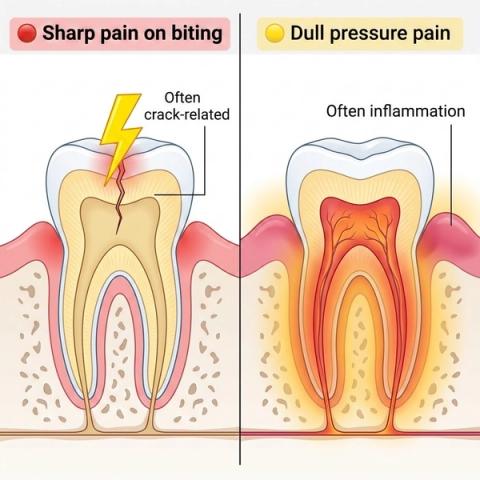
What This Usually Means
Pain while chewing does not automatically mean severe damage.
However, it does mean that the tooth should be evaluated if the problem continues.
Even mild or occasional pain can be an early warning sign of:
- Inflammation inside the tooth.
- A developing crack.
- Irritation around the root.
- Excess pressure on a specific tooth.
Some causes of chewing pain remain stable for long periods, while others may gradually worsen if left untreated. Because it is difficult to determine the cause without an examination, persistent chewing pain should not be ignored.
The earlier the cause is identified, the simpler treatment often becomes.
What Should You Do Right Now?
If chewing causes pain:
- Avoid chewing heavily on that side.
- Avoid very hard foods until the cause is identified.
- Keep the area clean.
- Pay attention to whether the pain occurs when biting down or releasing pressure.
- Arrange a dental evaluation if symptoms persist.
These observations can help your dentist identify the cause more quickly.
When Should You See a Dentist?
You should arrange an examination if:
- The pain happens repeatedly.
- One specific tooth seems responsible.
- The pain is becoming more frequent or intense.
- You feel pain when releasing pressure after biting.
- You avoid chewing on one side.
- The tooth feels sore even with light pressure.
Pain while chewing is generally not considered normal, even if pain comes and goes.
What Are Dentists Learning About Chewing-Related Tooth Pain?
Dentists are becoming better at identifying the exact cause of chewing-related pain, especially when cracks or early inflammation are difficult to detect.
New imaging techniques, improved crack-detection methods, and AI-assisted tools may help clinicians identify some problems earlier and more accurately than in the past.
Related questions
Clinical interpretation
What this means from a clinical perspective.
This patient explanation is supported by a detailed professional review that examines:
- Differential diagnosis
- Pain pattern interpretation
- Cracked tooth assessment
- Pulpal and periodontal causes
- Diagnostic testing
- Emerging research
Related Professional Topics
Key terms
Cracked Tooth
A cracked tooth is a tooth with a small fracture that may not always be visible on an X-ray. Some cracks cause pain only when chewing or when pressure is released after biting.
Dental Pulp
The dental pulp is the soft tissue inside the tooth that contains nerves and blood vessels. When the pulp becomes irritated or inflamed, chewing pressure can sometimes trigger pain.
Root Ligament (Periodontal Ligament)
The periodontal ligament is a thin layer of tissue that connects the tooth to the surrounding bone. Inflammation or excessive pressure on this ligament can make a tooth feel sore or bruised when chewing.
Tooth Inflammation
Tooth inflammation occurs when the tissues inside or around a tooth become irritated. Common causes include decay, cracks, infection, or excessive biting forces.
Bite Force
Bite force refers to the pressure placed on teeth during chewing, clenching, or grinding. Uneven bite forces can sometimes cause discomfort even when the tooth itself appears healthy.
CoTreat is building the AI colleague for dentists.
CoTreat makes it easy to go above and beyond for your patient. An AI that supports you in clinic.