
Why Does Cold Sensitivity Linger?



If your tooth hurts briefly when you drink something cold and the pain stops quickly after you swallow, that is often normal or related to mild irritation.
However, if the pain continues for several seconds or even minutes after the cold is removed, it usually means the nerve inside the tooth is more inflamed and recovering more slowly than it should.
The key question is not simply:
"Does cold hurt?"
But rather:
"How long does the pain last after the cold is gone?"
Cold sensitivity that lingers usually means the nerve inside the tooth remains inflamed even after the cold stimulus has been removed. Brief sensitivity can occur with mild irritation or exposed tooth surfaces, but prolonged lingering pain is more commonly associated with progressing inflammation inside the tooth.
The duration of the response is often more important than the presence of sensitivity alone.
Cold sensitivity that continues after the cold is gone may indicate that the nerve inside the tooth is struggling to recover from inflammation.
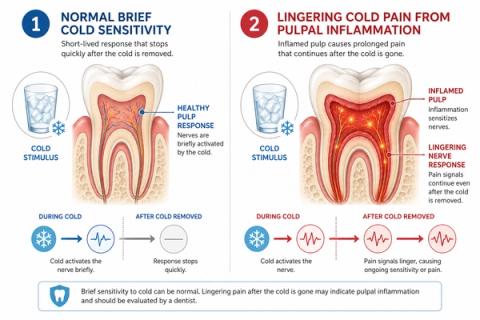
What Does Lingering Cold Sensitivity Mean?
Teeth normally react briefly to cold temperatures such as:
- Cold water
- Ice cream
- Chilled drinks
- Cold air
The sensation should usually stop quickly once the cold stimulus is removed.
People often describe lingering sensitivity as:
- "My tooth keeps hurting after cold drinks."
- "The pain lingers for several seconds."
- "Cold sensitivity is getting worse."
- "My tooth throbs after drinking something cold."
- "The pain stays even after I stop eating or drinking."
Lingering cold sensitivity often means:
- Inflammation inside the tooth is increasing.
- The nerve remains activated longer than normal.
- Recovery after stimulation is delayed.
This is very different from brief sensitivity that stops immediately after the cold is removed.
Why Does Cold Pain Continue After the Cold Is Gone?
The nerve inside the tooth reacts to temperature changes.
When irritation is mild, the nerve usually recovers quickly after the cold stimulus is removed.
As inflammation progresses:
- Recovery becomes slower.
- The nerve stays activated longer.
- Internal pressure may increase.
- Sensitivity becomes more noticeable.
People may begin noticing:
- Pain lasting several seconds or minutes
- Throbbing after cold drinks
- Increasing sensitivity over time
- More frequent episodes
As inflammation advances further, symptoms such as tooth pain worsening at night, spontaneous pain, or discomfort during chewing or biting may also begin to develop.
Why the Pattern of Sensitivity Matters
| Sensitivity Pattern | What It May Suggest |
|---|---|
| Brief cold sensitivity | Mild irritation or exposed tooth surfaces |
| Lingering cold pain | Progressing nerve inflammation |
| Increasing duration over time | Disease progression |
| Throbbing after cold drinks | Sustained inflammation inside the tooth |
| Cold sensitivity with chewing or biting pain | Possible crack involvement |
| Lingering cold sensitivity with night pain | More advanced inflammation |
| Sensitivity that comes and goes | Changing levels of irritation |
Dentists often focus on:
- How long the pain lasts
- Whether symptoms are changing
- Whether other symptoms are appearing
- The overall pattern over time
The duration of the pain is often more important than the intensity of the pain.
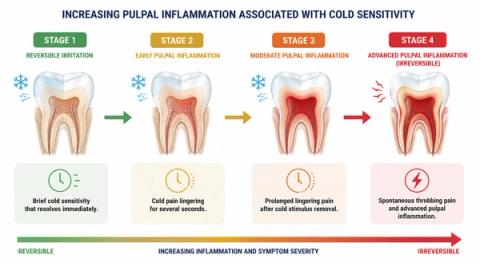
What This Usually Means
Lingering cold sensitivity does not automatically mean a root canal treatment is needed.
However, it often suggests that inflammation inside the tooth is progressing rather than remaining stable.
Symptoms may gradually progress from:
- Brief pain when cold touches the tooth
- Lingering discomfort after the cold is removed
- Tooth pain that comes and goes
- Pain occurring without a trigger
- Night-time tooth pain
- More persistent discomfort
Early evaluation can help determine whether the condition is mild and reversible or becoming more serious.
What Should You Do Right Now?
If cold sensitivity lingers:
- Pay attention to how long the pain lasts.
- Notice whether the duration is increasing over time.
- Avoid repeatedly testing the tooth.
- Continue normal oral hygiene.
- Pay attention to new symptoms such as night pain or biting discomfort.
- Arrange a dental evaluation if symptoms continue.
These observations may help identify the cause more quickly.
When Should You See a Dentist?
You should arrange an examination if:
- Cold sensitivity lingers repeatedly.
- The duration is increasing over time.
- Pain begins occurring without a trigger.
- Night-time tooth pain develops.
- Chewing or biting becomes uncomfortable.
- Heat sensitivity appears.
- Symptoms continue to worsen.
Sensitivity that repeatedly lingers after cold exposure is generally not considered normal.
What Are Dentists Learning About Cold Sensitivity?
Dentists are learning more about how temperature-related pain patterns reflect changes occurring inside the tooth.
Research suggests that the duration of cold sensitivity may sometimes provide valuable clues about the health of the tooth nerve before major changes become visible on X-rays. Advances in vitality testing, imaging, and AI-assisted diagnostic tools may help identify teeth at risk earlier and more accurately than in the past.
Related questions
Clinical interpretation
What this means from a clinical perspective.
This patient explanation is supported by a detailed professional review that examines:
- Reversible and irreversible pulpitis
- Cold testing interpretation
- Differential diagnosis
- Crack-related sensitivity
- Disease progression
- Diagnostic testing
Related Professional Topics
Key terms
Cold Sensitivity
Cold sensitivity is pain or discomfort triggered by cold temperatures such as drinks, foods, or air.
Dental Pulp
The dental pulp is the soft tissue inside the tooth that contains nerves and blood vessels. Inflammation of this tissue is a common cause of lingering cold pain.
Lingering Pain
Lingering pain is discomfort that continues after the original trigger has been removed.
Reversible Irritation
Reversible irritation is mild inflammation that may improve if the cause is identified and managed early.
Inflammation
Inflammation is the body's response to irritation or injury. Inside a tooth, inflammation can increase sensitivity and delay recovery after stimulation.
CoTreat is building the AI colleague for dentists.
CoTreat makes it easy to go above and beyond for your patient. An AI that supports you in clinic.