
Why Does My Tooth Throb Without Warning?



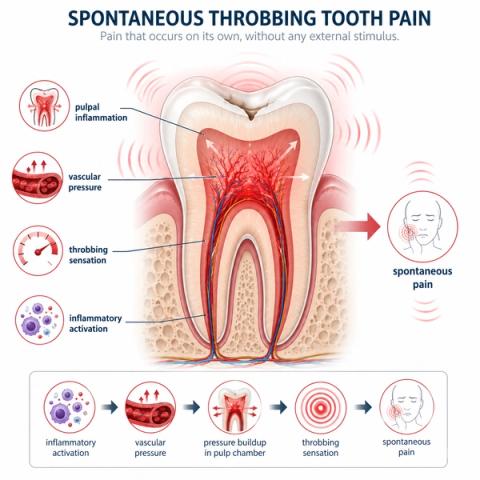
If your tooth throbs without any clear trigger, it often means inflammation inside the tooth has progressed to a point where the nerve is sending pain signals on its own.
This is different from pain that only occurs when something touches or stimulates the tooth.
Spontaneous throbbing pain is often more concerning than trigger-based sensitivity because it may indicate that inflammation is becoming self-sustaining.
A tooth may throb without warning when inflammation inside the tooth or surrounding tissues becomes active enough to trigger pain signals on its own.
Most tooth pain starts when something triggers it, such as cold drinks, hot foods, sweets, or chewing or biting. When pain begins occurring without any obvious trigger, it often means the tissues inside or around the tooth have become more irritated.
Spontaneous throbbing pain is often a sign that inflammation is becoming more active and deserves attention.
Why Can Tooth Pain Start Without Warning?
Most tooth pain is triggered by something specific, such as:
- Cold drinks
- Hot foods
- Sweets
- Chewing or biting
- Pressure
But when pain starts occurring on its own, it may suggest that inflammation has become more advanced.
People often describe it as:
- "My tooth suddenly started throbbing."
- "The pain comes without eating or drinking."
- "The tooth pulses randomly."
- "The pain wakes me at night."
- "The throbbing starts while resting."
- "It feels like pressure building inside the tooth."
The key difference is that the pain no longer depends on a trigger.
What Causes Spontaneous Throbbing Pain?
The nerve inside the tooth normally responds to outside stimulation.
As inflammation progresses:
- The tissues become more sensitive.
- Inflammatory pressure may increase.
- Recovery becomes more difficult.
- Pain signals may begin occurring without stimulation.
People may notice:
- Throbbing pain without triggers
- Night-time tooth pain
- Pain while resting
- Lingering sensitivity
- Pulsing episodes that come and go
Some people also experience:
- Cold sensitivity
- Hot sensitivity
- Chewing or biting discomfort
As symptoms become more spontaneous, they often become harder to predict.
Why the Pattern of Pain Matters
| Pain Pattern | What It May Suggest |
|---|---|
| Spontaneous throbbing pain | More advanced inflammation |
| Pain that wakes you at night | Increasing inflammatory activity |
| Lingering cold sensitivity | Ongoing nerve irritation |
| Hot sensitivity with throbbing pain | More advanced inflammation |
| Pain during chewing or biting | Structural or root-area involvement |
| Pressure-like pulsing sensation | Inflammatory pressure buildup |
| Intermittent throbbing episodes | Evolving inflammation |
| Pain while resting or lying down | Positional inflammatory behaviour |
Dentists often focus on:
- Whether the pain needs a trigger
- Whether symptoms occur at rest
- Whether symptoms are becoming more frequent
- Whether the pattern is changing over time
One of the most important clues is when a tooth begins producing pain on its own.
What This Usually Means
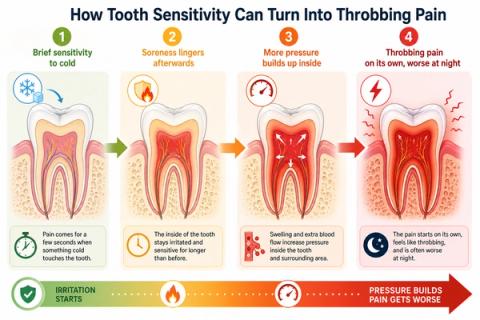
Spontaneous throbbing pain often suggests that the tooth is moving beyond simple trigger-based irritation.
Symptoms may gradually progress from:
- Mild sensitivity to cold
- Lingering sensitivity
- Tooth pain that comes and goes
- Pain that occurs at rest
- Spontaneous throbbing
- Night-time tooth pain
- More continuous discomfort
The important question is not simply:
"How bad is the pain?"
But rather:
"Why is the tooth producing pain without being stimulated?"
That change in behaviour is often more important than the intensity of the pain itself.
What Should You Do Right Now?
If your tooth is throbbing without warning:
- Pay attention to whether the pain occurs at rest.
- Notice whether it wakes you from sleep.
- Observe whether hot, cold, or pressure still trigger symptoms.
- Avoid repeatedly testing the tooth.
- Maintain good oral hygiene.
- Arrange a dental evaluation if symptoms continue.
These observations can help identify the cause more quickly.
When Should You See a Dentist?
You should arrange an examination if:
- Pain begins occurring spontaneously.
- Throbbing pain wakes you from sleep.
- Cold sensitivity or hot sensitivity lingers.
- Swelling develops.
- Chewing or biting becomes painful.
- Symptoms continue worsening over time.
Pain that repeatedly occurs without a trigger is generally not considered normal.
What Are Dentists Learning About Spontaneous Tooth Pain?
Dentists are learning more about how spontaneous pain patterns reflect changes occurring inside the tooth.
Research suggests that the transition from trigger-based pain to spontaneous pain may provide valuable clues about the progression of inflammation. Advances in vitality testing, imaging, and AI-assisted diagnostic tools may help identify high-risk teeth earlier and more accurately than in the past.
Related questions
Clinical interpretation
What this means from a clinical perspective.
This patient explanation is supported by a detailed professional review that examines:
- Spontaneous pulpal pain
- Differential diagnosis
- Reversible versus irreversible inflammation
- Periapical involvement
- Crack-related pain
- Diagnostic testing
Related Professional Topics
Key terms
Spontaneous Pain
Spontaneous pain is discomfort that occurs without an obvious trigger such as eating, drinking, chewing, or temperature changes.
Throbbing Pain
Throbbing pain is a rhythmic or pulsing type of discomfort often associated with inflammation and pressure changes inside tissues.
Dental Pulp
The dental pulp is the soft tissue inside the tooth that contains nerves and blood vessels. Inflammation of this tissue is a common cause of spontaneous tooth pain.
Inflammation
Inflammation is the body's response to irritation or injury. Increasing inflammation can change how a tooth responds and may eventually lead to pain occurring without a trigger.
Trigger-Based Pain
Trigger-based pain occurs only when something stimulates the tooth, such as cold drinks, hot foods, sweets, or biting pressure.
CoTreat is building the AI colleague for dentists.
CoTreat makes it easy to go above and beyond for your patient. An AI that supports you in clinic.