
What Are Signs of Failed Root Canal Treatment?
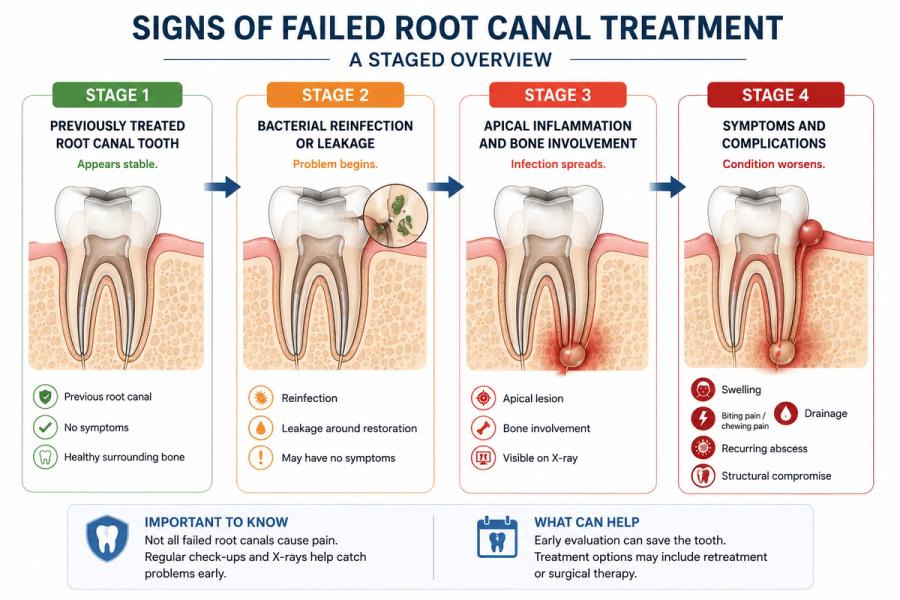
A root canal treated tooth may sometimes develop symptoms again if inflammation, reinfection, or structural problems occur around the tooth over time.



Short Answer
Possible signs of failed root canal treatment include recurring pain, swelling, chewing or biting discomfort, gum drainage, pressure sensitivity, recurring infection, or persistent inflammation seen on X-rays. Some failed root canals may also remain symptom-free initially and only become visible during dental examination.
Why Can a Root Canal Treated Tooth Develop Problems Again?
Root canal treatment is designed to:
- remove infection from inside the tooth,
- preserve surrounding tissues,
- and maintain long-term chewing and biting function.
However:some treated teeth may later develop:
- new biologic problems,
- bacterial reinfection,
- or structural complications over time.
Importantly:many root canal treated teeth remain healthy long term,and:occasional mild awareness after treatment is not automatically treatment failure.
What Symptoms May Suggest Root Canal Failure?
People may notice:
- pain returning months or years later,
- pressure while chewing or biting,
- swelling near the tooth,
- gum tenderness,
- bad taste or drainage,
- recurring pimple-like bumps on the gums,
- or looseness or discomfort around the tooth.
In some situations:
- there may initially be no symptoms,and:
- changes are detected only on X-rays during routine evaluation.
What Commonly Causes Root Canal Failure?
Possible causes may include:
- bacterial reinfection,
- leaking restorations,
- missed canals,
- hidden cracks,
- persistent apical inflammation,
- or structural weakening of the tooth.
Even well-treated teeth may later develop:
- coronal leakage,
- restoration breakdown,
- structural fatigue,
- or reinfection risk over time.
This is why:
- long-term monitoring remains important after root canal treatment.
Why the Pattern of Symptoms Matters
| Symptom Pattern | What It May Suggest |
|---|---|
| Mild stable function for years | Long-term successful adaptation |
| Recurring chewing or biting pain | Structural or apical reinvolvement |
| Swelling or gum drainage | Persistent or secondary infection |
| Pressure sensitivity | Ongoing apical inflammation |
| Loosening crown or filling | Coronal leakage risk |
| Recurring gum bump | Chronic draining infection |
| X-ray changes without symptoms | Silent persistent apical disease |
- symptom patterns,
- radiographic healing,
- restoration quality,
- structural integrity,
- and apical findingstogether rather than relying on one symptom alone.
What This Means
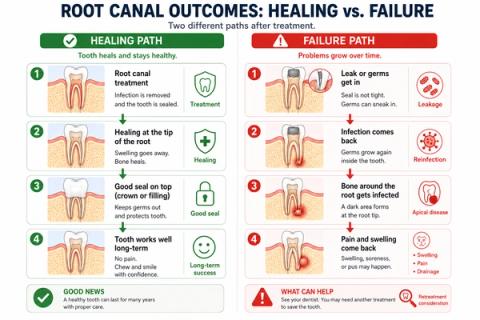
The important question is not simply:
“Does the tooth hurt again?”
but:
“Has long-term biologic stability around the tooth been maintained?”
A treated tooth continues functioning under:
- bacterial exposure,
- long-term chewing and biting forces,
- restorative aging,
- and structural loading.
Over time:
- microbial persistence,
- reinfection,
- crack progression,
- or restoration breakdownmay destabilize previously successful treatment.
Modern interpretation increasingly focuses on:
- longitudinal healing,
- restoration integrity,
- structural durability,
- and biologic stability over time.
When to See a Dentist
You should consider evaluation if:
- a previously treated tooth starts hurting again,
- chewing or biting becomes uncomfortable,
- swelling or drainage develops,
- the tooth feels pressure-sensitive,
- a crown or filling loosens,
- or recurring gum bumps appear near the tooth.
Previously treated teeth may still require:
- long-term monitoring,
- reassessment,
- and structural evaluation years later.
- apical healing,
- restoration integrity,
- crack risk,
- reinfection signs,
- and structural prognosis—not just whether the tooth had prior root canal treatment.
Early evaluation may improve:
- retreatment planning,
- tooth-preservation options,
- and long-term prognosis.
Related Questions
Clinical Perspective
For dental professionalsThis section discusses clinical reasoning and is not intended for self-diagnosis.
Post-Endodontic Failure Signs – Persistent Infection, Reinflammation, and Structural Compromise
Clinical Takeaway
Failed root canal treatment commonly reflects:
- persistent or secondary microbial contamination,
- unresolved apical inflammation,
- structural compromise,
- or inadequate long-term coronal sealingrather than:
- a single isolated procedural issue.
Interpretation Framework
Post-endodontic failure should be interpreted as a:
- biologic stability failureinvolving interaction between:
- microbial persistence,
- structural durability,
- restorative integrity,
- host healing response,
- and occlusal loading.
Clinical assessment requires integration of:
- symptom recurrence,
- radiographic progression,
- periodontal findings,
- structural assessment,
- restoration quality,
- occlusal factors,
- and longitudinal healing history.
The key challenge is distinguishing:
stable asymptomatic adaptation
from:
biologically active persistent disease.
Current interpretation increasingly emphasizes:
- longitudinal prognosis behavior,
- reinfection dynamics,
- and structural-restorative stability.
Current Understanding (Guidelines + Evidence)
Endodontic Perspective
Signs suggestive of failure may include:
- recurrent pain,
- percussion sensitivity,
- swelling or sinus tract formation,
- persistent apical radiolucency,
- chewing or biting discomfort,
- and delayed healing patterns.
Important interpretation principles include:
- symptoms alone incompletely predict treatment status,
- asymptomatic radiographic lesions may still represent unresolved disease,
- coronal leakage significantly influences long-term outcome,
- and structural fractures may mimic reinfection clinically.
Biologic Insight
Persistent intraradicular biofilms may:
- maintain chronic apical inflammation,
- prolong healing instability,
- and sustain low-grade inflammatory activity.
Coronal leakage permits:
- secondary bacterial contamination,
- biofilm recolonization,
- and recurrent apical disease.
Additionally:
- structural fatigue,
- crack propagation,
- and occlusal overloadmay progressively alter long-term biologic prognosis.
Differential Diagnosis
1. Persistent Apical Periodontitis
Features:
- unresolved inflammatory lesion,
- microbial persistence,
- delayed or absent healing.
2. Secondary Reinfection
Features:
- restoration breakdown,
- coronal leakage,
- recurrent bacterial ingress.
3. Vertical Root Fracture
Features:
- isolated probing defect,
- localized inflammation,
- poor restorability prognosis.
4. Occlusal Overload / Structural Fatigue
Features:
- ligament tenderness,
- pressure sensitivity,
- crack-related symptoms.
Key Diagnostic Distinctions
| Feature | Stable Treated Tooth | Failed Treatment Concern |
|---|---|---|
| Symptoms | Minimal/absent | Recurring/persistent |
| Apical findings | Healing/stable | Persistent/enlarging lesion |
| Swelling/drainage | Absent | Possible/present |
| Restoration integrity | Stable | Leakage/breakdown possible |
| Structural prognosis | Preserved | Compromised possible |
Common Pitfalls
Common diagnostic errors include:
- assuming asymptomatic teeth are fully healed,
- missing vertical root fractures,
- overlooking coronal leakage,
- interpreting transient postoperative symptoms as failure prematurely,
- and failing to reassess restorability before retreatment planning.
Interpretation should always integrate:
- biologic stability,
- structural durability,
- and long-term restorative prognosis.
Emerging Research Directions
Endodontic Prognosis Analytics
Research increasingly focuses on:
- biofilm persistence characterization,
- healing trajectory modeling,
- structural survival prediction,
- and reinfection-risk analysis.
AI-Assisted Interpretation
Emerging systems increasingly evaluate:
- reinfection-risk prediction,
- apical healing classification,
- retreatment prognosis analytics,
- and longitudinal failure-risk modeling.
Advanced Imaging
Current research increasingly explores:
- CBCT-based lesion characterization,
- fracture-risk assessment,
- longitudinal healing monitoring,
- and structural-restorative interaction analysis.
AI Potential
Failed root canal treatment represents a:
- longitudinal biologic and structural interpretation problemwhere:
- microbial persistence,
- restorative durability,
- and host healinginteract dynamically over time.
AI can assist across the clinical workflow:
Interpretation
- Integrating symptoms, imaging, restoration status, and apical findings
- Identifying clinically meaningful persistent-disease patterns
Decision Timing
- Supporting retreatment versus extraction decisions
- Flagging fracture-risk and reinfection-risk presentations
- Assisting long-term monitoring strategies
Patient Communication
- Explaining why treated teeth may develop problems again
- Clarifying differences between healing discomfort and treatment failure
- Improving understanding of retreatment rationale
Clinical Workflow Support
- Structuring post-endodontic reassessment consistently
- Supporting longitudinal healing tracking
- Reducing variability in failure interpretation
Emerging Direction
- AI-assisted post-endodontic prognosis modeling
- Predictive reinfection and leakage analytics
- Integrated biologic and structural risk-classification systems
Clinical Relevance
The challenge is not simply identifying symptoms after root canal treatment — it is determining whether:
- biologic healing has stabilized long term,or:
- persistent microbial and structural instability remains active.
AI may eventually help:
- improve interpretation of post-endodontic failure patterns,
- support earlier recognition of reinfection risk,
- reduce variability in retreatment planning,
- and enhance patient communication regarding long-term prognosis.
References
- American Association of Endodontists (AAE). Considerations for Restoration and Retreatment of Endodontically Treated Teeth. AAE Clinical Resources.
- European Society of Endodontology (ESE). Quality guidelines for endodontic treatment. International Endodontic Journal.
- Ray HA, Trope M. Periapical status of endodontically treated teeth in relation to the technical quality of the root filling and the coronal restoration. International Endodontic Journal.
- Ricucci D, Siqueira JF Jr. Clinical implications and microbiology of bacterial persistence after treatment procedures. Journal of Endodontics.
- Nair PNR. On the causes of persistent apical periodontitis: a review. International Endodontic Journal.
- Song M, Kim HC, Lee W, Kim E. Analysis of the cause of failure in nonsurgical endodontic treatment by microscopic inspection during endodontic microsurgery. Journal of Endodontics.
- Tsesis I, Rosenberg E, Tamse A, Taschieri S, Kfir A. Diagnosis of vertical root fractures in endodontically treated teeth based on clinical and radiographic indices: a systematic review. Journal of Endodontics.
- Aminoshariae A, Kulild J, Nagendrababu V. Artificial Intelligence in Endodontics: Current Applications and Future Directions. J Endod.