
Why Does My Root Canal Tooth Hurt When Biting?
A root canal treated tooth can still hurt during biting if the tissues around the root or the tooth structure itself remain irritated.



Short Answer
Pain while biting on a root canal treated tooth may occur due to inflammation around the root tip, bite imbalance, cracks, persistent infection, or stress on the supporting ligament around the tooth. The pain does not usually come from the removed nerve itself, but from the surrounding tissues.
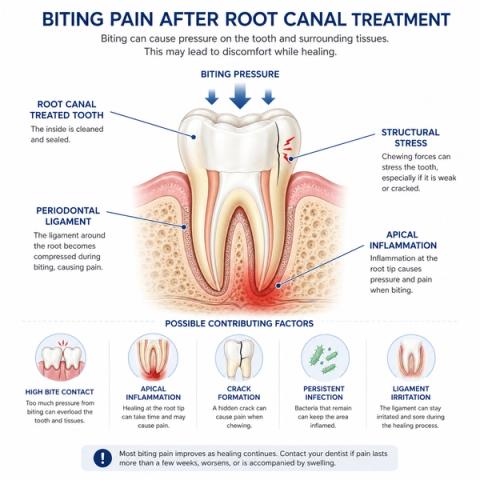
Why Can a Root Canal Tooth Still Hurt During Biting?
Even after root canal treatment:
- the tissues surrounding the tooth root remain alive and responsive.
If these tissues become irritated:
- biting pressure may trigger discomfort.
People may notice:
- pain while chewing or biting,
- tenderness when tapping the tooth,
- pressure sensitivity,
- discomfort while releasing the bite,
- or soreness around the treated tooth.
Importantly:root canal treated teeth do not lose all sensation,because:
- the supporting tissues around the root still contain nerves and pressure receptors.
What Commonly Causes Biting Pain After Root Canal Treatment?
Common causes may include:
- healing inflammation around the root,
- bite pressure that is slightly too high,
- persistent apical inflammation,
- hidden cracks,
- reinfection around the root,
- or structural stress within the tooth. [Tamse A]
In many cases:
- mild biting sensitivity improves gradually during healing.
However:persistent or worsening pain may suggest:
- delayed healing,
- structural instability,
- unresolved infection,
- or fracture-related stress.
Why the Pattern of Symptoms Matters
| Symptom Pattern | What It May Suggest |
|---|---|
| Mild biting discomfort gradually improving | Healing-related inflammation |
| Tooth feels “high” during biting | Hyperocclusion or bite imbalance |
| Pain while releasing bite pressure | Crack-related structural stress |
| Persistent percussion tenderness | Delayed apical healing |
| Localized sharp biting pain | Possible fracture |
| Swelling with biting pain | Persistent apical infection |
| Symptoms worsening over time | Reassessment needed |
- bite response,
- percussion findings,
- radiographic healing,
- crack risk,
- and restoration conditiontogether rather than assuming all biting pain means treatment failure.
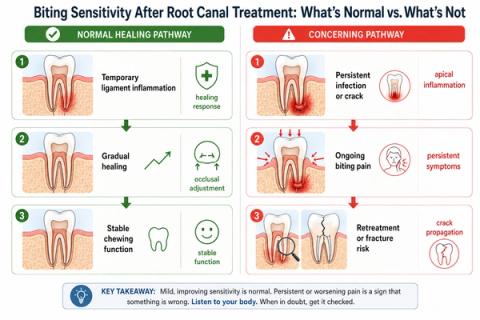
What This Means
The important question is not simply:
“Does the tooth hurt when biting?”
but:
“Are the surrounding tissues healing normally, or is persistent structural or inflammatory stress present?”
Chewing and biting forces place pressure on:
- the periodontal ligament,
- apical tissues,
- surrounding bone,
- and the structural walls of the tooth.
If inflammation or structural instability remains:
- these forces may trigger pain even after the pulp has been removed.
Modern interpretation increasingly focuses on:
- healing trajectory,
- occlusal loading,
- crack behavior,
- and biologic stability over time.
When to See a Dentist
You should consider evaluation if:
- biting pain worsens,
- chewing becomes difficult,
- swelling develops,
- the tooth feels high during biting,
- symptoms persist for an extended period,
- or pressure pain returns after improving initially.
Persistent biting pain may indicate:
- ongoing inflammatory activity,
- structural instability,
- crack progression,
- or delayed healing.
- bite alignment,
- apical healing,
- crack patterns,
- restoration stability,
- and signs of reinfection—not just whether the root canal was completed.
Early reassessment may improve the chances of preserving the tooth long term.
Related Questions
Clinical Perspective
For dental professionalsThis section discusses clinical reasoning and is not intended for self-diagnosis.
Post-Endodontic Biting Pain – Apical Inflammation, Structural Stress, and Occlusal Loading
Clinical Takeaway
Biting pain after root canal treatment commonly reflects:
- periodontal ligament sensitization,
- apical inflammatory persistence,
- occlusal overload,
- or structural compromiserather than:
- pulpal nociception itself.
Interpretation Framework
Post-endodontic biting pain should be interpreted as a:
- biomechanical and inflammatory loading phenomenoninvolving:
- periodontal ligament response,
- apical healing status,
- occlusal stress distribution,
- structural integrity,
- and microbial persistence.
Clinical assessment requires integration of:
- percussion response,
- bite-specific pain behavior,
- occlusal analysis,
- radiographic findings,
- crack-risk indicators,
- symptom trajectory,
- and restoration condition.
The key challenge is distinguishing:
transient healing-related sensitivity
from:
persistent structural or biologic pathology.
Current interpretation increasingly emphasizes:
- dynamic loading behavior,
- structural prognosis,
- and longitudinal healing analysis.
Current Understanding (Guidelines + Evidence)
Endodontic Perspective (AAE / ESE Aligned)
Biting pain after RCT may occur due to:
- residual apical inflammation,
- periodontal ligament compression,
- hyperocclusion,
- persistent apical disease,
- vertical root fracture,
- or structural overload.
Important interpretation principles include:
- biting pain may persist temporarily during healing,
- release pain raises suspicion for crack-related pathology,
- percussion tenderness alone does not define treatment failure,
- and occlusal discrepancies are commonly underrecognized contributors.
Biomechanical Insight
- inflamed periodontal ligament tissues,
- healing apical tissues,
- and structurally weakened dentin.
Structural cracks alter:
- force distribution,
- stress concentration,
- and nociceptive activation unpredictably.
Apical inflammatory tissues may remain mechanically sensitive despite:
- pulpal extirpation,
- canal obturation,
- and microbial reduction.
Differential Diagnosis
1. Healing Apical Inflammation
Features:
- mild chewing tenderness,
- improving trajectory,
- stable radiographic healing.
2. Hyperocclusion
Features:
- localized bite sensitivity,
- ligament soreness,
- relief after adjustment possible.
3. Persistent Apical Periodontitis
Features:
- ongoing percussion tenderness,
- delayed radiographic healing,
- chronic inflammatory activity.
4. Vertical Root Fracture
Features:
- isolated biting pain,
- deep probing defect,
- poor long-term prognosis.
Key Diagnostic Distinctions
| Feature | Healing-Related Pain | Persistent Pathology Concern |
|---|---|---|
| Symptom trend | Improving | Persistent/worsening |
| Bite pain | Mild/transient | Increasing/localized |
| Percussion response | Gradually resolving | Persistent |
| Radiographic healing | Progressive | Static/worsening |
| Crack indicators | Absent | Possible/present |
Common Pitfalls
Common diagnostic errors include:
- assuming all post-RCT biting pain is normal,
- missing hyperocclusion,
- overlooking vertical root fractures,
- failure to reassess restorability,
- and over-reliance on early radiographs without symptom correlation.
Interpretation should always integrate:
- biomechanical loading,
- healing trajectory,
- and structural prognosis.
Emerging Research Directions
Post-Endodontic Biomechanics
Research increasingly focuses on:
- occlusal stress-distribution modeling,
- ligament strain analysis,
- crack-propagation dynamics,
- and structural fatigue prediction.
AI-Assisted Interpretation
Emerging systems increasingly evaluate:
- biting-pain pattern classification,
- apical-healing prediction,
- retreatment-risk analytics,
- and structural-risk modeling.
Advanced Imaging
Current research increasingly explores:
- CBCT fracture detection,
- longitudinal apical-healing assessment,
- structural fatigue monitoring,
- and occlusal-load analytics.
AI Potential
Biting pain after root canal treatment represents a:
- complex healing-versus-failure interpretation problemwhere:
- structural loading,
- inflammatory response,
- and biologic healinginteract dynamically over time.
AI can assist across the clinical workflow:
Interpretation
- Integrating bite behavior, imaging, percussion findings, and structural risk
- Identifying clinically meaningful healing versus persistent pathology patterns
Decision Timing
- Supporting monitor versus retreatment decisions
- Flagging crack-risk or overload-risk cases
- Assisting occlusal adjustment planning
Patient Communication
- Explaining why root canal treated teeth may still hurt during biting
- Clarifying the role of surrounding ligament tissues and healing
- Improving understanding of post-treatment expectations
Clinical Workflow Support
- Structuring post-endodontic reassessment consistently
- Supporting longitudinal symptom tracking
- Reducing variability in biting-pain interpretation
Emerging Direction
- AI-assisted post-endodontic load analytics
- Predictive apical-healing modeling
- Integrated structural and inflammatory outcome prediction systems
Clinical Relevance
The challenge is not simply identifying biting pain after root canal treatment — it is determining whether symptoms reflect:
- normal healing adaptation,
- persistent inflammatory activity,
- occlusal overload,
- or structural failure.
AI may eventually help:
- improve interpretation of post-endodontic biting pain,
- support earlier recognition of persistent pathology,
- reduce variability in retreatment decisions,
- and enhance patient communication regarding healing and prognosis.
References
- American Association of Endodontists (AAE). Cracked Teeth: Clinical Diagnosis and Treatment Recommendations. AAE Clinical Resources.
- Tsesis I, Faivishevsky V, Fuss Z, Zukerman O. Flare-ups after endodontic treatment: a meta-analysis of literature. Quintessence International.
- Tamse A. Vertical root fractures in endodontically treated teeth: diagnostic signs and clinical management. Endodontic Topics.
- Fouad AF. Endodontic interappointment flare-ups: a prospective study of incidence and related factors. Journal of Endodontics.
- Torabinejad M, Walton RE, Fouad AF. Endodontics: Principles and Practice. Elsevier.
- Fuss Z, Lustig J, Tamse A. Prevalence of vertical root fractures in extracted endodontically treated teeth. International Endodontic Journal.
- Shamszadeh S, Shirvani A, Asgary S. Does occlusal reduction reduce post-endodontic pain? A systematic review and meta-analysis. J Oral Rehabil. 2020 Apr;47(4):528-535. doi: 10.1111/joor.12929. Epub 2020 Jan 16. PMID: 31880822.
- Aminoshariae A, Kulild J, Nagendrababu V. Artificial Intelligence in Endodontics: Current Applications and Future Directions. J Endod.