
Why Does My Tooth Throb Without Warning?
Throbbing tooth pain without an obvious trigger often suggests that inflammation inside or around the tooth has become more active and self-sustaining.



Short Answer
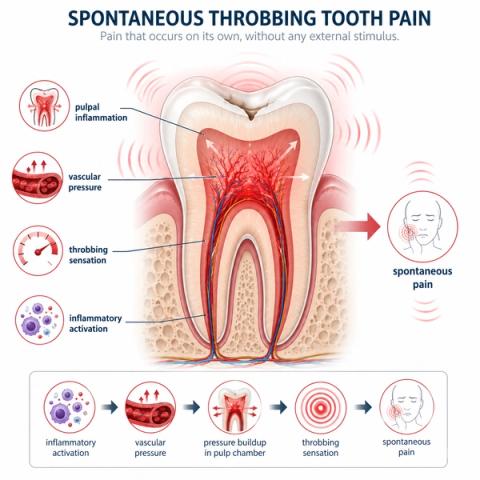
A tooth may throb without warning when inflammation inside the pulp or surrounding tissues becomes advanced enough to trigger spontaneous pain signals. This is commonly associated with deeper pulpal inflammation, infection-related pressure changes, or irritation around the root. Pain that occurs without cold, heat, chewing, or biting triggers often indicates that the nerve inside the tooth has become highly sensitized.
Why Can Tooth Pain Start Without Warning?
Most tooth pain is triggered by:
- cold,
- heat,
- chewing or biting,
- sweets,
- or pressure.
However:when pain starts occurring on its own without obvious triggers, it may indicate that inflammation has become more advanced.
People commonly describe it as:
- “My tooth suddenly started throbbing.”
- “The pain comes without eating or drinking.”
- “The tooth pulses randomly.”
- “The pain wakes me at night.”
- “The throbbing starts while resting.”
- “It feels like pressure building inside the tooth.”
This pattern commonly occurs when:
- the pulp becomes highly inflamed,
- pressure inside the tooth increases,
- or surrounding tissues near the root become irritated.
What Causes Spontaneous Throbbing Pain?
The nerve inside the tooth normally reacts to external triggers.
As inflammation progresses:
- inflammatory chemicals accumulate,
- pressure regulation becomes more difficult,
- and nerve tissues may begin firing pain signals spontaneously.
People may notice:
- throbbing pain without triggers,
- spontaneous night pain,
- lingering discomfort,
- or episodes that pulse rhythmically.
In some cases:
- heat sensitivity,
- chewing or biting discomfort,
- or pressure-related sorenessmay also occur together.
However:
- spontaneous pain does not automatically confirm severe infection,and:
- nearby sinus or nerve-related conditions may occasionally mimic similar symptoms.
Why the Pattern of Pain Matters
| Pain Pattern | What It May Suggest |
|---|---|
| Spontaneous throbbing pain | Advanced pulpal inflammation |
| Pain waking you at night | Increasing inflammatory activation |
| Lingering heat or cold pain | Sustained pulpal irritation |
| Pain while chewing or biting | Root-area or structural involvement |
| Pressure-like pulsing sensation | Inflammatory vascular congestion |
| Intermittent throbbing episodes | Evolving pulpal instability |
- spontaneity of pain,
- thermal behavior,
- vitality response,
- structural findings,
- and apical involvementrather than relying on throbbing pain alone.
What This Means
Spontaneous throbbing pain often suggests that the tooth is moving beyond simple stimulus-triggered irritation toward a more self-sustaining inflammatory state.
The important question is not simply:
“How severe is the pain?”
but:
“Why is the tooth producing pain without external stimulation?”
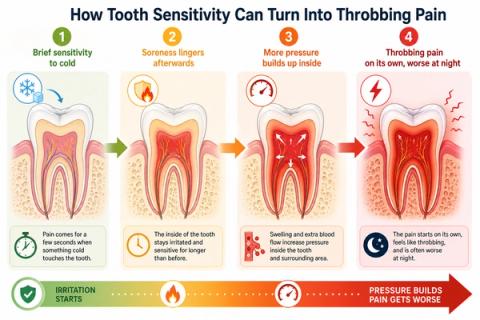
As pulpal inflammation progresses, symptoms may shift from:
- mild trigger-dependent sensitivity,to:
- lingering pain,
- spontaneous throbbing,
- night pain,
- or continuous discomfort.
Early evaluation can help determine whether the pain is related to:
- progressing pulpitis,
- apical inflammation,
- crack-related irritation,
- or non-dental causes.
When to See a Dentist
You should consider evaluation if:
- pain begins occurring spontaneously,
- throbbing pain wakes you at night,
- heat or cold sensitivity lingers,
- swelling develops,
- chewing or biting becomes painful,
- or symptoms worsen over time.
- vitality response,
- thermal behavior,
- apical findings,
- structural integrity,
- and symptom progression—not just pain intensity alone.
Early evaluation may help prevent progression toward more advanced inflammatory disease or infection.
Related Questions
Clinical Perspective
For dental professionalsThis section discusses clinical reasoning and is not intended for self-diagnosis.
Spontaneous Throbbing Tooth Pain – Pulpal Inflammatory Activation
Clinical Takeaway
Spontaneous throbbing tooth pain commonly reflects advanced pulpal inflammatory activation with altered nociceptive regulation, vascular congestion, and increasing biologic instability within the dentin-pulp complex.
Interpretation Framework
Spontaneous dental pain should be interpreted as a loss of stimulus dependency in pulpal nociceptive behavior.
Clinical assessment requires integration of:
- spontaneous symptom timing,
- thermal response dynamics,
- vitality status,
- positional behavior,
- apical involvement,
- structural condition,
- and referred-pain considerations.
The key challenge is distinguishing:
- advanced pulpal inflammatory pain,from:
- non-odontogenic or referred pain syndromes.
Current interpretation increasingly emphasizes:
- inflammatory progression behavior,
- nociceptive dysregulation,
- and contextual vitality assessmentrather than symptom intensity alone.
Current Understanding (Guidelines + Evidence)
Endodontic Perspective
Spontaneous throbbing pain is commonly associated with:
- symptomatic irreversible pulpitis,
- advanced pulpal inflammatory states,
- and acute apical inflammatory involvement.
Important interpretation principles include:
- spontaneous pain increases concern for irreversible inflammatory compromise,
- nocturnal throbbing often correlates with advanced pulpal sensitization,
- symptom intensity alone does not determine prognosis,
- and vitality interpretation remains essential.
Biologic Insight
Inflammatory mediator accumulation sensitizes pulpal nociceptors.
Vascular congestion within the confined pulp chamber contributes to:
- pressure-related pain,
- altered perfusion dynamics,
- and spontaneous neural discharge without external stimulation.
Advanced inflammatory states may therefore demonstrate:
- loss of stimulus dependency,
- persistent nociceptive activation,
- and spontaneous throbbing episodes.
Differential Diagnosis
1. Symptomatic Irreversible Pulpitis
Features:
- spontaneous throbbing,
- lingering thermal pain,
- nocturnal symptoms,
- increasing inflammatory activation.
2. Acute Apical Periodontitis
Features:
- pressure sensation,
- percussion tenderness,
- inflammatory apical involvement,
- localized discomfort.
3. Acute Apical Abscess
Features:
- throbbing pain,
- swelling,
- localized infection progression,
- possible systemic involvement.
4. Non-Odontogenic Facial Pain
Features:
- atypical spontaneous pain,
- inconsistent dental findings,
- neuropathic overlap possible,
- variable localization.
Key Diagnostic Distinctions
| Feature | Advanced Pulpal Pain | Non-Odontogenic Pain |
|---|---|---|
| Thermal sensitivity | Common | Variable |
| Spontaneous throbbing | More characteristic | Variable |
| Night pain | More common | Less specific |
| Vitality changes | Often present | Usually absent |
| Localized dental findings | More likely | Less consistent |
| Symptom progression | More inflammatory | More variable |
Common Pitfalls
Common diagnostic errors include:
- assuming all throbbing pain is infectious,
- missing referred sinus or neuropathic pain,
- over-reliance on symptom severity alone,
- failure to correlate vitality findings,
- and ignoring crack-related inflammatory overlap.
Spontaneous pain should always be interpreted within broader inflammatory and diagnostic context.
Emerging Research Directions
Pulpal Nociception
Research increasingly focuses on:
- neuroinflammatory signaling pathways,
- vascular-pressure dynamics,
- spontaneous neural firing mechanisms,
- and inflammatory sensitization behavior.
AI-Assisted Interpretation
Emerging systems increasingly evaluate:
- spontaneous pain-pattern analytics,
- pulpal-risk stratification,
- and multimodal inflammatory-state classification.
Advanced Vitality Diagnostics
Current research increasingly explores:
- physiologic pulpal perfusion analysis,
- inflammatory biomarker mapping,
- and dynamic nociceptive assessment systems.
AI Potential
Spontaneous throbbing tooth pain represents a high-significance inflammatory interpretation problem where loss of stimulus dependency may indicate escalating pulpal compromise.
AI can assist across the clinical workflow:
Interpretation
- Integrating spontaneous pain timing, thermal response, vitality findings, and imaging
- Identifying clinically meaningful advanced inflammatory patterns
Decision Timing
- Supporting urgency assessment
- Flagging progression-risk pulpal states
- Assisting pulpal versus non-odontogenic differentiation
Patient Communication
- Explaining why pain may occur without obvious triggers
- Clarifying the relationship between inflammation and throbbing sensations
- Improving understanding of progression risk
Clinical Workflow Support
- Structuring spontaneous-pain assessment consistently
- Supporting longitudinal inflammatory-pattern tracking
- Reducing variability in advanced pulpal interpretation
Emerging Direction
- AI-assisted nociceptive-pattern modeling
- Predictive pulpal inflammatory analytics
- Integrated spontaneous-pain interpretation systems
Clinical Relevance
The challenge is not simply identifying throbbing pain — it is determining whether spontaneous nociceptive activation reflects progressing pulpal instability, apical involvement, or non-odontogenic pathology.
AI may eventually help:
- improve interpretation of spontaneous inflammatory pain,
- support earlier recognition of irreversible pulpal states,
- reduce variability in advanced pain assessment,
- and enhance patient communication regarding inflammatory progression.
References
- Siqueira JF Jr, Rôças IN. Microbiology and treatment of acute apical abscesses. Clinical Microbiology Reviews.
- American Association of Endodontists (AAE). Endodontic Diagnosis. AAE Clinical Resources.
- Hargreaves KM, Keiser K. Development of new pain management strategies. Journal of Dental Education.
- Caviedes-Bucheli J, Azuero-Holguín MM, Correa-Ortíz JA, et al. The effect of experimentally induced occlusal trauma on substance P expression in human dental pulp and periodontal ligament. Journal of Endodontics.
- Seltzer S, Bender IB, Ziontz M. The interrelationship of pulp and periodontal disease. Oral Surgery, Oral Medicine, Oral Pathology.
- Abbott PV. Classification, diagnosis and clinical manifestations of apical periodontitis. Endodontic Topics.
- Nixdorf DR, Moana-Filho EJ, Law AS, et al. Frequency of nonodontogenic pain after endodontic therapy: a systematic review and meta-analysis. Journal of Endodontics.
- Schwendicke F, Samek W, Krois J. Artificial intelligence in dentistry: chances and challenges. Journal of Dental Research.