
Can a Root Canal Fail Years Later?



Yes. Root canal treatment can occasionally fail months or even years later.
Common reasons include:
- Reinfection.
- Leakage around old fillings or crowns.
- New tooth decay.
- Cracks or fractures.
- Hidden areas inside the tooth that later become problematic.
- Persistent inflammation around the root.
Many root canal-treated teeth remain stable long term, and delayed failure does not automatically mean the original treatment was unsuccessful.
Yes. A tooth that had root canal treatment years ago can sometimes develop problems again.
Many root canal-treated teeth remain healthy and functional for many years. However, like any restored tooth, they can still be affected by new decay, leakage around fillings or crowns, cracks, or new infection over time.
A problem developing years later does not automatically mean the original treatment was poorly performed. In many cases, the tooth functioned successfully for a long period before new issues developed.
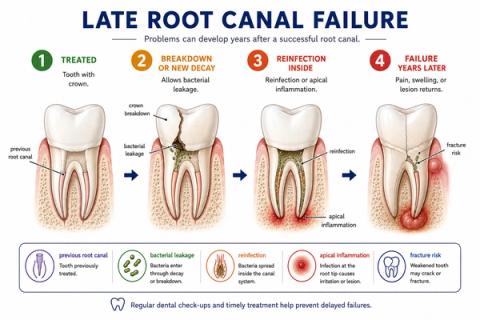
Why Can a Root Canal Fail Years Later?
Root canal treatment can successfully preserve a tooth for many years.
However, the tooth continues functioning in the same environment as all other teeth. Problems may develop later if:
- Bacteria re-enter the tooth.
- A filling or crown begins leaking.
- New decay develops.
- A crack forms in the tooth.
- Parts of the canal system remained difficult to clean completely.
- Inflammation around the root does not fully resolve or later returns.
Importantly, many root canal-treated teeth remain healthy long term, and delayed failure does not automatically mean anything was done incorrectly during the original treatment.
What Symptoms Can Develop Years Later?
You may notice:
- Pain when chewing or biting.
- Pressure sensitivity.
- Swelling near the tooth.
- A small pimple-like swelling on the gum.
- Gum tenderness.
- A bad taste or drainage.
- Recurrent infection.
- Discomfort that gradually returns over time.
In some cases, changes may appear on X-rays before symptoms become obvious.
A previously treated tooth can occasionally develop silent problems that are discovered during a routine dental examination.
Why the Pattern of Symptoms Matters
| Symptom Pattern | What It May Suggest |
|---|---|
| Comfortable function for many years | Long-term successful outcome |
| New chewing or biting pain | Structural problem or infection around the root |
| Swelling or drainage | Recurrent infection |
| Loose crown or filling | Risk of bacteria re-entering the tooth |
| Pressure sensitivity | Ongoing inflammation around the root |
| Localized pain when biting | Possible crack or fracture |
| X-ray changes without symptoms | Silent recurrence around the root |
One pattern deserves special attention:
A root canal-treated tooth that has been comfortable for years and then suddenly develops symptoms should not be ignored. New symptoms often indicate a new problem rather than the original problem returning unchanged.
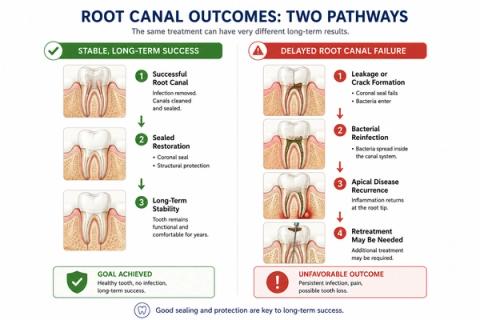
What This Usually Means
The important question is not:
"Was the root canal done years ago?"
The more important question is:
"Has the tooth remained healthy and stable over time?"
A root canal-treated tooth continues to experience:
- Daily chewing and biting forces.
- Wear of fillings and crowns.
- Exposure to bacteria in the mouth.
- Long-term structural stress.
Over time, new decay, leakage around a filling or crown, hidden areas inside the tooth, or new cracks can affect how long the tooth remains healthy.
This is why dentists recommend periodic examinations even when a root canal-treated tooth feels completely normal.
What Should You Do Right Now?
If you have a root canal-treated tooth:
- Continue regular dental examinations.
- Maintain good oral hygiene.
- Watch for changes in chewing comfort.
- Pay attention to swelling, pressure sensitivity, or gum changes.
- Have loose crowns or fillings evaluated promptly.
- Do not ignore symptoms simply because the tooth was treated years ago.
Many delayed problems can be managed more predictably when identified early.
When Should You See a Dentist?
You should arrange an examination if:
- A previously treated tooth begins hurting again.
- Swelling develops near the tooth.
- A pimple-like bump appears on the gum.
- Chewing or biting becomes uncomfortable.
- A crown or filling becomes loose.
- Drainage or a bad taste develops.
- Pressure sensitivity returns unexpectedly.
A dentist may evaluate:
- Healing around the root.
- The condition of the crown or filling.
- Whether leakage is present.
- Possible cracks or fractures.
- Long-term structural stability.
- Whether retreatment or another solution is needed.
Early evaluation may improve the chances of preserving the tooth long term.
What Are Dentists Learning About Long-Term Root Canal Success?
Dentists are becoming better at identifying factors that influence long-term success after root canal treatment.
Current research focuses on:
- Earlier detection of reinfection.
- Improving long-term sealing of fillings and crowns.
- Better identification of hidden canals and complex anatomy.
- Earlier recognition of cracks and structural weakness.
- Improved imaging of tissues around the root.
- Predicting which teeth are most likely to remain successful long term.
Researchers are also exploring AI-assisted tools that may help identify subtle signs of reinfection, structural failure, and treatment risk before obvious symptoms develop.
Related questions
Clinical interpretation
What this means from a clinical perspective.
This patient explanation is supported by a detailed professional review that examines:
- Endodontic treatment failure.
- Secondary infection and reinfection.
- Coronal leakage.
- Persistent apical disease.
- Cracks and structural compromise.
- Retreatment decision-making.
- Long-term outcome assessment.
- Emerging diagnostic technologies.
Related Professional Topics
Key terms
Root Canal Retreatment
Root canal retreatment is a procedure performed when a previously treated tooth develops new problems and requires the root canal system to be cleaned and treated again.
Reinfection
Reinfection occurs when bacteria gain access to a previously treated tooth and cause new inflammation or infection.
Dental Crown
A dental crown is a protective covering placed over a tooth to restore strength, function, and appearance.
Leakage
Leakage occurs when bacteria, saliva, or fluids enter gaps around a filling or crown and reach areas that should remain sealed.
Root Infection
A root infection develops when bacteria affect the tissues around the root of a tooth and may cause pain, swelling, or bone changes.
Tooth Fracture
A tooth fracture is a crack or break in a tooth that may affect its strength, function, or long-term prognosis.
Dental X-Ray
A dental X-ray allows dentists to evaluate the roots, surrounding bone, previous treatment, and areas that cannot be seen during a routine examination.
CoTreat is building the AI colleague for dentists.
CoTreat makes it easy to go above and beyond for your patient. An AI that supports you in clinic.