
What Are Signs of Failed Root Canal Treatment?



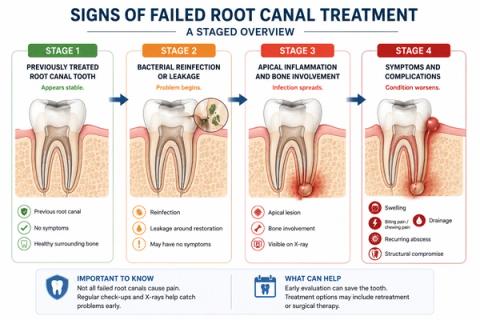
Possible signs of failed root canal treatment include recurring pain, swelling, chewing or biting discomfort, drainage from the gum, pressure sensitivity, recurring infection, or changes seen on X-rays.
Some teeth with failed root canal treatment may not cause symptoms at first and are discovered only during a routine dental examination.
Many root canal-treated teeth remain healthy long term, and occasional mild awareness of a treated tooth does not automatically mean treatment failure.
A root canal-treated tooth can sometimes develop problems again if infection returns, healing does not occur as expected, or the tooth becomes damaged over time.
Many root canal-treated teeth remain healthy for many years. However, a tooth that was previously comfortable may occasionally develop new symptoms months or even years later.
Possible warning signs include:
- Pain returning after a period of comfort.
- Pain when chewing or biting.
- Swelling near the tooth.
- A pimple-like bump on the gum.
- Pressure sensitivity.
- A bad taste or drainage near the tooth.
- A loose crown or filling.
What matters most is not just whether symptoms are present, but how they change over time and what your dentist finds during examination and X-rays.
Why Can a Root Canal-Treated Tooth Develop Problems Again?
Root canal treatment is designed to:
- Remove infection from inside the tooth.
- Help the tissues around the root heal.
- Preserve the natural tooth.
- Maintain normal chewing and biting function.
Although treatment is often successful, problems can occasionally develop later because:
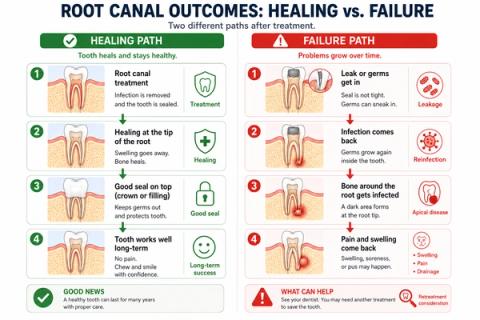
- Bacteria re-enter the tooth.
- A filling or crown leaks.
- A crack develops.
- Healing around the root does not fully occur.
- New decay affects the tooth.
Importantly, many root canal-treated teeth remain healthy for years and never develop these problems.
What Symptoms May Suggest Root Canal Failure?
You may notice:
- Pain returning months or years later.
- Pressure while chewing or biting.
- Swelling near the tooth.
- Tenderness around the gum.
- A bad taste in the mouth.
- Drainage from the gum.
- A recurring pimple-like bump on the gum.
- Discomfort around a previously treated tooth.
Sometimes there are no obvious symptoms.
In some cases, changes are discovered only during a routine X-ray examination.
Why the Pattern of Symptoms Matters
| Symptom Pattern | What It May Suggest |
|---|---|
| Comfortable function for years | Long-term treatment success |
| Pain when chewing or biting returns | Infection or structural problem |
| Swelling or drainage | Infection around the root |
| Pressure sensitivity | Ongoing irritation around the root |
| Loose crown or filling | Possible leakage into the tooth |
| Recurring gum bump | Long-standing draining infection |
| Changes on X-rays without symptoms | Silent disease around the root |
One pattern deserves special attention:
A pimple-like bump on the gum that repeatedly appears and disappears may indicate an ongoing infection that is draining through the gum.
What This Usually Means
The important question is not:
"Does the tooth hurt again?"
The more important question is:
"Is the tooth still healthy and stable over time?"
A treated tooth continues to experience:
- Daily chewing forces.
- Normal wear over time.
- Exposure to bacteria in the mouth.
- Aging of crowns and fillings.
Because of this, problems may occasionally develop years after treatment.
Dentists look at:
- Symptoms.
- X-rays.
- Restoration condition.
- Signs of cracking.
- Healing around the root.
to determine whether the tooth remains healthy or needs additional treatment.
What Should You Do Right Now?
If a root canal-treated tooth begins causing symptoms again:
- Avoid chewing heavily on that side.
- Maintain good oral hygiene.
- Monitor whether symptoms are improving or worsening.
- Watch for swelling or drainage.
- Pay attention to changes in crowns or fillings.
- Arrange a dental examination.
Many problems can be managed more predictably when identified early.
When Should You See a Dentist?
You should arrange an examination if:
- A previously treated tooth begins hurting again.
- Chewing or biting becomes uncomfortable.
- Swelling develops.
- Drainage appears near the tooth.
- A pimple-like bump develops on the gum.
- A crown or filling becomes loose.
- Pressure sensitivity returns unexpectedly.
A dentist may evaluate:
- Healing around the root.
- Condition of crowns and fillings.
- Possible cracks.
- Signs of reinfection.
- Long-term stability of the tooth.
Early evaluation may improve treatment options and increase the chances of preserving the tooth.
What Are Dentists Learning About Failed Root Canal Treatment?
Dentists are becoming better at identifying why some root canal-treated teeth develop problems again years after treatment.
Current research focuses on:
- Earlier detection of reinfection.
- Improved imaging of hidden canals.
- Better identification of cracks and fractures.
- Long-term performance of crowns and restorations.
- Healing patterns around the root.
- More accurate prediction of treatment outcomes.
Researchers are also exploring AI-assisted tools that may help identify subtle signs of reinfection, structural problems, and delayed healing before symptoms become obvious.
Related questions
Clinical interpretation
What this means from a clinical perspective.
This patient explanation is supported by a detailed professional review that examines:
- Endodontic treatment failure.
- Persistent apical disease.
- Reinfection mechanisms.
- Coronal leakage.
- Missed canal anatomy.
- Vertical root fracture.
- Interpretation of post-treatment symptoms.
- Long-term prognosis assessment.
Related Professional Topics
Key terms
Root Canal Treatment
Root canal treatment removes damaged or infected tissue from inside a tooth and seals the root canal space to help preserve the tooth.
Reinfection
Reinfection occurs when bacteria gain access to a previously treated tooth and cause new inflammation or infection.
Crown
A crown is a protective covering placed over a tooth to restore strength, appearance, and function.
Dental Filling
A dental filling repairs an area of a tooth damaged by decay or fracture.
Drainage
Drainage refers to fluid or pus leaving an infected area through the gum.
Tooth Crack
A tooth crack is a fracture within a tooth that may affect comfort, strength, or long-term stability.
Dental X-Ray
A dental X-ray allows dentists to identify changes around the roots and supporting bone that may not be visible during a routine examination.
CoTreat is building the AI colleague for dentists.
CoTreat makes it easy to go above and beyond for your patient. An AI that supports you in clinic.