
Does Root Canal Treatment Always Remove Pain?



Root canal treatment often relieves pain because it removes the source of irritation or infection inside the tooth.
However, some discomfort may continue temporarily while the tissues around the root heal. Mild tenderness when chewing or biting is common during the early healing period.
Most treated teeth gradually improve over time. If symptoms persist, worsen, or return after initial improvement, a follow-up examination may be needed to identify the cause.
Root canal treatment often reduces or eliminates pain by removing damaged or infected tissue from inside the tooth.
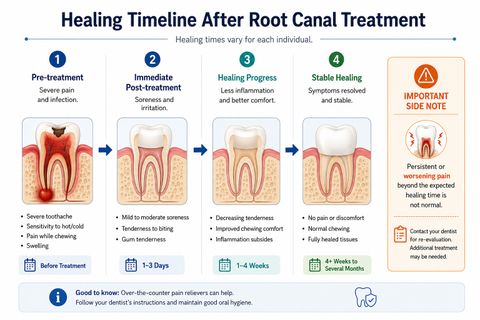
However, pain does not always disappear immediately. The tissues around the root may remain irritated for a period of time, and healing can continue for days, weeks, or even months after treatment.
Many people expect a tooth to feel completely normal as soon as the procedure is finished. That is not always realistic. Mild soreness after treatment is common and does not automatically mean the treatment failed.
The more important question is not whether discomfort is present immediately after treatment, but whether healing is progressing normally over time.
What Does Root Canal Treatment Actually Do?
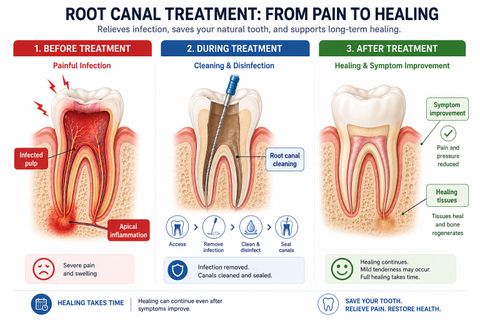
Root canal treatment is designed to:
- Remove damaged or infected tissue from inside the tooth.
- Clean and disinfect the root canal system.
- Reduce bacteria inside the tooth.
- Seal the root canals.
- Preserve the natural tooth whenever possible.
When the source of pain is coming from inside the tooth, treatment often results in significant improvement.
People commonly notice:
- Less throbbing pain.
- Less heat sensitivity.
- Improvement in night pain.
- Reduced pressure inside the tooth.
- Gradual improvement when chewing or biting.
Even when treatment is successful, the surrounding tissues may still need time to heal.
Why Can Pain Continue After Root Canal Treatment?
The tissues around the root often remain irritated for some time after treatment.
This can happen because:
- Inflammation was already present before treatment.
- The tissues around the root are healing.
- Chewing forces temporarily irritate healing tissues.
- The body is still clearing inflammation and repairing damage.
People may notice:
- Mild soreness.
- Tenderness when chewing.
- Pressure sensitivity.
- Temporary discomfort around the tooth.
In many cases, these symptoms gradually improve as healing progresses.
Why the Pattern of Symptoms Matters
| Symptom Pattern | What It May Suggest |
|---|---|
| Mild soreness gradually improving | Normal healing response |
| Temporary chewing tenderness | Healing of the tissues around the root |
| Tooth feels high when biting | Bite-related irritation |
| Symptoms steadily decreasing | Expected recovery |
| Persistent swelling | Ongoing irritation or infection |
| Symptoms returning after improvement | May require reassessment |
| Persistent biting pain in one area | Possible crack or structural problem |
| Pain that does not fit normal patterns | May have another cause |
One pattern deserves special attention:
Symptoms that gradually improve over time are generally more reassuring than symptoms that remain unchanged, worsen, or return after initial improvement.
What This Usually Means
The important question is not:
"Is there still pain?"
The more important question is:
"Is the tooth healing normally over time?"
Many treated teeth continue improving because:
- Inflammation around the root gradually decreases.
- Healing tissues remodel and stabilize.
- The surrounding bone and ligament recover.
- Pressure sensitivity slowly resolves.
Most discomfort becomes less noticeable with time.
However, persistent or worsening symptoms may occasionally be related to:
- Remaining infection.
- Areas inside the tooth that require further treatment.
- Structural cracks.
- Bite-related irritation.
- Problems originating outside the tooth.
This is why healing is evaluated over time rather than immediately after treatment.
What Should You Do Right Now?
If you recently had root canal treatment:
- Follow your dentist's instructions carefully.
- Avoid heavy chewing on the treated tooth initially.
- Maintain good oral hygiene.
- Monitor whether symptoms are improving.
- Attend recommended follow-up visits.
- Contact your dentist if symptoms worsen significantly.
Most healing occurs gradually rather than instantly.
When Should You See a Dentist?
You should arrange a follow-up examination if:
- Pain becomes worse instead of better.
- Swelling develops.
- Chewing or biting becomes increasingly uncomfortable.
- Symptoms return after improving.
- Throbbing pain reappears.
- The tooth feels unusually high when biting.
- Symptoms persist longer than expected.
Early reassessment can help determine whether healing is progressing normally or whether additional treatment is needed.
What Are Dentists Learning About Healing After Root Canal Treatment?
Dentists are becoming better at understanding why some teeth heal quickly while others require additional monitoring.
Current research is helping clinicians evaluate:
- How inflammation around the root resolves after treatment.
- Which teeth are more likely to heal successfully.
- Early signs of persistent infection.
- Changes in bone healing around treated teeth.
- Factors associated with continued discomfort after treatment.
Researchers are also exploring AI-assisted tools that may help dentists evaluate follow-up X-rays, monitor healing patterns, and identify potential problems earlier than was previously possible.
Related questions
Clinical interpretation
What this means from a clinical perspective.
This patient explanation is supported by a detailed professional review that examines:
- Post-endodontic healing.
- Persistent pain after root canal treatment.
- Differential diagnosis of post-treatment symptoms.
- Apical healing patterns.
- Occlusal factors.
- Cracked tooth considerations.
- Retreatment decision-making.
- Emerging diagnostic technologies.
Related Professional Topics
Key terms
Root Canal Treatment
Root canal treatment removes damaged or infected tissue from inside a tooth and seals the root canals to help preserve the tooth.
Healing Around the Root
Healing around the root refers to recovery of the tissues that surround and support the root after inflammation or infection has been treated.
Dental Infection
A dental infection occurs when bacteria invade tissues inside or around a tooth and trigger inflammation.
Bite Adjustment
A bite adjustment is a minor modification to the chewing surface of a tooth or restoration to reduce excessive biting pressure.
Retreatment
Retreatment is additional root canal treatment performed when a previously treated tooth requires further care.
Cracked Tooth
A cracked tooth contains a fracture that may contribute to pain during chewing and can sometimes mimic other dental problems.
Dental X-Ray
A dental X-ray helps dentists evaluate healing, infection, bone changes, and structural conditions that may not be visible during a clinical examination.
CoTreat is building the AI colleague for dentists.
CoTreat makes it easy to go above and beyond for your patient. An AI that supports you in clinic.