
Can an Inflamed Tooth Nerve Heal on Its Own?



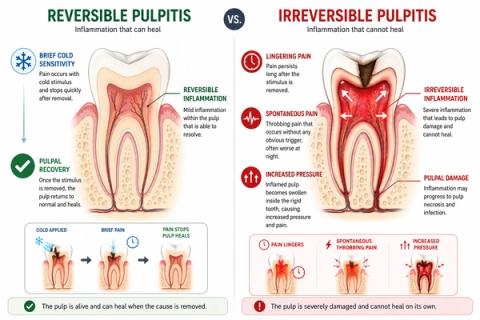
Yes, some inflamed tooth nerves can heal on their own if the cause is identified and treated early.
Mild irritation often causes brief sensitivity that settles quickly once the trigger is removed. More persistent symptoms—such as lingering sensitivity, heat-related pain, spontaneous pain, night pain, or increasing discomfort—may indicate that the tooth is becoming less able to recover normally.
Because symptoms can overlap, dentists use examinations, X-rays, and testing to determine whether the tooth is healing or continuing to deteriorate.
If the soft tissue inside a tooth is only mildly irritated and the cause is removed early, the tooth may recover normally. However, if the irritation becomes more severe or continues for too long, the tooth may lose its ability to heal on its own.
Many people assume that all tooth nerve inflammation automatically leads to root canal treatment. That is not always true. Some teeth recover after the source of irritation is treated, while others continue to worsen despite the body's natural healing response.
The important question is not simply whether the tooth is inflamed, but whether the tissue inside the tooth is still capable of recovery.
What Determines Whether a Tooth Can Heal?
Inside every tooth is a soft tissue called the dental pulp.
The dental pulp contains:
- Nerves.
- Blood vessels.
- Connective tissue.
When this tissue becomes irritated, the body attempts to repair the damage.
Whether healing occurs depends on factors such as:
- How severe the irritation is.
- How long it has been present.
- Whether the cause has been removed.
- Whether the blood supply remains healthy.
- Whether infection has developed.
Some teeth recover normally after treatment. Others continue to worsen even after symptoms first appear.
When Is Recovery More Likely?
Recovery is generally more likely when irritation is mild and addressed early.
Common causes include:
- Early tooth decay.
- Small leaking fillings.
- Exposed dentin.
- Minor tooth wear.
- Mild crack-related irritation.
People often describe symptoms such as:
- "Cold drinks hurt briefly."
- "The tooth is sensitive sometimes."
- "The pain goes away quickly."
- "The discomfort is mild."
At this stage, the tooth may still have a good chance of recovery if the cause is treated promptly.
Why the Pattern of Symptoms Matters
| Symptom Pattern | What It May Suggest |
|---|---|
| Brief cold sensitivity | Greater chance of recovery |
| Symptoms improving over time | Healing may be occurring |
| Lingering cold sensitivity | Reduced healing potential |
| Heat sensitivity | More advanced irritation inside the tooth |
| Pain that starts on its own | Ongoing internal damage |
| Night pain | More advanced inflammation |
| Pain when chewing or biting | Possible involvement beyond the tooth itself |
| Symptoms becoming more frequent | Increasing risk of progression |
One pattern deserves special attention:
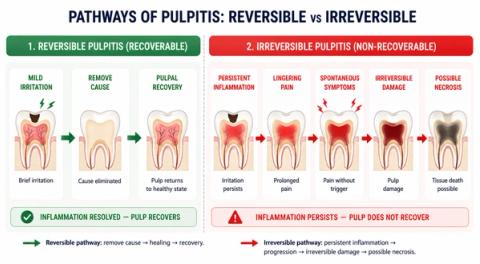
Symptoms that become longer-lasting, more frequent, or more intense over time are generally more concerning than symptoms that gradually improve.
What This Usually Means
The important question is not:
"Does the tooth hurt?"
The more important question is:
"Is the inside of the tooth getting better or getting worse?"
When healing occurs, symptoms often become:
- Less frequent.
- Less intense.
- Shorter in duration.
When healing becomes less likely, symptoms often become:
- More frequent.
- Longer-lasting.
- More unpredictable.
- More severe.
If damage continues, the tooth may eventually develop:
- Loss of vitality.
- Infection around the root.
- The need for root canal treatment.
What Should You Do Right Now?
If a tooth has become sensitive or uncomfortable:
- Pay attention to whether symptoms are improving or worsening.
- Notice how the tooth reacts to hot and cold foods.
- Avoid chewing heavily on a painful tooth.
- Maintain good oral hygiene.
- Address obvious causes such as decay or broken fillings.
- Arrange a dental examination if symptoms continue.
Tracking symptom changes over time can provide valuable information for your dentist.
When Should You See a Dentist?
You should arrange an examination if:
- Cold sensitivity begins lingering.
- Heat starts causing pain.
- Pain occurs without a trigger.
- Symptoms wake you at night.
- Chewing or biting becomes uncomfortable.
- Symptoms are becoming more frequent.
- Symptoms are becoming more intense.
- The problem has not improved over time.
Early assessment may improve the chance of preserving the health of the tissue inside the tooth.
What Are Dentists Learning About Tooth Nerve Healing?
Dentists are becoming better at identifying which teeth can recover and which are unlikely to heal without further treatment.
New research is helping clinicians evaluate:
- Early signs of recovery.
- Early signs of worsening disease.
- Blood supply inside the tooth.
- The ability of dental tissues to repair themselves.
- How symptom patterns relate to healing potential.
Researchers are also exploring AI-assisted tools that may help dentists predict whether a tooth is likely to recover or continue to deteriorate.
Related questions
Clinical interpretation
What this means from a clinical perspective.
This patient explanation is supported by a detailed professional review that examines:
- Reversible versus irreversible pulpal disease.
- Healing potential of inflamed pulp tissue.
- Interpretation of symptom progression.
- Thermal sensitivity patterns.
- Vitality assessment.
- Treatment decision-making.
- Emerging diagnostic technologies.
Related Professional Topics
Key terms
Dental Pulp
The dental pulp is the soft tissue inside a tooth that contains nerves, blood vessels, and connective tissue.
Tooth Nerve
The term "tooth nerve" is commonly used to describe the living tissue inside a tooth that helps it sense temperature, pressure, and injury.
Cold Sensitivity
Cold sensitivity is discomfort triggered by cold foods, drinks, or air. How long the discomfort lasts is often more important than whether it occurs.
Heat Sensitivity
Heat sensitivity is discomfort triggered by warm foods or drinks and may indicate a more advanced problem inside the tooth.
Loss of Vitality
Loss of vitality occurs when the living tissue inside a tooth is no longer functioning normally.
Root Canal Treatment
Root canal treatment removes damaged or infected tissue from inside a tooth to help preserve the tooth and prevent further infection.
Healing Potential
Healing potential refers to the ability of the tissue inside a tooth to recover normally after the source of irritation has been removed.
CoTreat is building the AI colleague for dentists.
CoTreat makes it easy to go above and beyond for your patient. An AI that supports you in clinic.