
What Happens If Root Canal Treatment Is Delayed?



If root canal treatment is delayed, infection or inflammation inside the tooth may continue to spread over time.
This can lead to:
- Worsening pain.
- Swelling.
- Abscess formation.
- Damage around the root.
- Weakening of the tooth.
- Reduced long-term prognosis.
Sometimes symptoms become less noticeable even while infection continues to progress silently around the root.
Early treatment often provides a better chance of preserving the tooth and preventing complications.
Delaying root canal treatment can allow inflammation or infection inside the tooth to continue progressing.
Over time, this may lead to:
- More severe pain.
- Swelling.
- Infection around the root.
- Damage to the supporting bone.
- Weakening of the tooth.
- A reduced chance of saving the tooth successfully.
In some situations, the pain may actually become quieter for a period of time even though the disease is continuing to worsen.
The absence of pain does not always mean the problem has gone away.
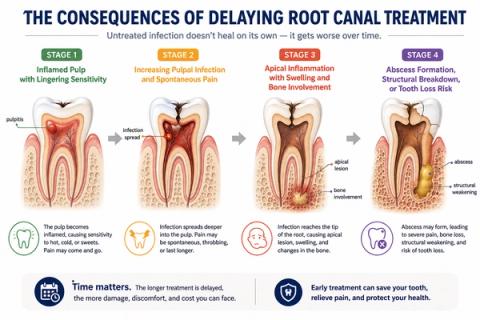
What Happens When an Infected Tooth Is Left Untreated?
When the soft tissue inside a tooth becomes too damaged to recover normally, the condition usually does not remain stable forever.
Without treatment:
- Inflammation may continue progressing.
- Infection may spread beyond the root.
- Surrounding bone and supporting tissues may become involved.
You may notice:
- Increasing pain.
- Pain that wakes you at night.
- Swelling near the tooth or gum.
- Pain when chewing or biting.
- A bad taste in the mouth.
- Drainage from the gum.
- Pain that later disappears as the tooth loses vitality.
In some situations, symptoms may temporarily improve while infection continues developing around the root.
Why Can Pain Sometimes Disappear Without Healing?
Many people assume that if the pain goes away, the tooth must be getting better.
That is not always true.
Sometimes pain decreases because the nerve inside the tooth is losing vitality, not because the underlying problem has healed.
This means:
- The tooth may become less sensitive.
- Pain may decrease or disappear.
- Infection may continue to develop around the root.
Even when symptoms become quieter, the disease may still lead to:
- Infection around the root.
- Swelling.
- Bone loss.
- Weakening of the tooth.
- Eventual tooth loss.
A reduction in pain does not always mean recovery.
Why the Pattern of Symptoms Matters
| Symptom Pattern | What It May Suggest |
|---|---|
| Lingering cold or heat pain | Progressive inflammation inside the tooth |
| Spontaneous throbbing pain | Advanced disease inside the tooth |
| Swelling or drainage | Infection extending beyond the root |
| Pain while chewing or biting | Inflammation around the root or structural stress |
| Pain suddenly disappears | Possible loss of vitality |
| Repeated flare-ups | Ongoing disease around the root |
| Increasing tooth weakness | Structural compromise over time |
One pattern deserves special attention:
A tooth that was painful and then suddenly becomes quiet is not necessarily healing. In some cases, the tissue inside the tooth may be losing vitality while infection continues progressing around the root.
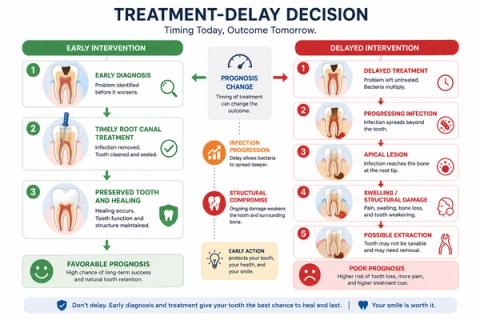
What This Usually Means
The important question is not:
"Does the tooth still hurt?"
The more important question is:
"How is the disease progressing over time?"
As untreated disease progresses:
- The infection may continue to grow.
- Inflammation may spread beyond the inside of the tooth.
- The tooth may become weaker.
- Long-term repair may become less predictable.
Some teeth remain relatively quiet for a period of time.
Others worsen more quickly depending on:
- The amount of infection present.
- Cracks or structural weakness.
- Individual healing responses.
- Involvement of the tissues around the root.
This is why delaying treatment can reduce the chances of long-term success and tooth preservation.
What Should You Do Right Now?
If you think a tooth may need root canal treatment:
- Do not ignore symptoms that continue or worsen.
- Pay attention to swelling, drainage, or changes in pain.
- Avoid chewing heavily on the affected side.
- Maintain good oral hygiene.
- Arrange a dental evaluation as soon as practical.
- Do not assume pain disappearing means the problem has resolved.
Early treatment often helps prevent more extensive damage.
When Should You See a Dentist?
You should arrange an examination if:
- Cold or heat sensitivity begins lingering.
- Pain starts without a trigger.
- Swelling develops near the tooth or gum.
- Chewing or biting becomes painful.
- Symptoms worsen over time.
- Drainage develops.
- A previously painful tooth suddenly becomes quiet.
A dentist may assess:
- The health of the tissue inside the tooth.
- Whether infection has spread beyond the root.
- The extent of structural damage.
- Whether the tooth can still be repaired successfully.
Early evaluation may help prevent more advanced infection, structural breakdown, and reduced long-term prognosis.
What Are Dentists Learning About Delayed Root Canal Treatment?
Dentists are becoming better at understanding how untreated disease progresses inside and around teeth.
Current research is exploring:
- Earlier identification of teeth at risk of infection.
- Better ways to predict disease progression.
- Factors that influence long-term tooth survival.
- Improved methods for detecting hidden infection around the root.
- Technologies that help assess whether a tooth can still be preserved.
Researchers are also studying AI-assisted tools that may help identify disease progression earlier, estimate prognosis more accurately, and support treatment-planning decisions before severe complications develop.
Related questions
Clinical interpretation
What this means from a clinical perspective.
This patient explanation is supported by a detailed professional review that examines:
- Progression of untreated pulpal disease.
- Pulpal necrosis and vitality loss.
- Apical infection development.
- Structural deterioration over time.
- Restorability and prognosis.
- Timing of intervention.
- Emerging diagnostic technologies.
Related Professional Topics
Key terms
Tooth Infection
A tooth infection occurs when bacteria invade the inner part of a tooth and trigger inflammation or infection that may spread beyond the root.
Root Canal Treatment
Root canal treatment removes damaged or infected tissue from inside a tooth and helps prevent infection from continuing to spread.
Swelling
Swelling is enlargement of soft tissues caused by inflammation or infection and may occur near an affected tooth or gum.
Dental Abscess
A dental abscess is a collection of infection that can develop when bacteria spread beyond the inside of a tooth into surrounding tissues.
Bone Loss Around a Tooth
Bone loss occurs when infection or inflammation damages the supporting bone around a tooth.
Tooth Vitality
Tooth vitality refers to the health and function of the living tissue inside a tooth.
Tooth Restorability
Restorability refers to whether a damaged tooth can still be repaired and maintained successfully over the long term.
CoTreat is building the AI colleague for dentists.
CoTreat makes it easy to go above and beyond for your patient. An AI that supports you in clinic.