
How Do You Know If a Tooth Needs Root Canal Treatment?



You may need root canal treatment if the inside of the tooth is too inflamed, infected, or damaged to recover normally.
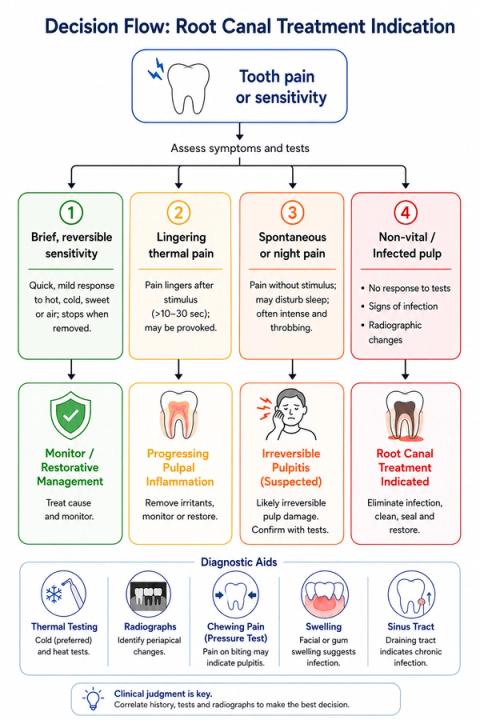
Common warning signs include lingering hot or cold sensitivity, spontaneous pain, night pain, swelling, pain when chewing, or changes in how the tooth responds over time.
However, symptoms alone do not determine whether a root canal is needed. Dentists also use examinations, X-rays, and tests that help determine whether the nerve inside the tooth is still healthy.
A tooth may need root canal treatment when the soft tissue inside the tooth can no longer heal normally on its own.
Many people assume a root canal is only needed when the pain becomes unbearable. That is not always true. Some teeth needing root canal treatment are very painful, while others cause only mild symptoms. In some cases, the pain may even decrease as the nerve inside the tooth loses vitality.
Common warning signs include:
- Lingering sensitivity to cold or heat.
- Pain that starts on its own.
- Throbbing pain that wakes you up at night.
- Pain when chewing or biting.
- Swelling near the tooth or gum.
- A tooth becoming darker than the surrounding teeth.
- A painful tooth that suddenly stops hurting.
What matters most is not just how much the tooth hurts, but the overall pattern of symptoms and how the tooth responds during testing.
What Are the Common Signs That a Tooth May Need a Root Canal?
People often describe root-canal-related symptoms like this:
- "My tooth hurts for a long time after cold drinks."
- "Hot drinks make the pain worse."
- "The pain starts by itself."
- "My tooth throbs at night."
- "It hurts when I chew."
- "The pain was severe and then suddenly disappeared."
- "My tooth has become darker."
- "There is swelling near the gum."
Some of these patterns are more concerning than others. Lingering thermal pain, spontaneous pain, night pain, swelling, and changes in how the tooth responds often raise more concern than brief sensitivity that disappears quickly.
What Happens Inside a Tooth That Needs Root Canal Treatment?
Inside every tooth is a soft tissue called the dental pulp.
The pulp contains:
- Nerves.
- Blood vessels.
- Connective tissue.
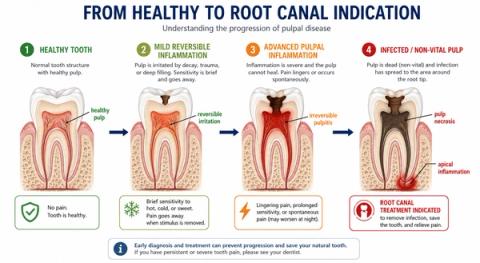
When the pulp becomes irritated, it may recover if the cause is treated early.
However, if inflammation becomes severe or infection develops, the pulp may lose its ability to heal. At that stage, root canal treatment may be needed to remove the damaged tissue and protect the tooth from further infection.
The process often develops gradually rather than suddenly.
Why the Pattern of Symptoms Matters
| Symptom Pattern | What It May Suggest |
|---|---|
| Brief cold sensitivity | Mild irritation that may still recover |
| Lingering cold sensitivity | Inflammation that may no longer heal normally |
| Heat sensitivity | More advanced inflammation inside the tooth |
| Spontaneous throbbing pain | Progressing damage inside the tooth |
| Pain when chewing or biting | Involvement of the tissues around the root, a crack, or progressing disease |
| Swelling near the tooth | Infection extending beyond the tooth |
| Pain suddenly disappears after severe symptoms | The nerve inside the tooth may be dying |
| Darkened tooth | Previous trauma or loss of vitality |
One pattern deserves special attention:
A tooth that was very painful and then suddenly stops hurting is not necessarily healing. In some cases, the nerve inside the tooth may be losing vitality, which can reduce pain even while the underlying problem continues to progress.
What This Usually Means
The real question is not:
"Does the tooth hurt?"
The real question is:
"Can the inside of the tooth still recover?"
As damage progresses, a tooth may move through several stages:
- Mild irritation.
- Early nerve inflammation.
- Advanced nerve inflammation.
- Nerve death.
- Infection around the root..
Not every painful tooth needs root canal treatment.
Likewise, not every tooth needing root canal treatment is extremely painful.
This is why dentists focus on the overall pattern of symptoms rather than pain intensity alone.
What Should You Do Right Now?
If you think a tooth may need root canal treatment:
- Avoid chewing heavily on that side.
- Maintain good oral hygiene.
- Monitor whether symptoms are improving or worsening.
- Pay attention to hot, cold, and chewing triggers.
- Do not assume pain disappearing means the problem has resolved.
- Arrange a dental examination if symptoms continue.
These observations can help your dentist determine the cause more efficiently.
When Should You See a Dentist?
You should arrange an examination if:
- Sensitivity lingers after hot or cold foods.
- Pain starts without a trigger.
- The tooth hurts when chewing or biting.
- Swelling develops near the tooth or gum.
- Pain wakes you up at night.
- Symptoms are becoming more frequent.
- A previously painful tooth suddenly stops responding.
The earlier the problem is evaluated, the more treatment options may be available.
What Are Dentists Learning About Root Canal Diagnosis?
Dentists are becoming better at identifying teeth that need treatment before severe symptoms develop.
New technologies are helping clinicians evaluate:
- Whether the nerve inside the tooth is still alive.
- Whether the tooth can still recover naturally.
- Early signs of infection.
- Structural problems that mimic root canal symptoms.
Researchers are also exploring AI-assisted tools that may help dentists interpret symptom patterns and diagnostic findings more accurately in the future.
Related questions
Clinical interpretation
What this means from a clinical perspective.
This patient explanation is supported by a detailed professional review that examines:
- Root canal diagnosis.
- Reversible versus irreversible pulpal disease.
- Vitality testing.
- Interpretation of symptom patterns.
- Differential diagnosis of root-canal-related symptoms.
- Emerging diagnostic technologies.
Related Professional Topics
Key terms
Dental Pulp
The dental pulp is the soft tissue inside the tooth that contains nerves, blood vessels, and connective tissue.
Root Canal Treatment
Root canal treatment removes damaged or infected tissue from inside the tooth and seals the space to help preserve the tooth.
Tooth Nerve
The tooth nerve is the part of the pulp that allows a tooth to feel temperature and other sensations. When it becomes severely damaged, root canal treatment may be needed.
Nerve Death
Nerve death occurs when the tissue inside the tooth can no longer survive normally. A tooth may become less painful as this happens, even though the underlying problem is getting worse.
Infection Around the Root
An infection around the root develops when bacteria spread beyond the inside of the tooth into the surrounding tissues and bone.
CoTreat is building the AI colleague for dentists.
CoTreat makes it easy to go above and beyond for your patient. An AI that supports you in clinic.