
What Are the Early Warning Signs That a Tooth May Need a Root Canal?



Early warning signs that a tooth may need root canal treatment often include:
- Lingering sensitivity to cold.
- Increasing sensitivity to heat.
- Pain that lasts longer than it used to.
- Pain when chewing or biting.
- Spontaneous pain that starts without a trigger.
- Pain that wakes you at night.
- A tooth becoming darker than surrounding teeth.
- A previously painful tooth suddenly becoming unresponsive.
As symptoms become more severe or persistent, the tooth is generally less able to recover normally.
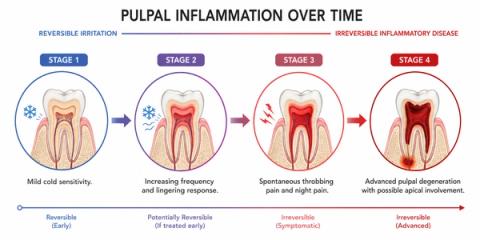
Most teeth that eventually need root canal treatment do not become severely painful overnight. The warning signs often develop gradually as inflammation inside the tooth becomes more advanced.
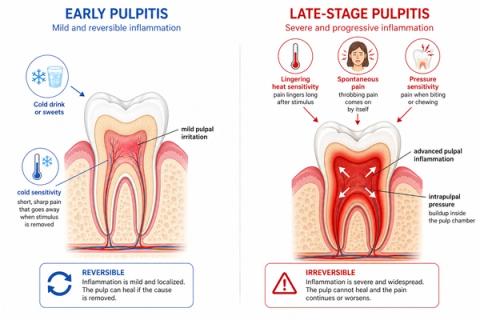
Early symptoms may include brief sensitivity to cold, sweets, or chewing pressure. As the condition progresses, symptoms may become longer-lasting, more frequent, less predictable, and more difficult for the tooth to recover from on its own.
Understanding how symptoms change over time can help you recognize when a tooth may need professional evaluation.
What Happens When the Tooth Nerve Becomes Inflamed?
Inside every tooth is a soft tissue called the dental pulp.
The pulp contains:
- Nerves.
- Blood vessels.
- Connective tissue.
When the pulp becomes irritated, it may initially respond with mild sensitivity.
If the cause continues, inflammation may become more severe. As inflammation increases, the pulp has greater difficulty recovering, and symptoms often become more noticeable.
This process usually develops gradually rather than suddenly.
What Are the Earliest Warning Signs?
Early tooth nerve irritation commonly causes:
- Brief cold sensitivity.
- Mild discomfort with sweets.
- Occasional sensitivity while chewing.
- Symptoms that disappear quickly after the trigger stops.
People often describe it as:
- "Cold water hurts briefly."
- "My tooth feels sensitive sometimes."
- "Sweet foods make it uncomfortable."
- "The pain goes away quickly."
At this stage, the tooth may still have the ability to recover if the underlying cause is treated early.
Why the Pattern of Symptoms Matters
| Symptom Pattern | What It May Suggest |
|---|---|
| Brief cold sensitivity | Early inflammation that may still recover |
| Lingering cold sensitivity | Progressing inflammation inside the tooth |
| Heat sensitivity | More advanced nerve involvement |
| Spontaneous throbbing pain | Advanced inflammatory activation |
| Night pain | Increasing nerve irritation |
| Pain while chewing or biting | Structural change or root involvement |
| Pain suddenly disappears | The nerve inside the tooth may be dying |
One pattern deserves special attention:
A tooth that was becoming increasingly sensitive and then suddenly stops responding is not necessarily healing. In some cases, the nerve inside the tooth may be losing vitality.
What This Usually Means
The important question is not:
"How much does the tooth hurt?"
The more important question is:
"Are the symptoms becoming more severe, more frequent, or lasting longer?"
Early inflammation may still be reversible if the cause is identified and treated.
More advanced inflammation is more likely to involve:
- Persistent irritation.
- Ongoing nerve sensitization.
- Reduced healing capacity.
- Progression toward nerve death inside the tooth.
As the disease progresses, the tooth may eventually develop:
- Advanced nerve damage.
- Nerve death.
- Infection around the root.
What Should You Do Right Now?
If you notice changes in tooth sensitivity or pain:
- Pay attention to whether symptoms are improving or worsening.
- Notice whether cold or heat causes discomfort.
- Monitor how long the pain lasts.
- Avoid chewing heavily on a painful tooth.
- Maintain good oral hygiene.
- Arrange a dental evaluation if symptoms persist or worsen.
The pattern of symptoms often provides valuable information to your dentist.
When Should You See a Dentist?
You should arrange an examination if:
- Cold sensitivity begins lingering.
- Heat starts triggering pain.
- Pain occurs without a trigger.
- Pain wakes you at night.
- Chewing or biting becomes uncomfortable.
- Symptoms are becoming more frequent.
- Pain lasts longer than it used to.
- A previously sensitive tooth suddenly becomes unresponsive.
Early evaluation may help prevent progression toward severe nerve damage or infection.
What Are Dentists Learning About Early Root Canal Warning Signs?
Dentists are becoming better at identifying teeth that are progressing toward severe nerve damage before severe symptoms develop.
Modern diagnostic approaches help clinicians evaluate:
- Whether the tooth may still recover naturally.
- Early signs that the nerve inside the tooth is no longer healthy.
- Changes in symptom patterns over time.
- Structural problems that may mimic pulp disease.
- Early infection around the root.
Researchers are also studying advanced vitality testing methods that may provide a more accurate picture of the health of the tissue inside the tooth than traditional sensitivity tests alone.
AI-assisted diagnostic tools are being explored to help clinicians identify symptom patterns associated with disease progression earlier and more consistently.
Related questions
Clinical interpretation
What this means from a clinical perspective.
This patient explanation is supported by a detailed professional review that examines:
- Early versus advanced pulpal inflammation.
- Symptom progression patterns.
- Interpretation of thermal sensitivity.
- Changes in pulp vitality.
- Differential diagnosis.
- Risk assessment and treatment timing.
- Emerging diagnostic technologies.
Related Professional Topics
Key terms
Dental Pulp
The dental pulp is the soft tissue inside a tooth that contains nerves, blood vessels, and connective tissue.
Cold Sensitivity
Cold sensitivity is discomfort triggered by cold foods, drinks, or air. Pain that lingers after the cold is removed may be more concerning than a brief response.
Heat Sensitivity
Heat sensitivity is discomfort triggered by hot foods or drinks. Increasing heat sensitivity may occur as inflammation inside the tooth becomes more advanced.
Spontaneous Pain
Spontaneous pain is pain that starts without an obvious trigger such as eating, drinking, or chewing.
Tooth Nerve
The tooth nerve is part of the soft tissue inside the tooth. When it becomes severely inflamed or damaged, root canal treatment may sometimes be needed.
Infection Around the Root
An infection around the root develops when irritation or bacteria spread beyond the inside of the tooth into the tissues surrounding the root.
CoTreat is building the AI colleague for dentists.
CoTreat makes it easy to go above and beyond for your patient. An AI that supports you in clinic.