
Why Does a Root Canal-Treated Tooth Become Dark?



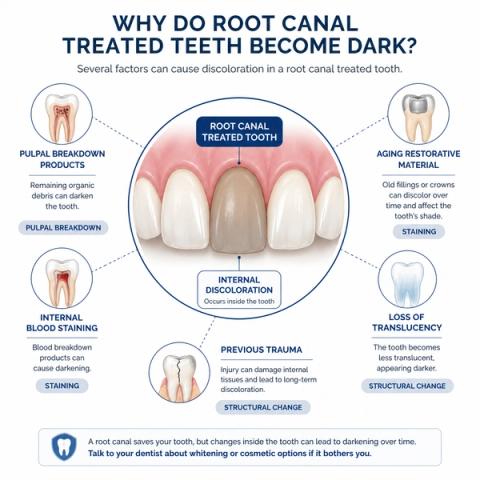
A root canal-treated tooth can become darker over time because of internal staining, previous injury to the nerve inside the tooth, aging dental materials, or changes in the tooth structure after treatment.
Discoloration alone does not automatically mean the root canal has failed. Many darkened teeth remain healthy and functional long term.
A root canal-treated tooth can become darker over time. This is common and does not automatically mean something is wrong.
Many people become concerned when a treated tooth starts looking gray, yellow, or darker than the surrounding teeth. In many cases, the color change is related to changes that happened inside the tooth before or during treatment, rather than a new problem developing.
Common reasons include:
- Internal staining from previous damage inside the tooth.
- Bleeding inside the tooth before treatment.
- Older dental materials.
- Natural aging of the tooth.
- Changes in how light passes through the tooth after treatment.
Many darkened root canal-treated teeth remain healthy and stable for years.
Why Can a Root Canal-Treated Tooth Become Darker?
A healthy tooth normally contains:
- Living tissue inside the tooth.
- Blood supply.
- Natural translucency.
After root canal treatment, the inside of the tooth changes.
Over time, these changes may affect how the tooth looks.
You may notice:
- Yellowing.
- Gray discoloration.
- A darker appearance than nearby teeth.
- Gradual color change over months or years.
Some teeth begin darkening before treatment because the inside of the tooth was already damaged.
What Commonly Causes Tooth Darkening After Root Canal Treatment?
Several factors can contribute to discoloration.
Common causes include:
- Old blood products trapped inside the tooth.
- Internal staining from previous damage.
- Aging fillings or restorations.
- Previous injury to the tooth.
- Changes in how light passes through the tooth structure over time.
In some situations, discoloration begins before root canal treatment because the tooth had already been affected by:
- Trauma.
- Loss of vitality.
- Internal bleeding.
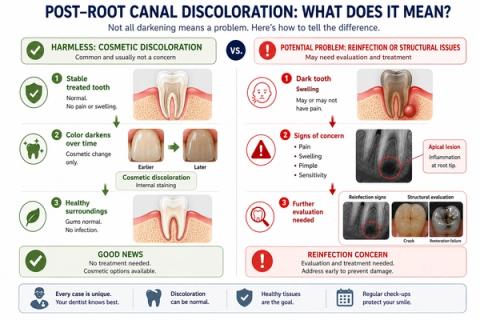
Importantly, a darker tooth does not automatically mean infection is present.
Many root canal-treated teeth become darker while remaining healthy and stable.
Why the Pattern of Symptoms Matters
| Symptom Pattern | What It May Suggest |
|---|---|
| Darkening without symptoms | Stable cosmetic discoloration |
| Gradual gray or yellow color change | Internal staining or aging changes |
| Discoloration after trauma | Previous injury inside the tooth |
| Dark tooth with swelling | Possible infection around the root |
| Pain while chewing or biting | Structural problem or inflammation around the root |
| Loose crown or filling | Possible leakage around the restoration |
| Discoloration with worsening symptoms | Needs reassessment |
One pattern deserves special attention:
A darkened tooth that also develops swelling, chewing pain, drainage, or gum changes should be evaluated, as these symptoms may indicate a problem beyond simple discoloration.
What This Usually Means
The important question is not:
"Why is the tooth darker?"
The more important question is:
"Is the color change cosmetic only, or is there also a problem affecting the tooth?"
Many color changes after root canal treatment are related to:
- Previous injury.
- Internal staining.
- Older restorative materials.
- Natural aging changes inside the tooth.
However, if discoloration occurs together with:
- Pain.
- Swelling.
- Drainage.
- Gum changes.
- Biting discomfort.
the tooth should be examined.
Dentists evaluate both appearance and overall tooth health rather than relying on color alone.
What Should You Do Right Now?
If a root canal-treated tooth becomes darker:
- Compare it with nearby teeth.
- Monitor for any new symptoms.
- Maintain good oral hygiene.
- Keep regular dental check-ups.
- Report any pain, swelling, or chewing discomfort.
- Ask your dentist whether cosmetic treatment options are appropriate.
Many darkened teeth remain healthy and only require cosmetic management.
When Should You See a Dentist?
You should arrange an examination if:
- The tooth continues becoming darker.
- Swelling develops.
- Chewing or biting becomes uncomfortable.
- Gum changes appear near the tooth.
- A crown or filling becomes loose.
- Drainage develops.
- The tooth was recently injured.
A dentist may evaluate:
- Healing around the root.
- Restoration integrity.
- Possible cracks.
- Internal staining.
- Long-term tooth stability.
Early assessment can help distinguish cosmetic discoloration from problems that require treatment.
What Are Dentists Learning About Darkened Root Canal-Treated Teeth?
Dentists are becoming better at understanding why treated teeth change color and how to manage discoloration while preserving tooth structure.
Current research focuses on:
- Internal bleaching techniques.
- Long-term color stability after treatment.
- Effects of restorative materials on tooth color.
- Earlier identification of cracks and leakage.
- Improved imaging of treated teeth.
- Better prediction of long-term tooth stability.
Researchers are also exploring AI-assisted tools that may help identify subtle signs of structural or restorative problems before symptoms become obvious.
Related questions
Clinical interpretation
What this means from a clinical perspective.
This patient explanation is supported by a detailed professional review that examines:
- Discoloration of root canal-treated teeth.
- Internal staining mechanisms.
- Pulpal hemorrhage and tissue breakdown products.
- Restoration-related discoloration.
- Differential diagnosis of post-endodontic color change.
- Reinfection and apical disease considerations.
- Internal bleaching.
- Long-term structural prognosis.
Related Professional Topics
Key terms
Root Canal Treatment
Root canal treatment removes damaged or infected tissue from inside a tooth and seals the root canal space to help preserve the tooth.
Tooth Discoloration
Tooth discoloration refers to a change in the normal color of a tooth, making it appear darker, grayer, or more yellow than surrounding teeth.
Internal Staining
Internal staining occurs when color changes develop inside a tooth rather than on the outer surface.
Tooth Trauma
Tooth trauma is an injury to a tooth caused by an accident, fall, sports injury, or other impact.
Crown
A crown is a protective covering placed over a tooth to restore strength, appearance, and function.
Internal Bleaching
Internal bleaching is a cosmetic procedure used to lighten the color of some root canal-treated teeth from the inside.
Reinfection
Reinfection occurs when bacteria re-enter a previously treated tooth and cause new inflammation or infection around the root.
CoTreat is building the AI colleague for dentists.
CoTreat makes it easy to go above and beyond for your patient. An AI that supports you in clinic.