
Can Tooth Pain Go Away Without Treatment?



Yes, tooth pain can disappear without treatment. However, the absence of pain does not always mean the problem is gone.
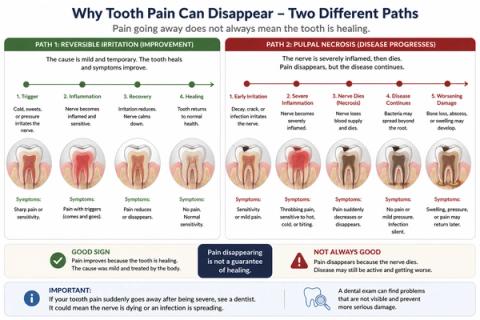
Sometimes pain fades because inflammation settles. In other situations, the nerve inside the tooth becomes damaged and stops responding, while infection or disease continues beneath the surface.
The pattern of symptoms before and after the pain disappears often provides important clues about what is happening.
Yes, tooth pain can go away without treatment, but this does not always mean the tooth has healed.
Sometimes symptoms improve because irritation settles temporarily. In other cases, pain disappears because the nerve inside the tooth loses its ability to respond, even while decay, infection, or structural damage continues to progress.
For this reason, dentists pay close attention to changes in pain patterns. A tooth that stops hurting may be improving, but it may also be becoming more seriously damaged.
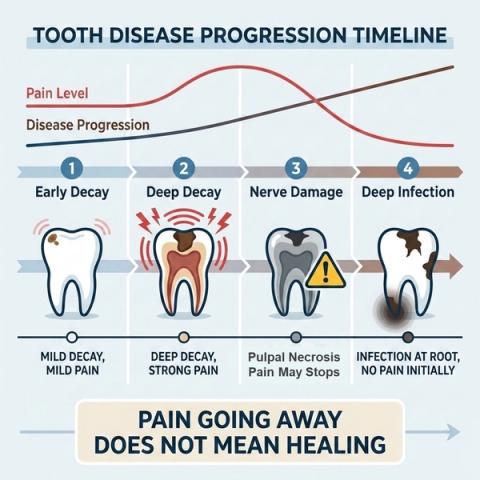
Can Tooth Pain Really Disappear on Its Own?
Yes. Tooth pain can temporarily reduce or disappear without treatment.
People often describe it as:
- "The tooth stopped hurting suddenly."
- "The pain disappeared after a few days."
- "My tooth feels normal again."
- "The sensitivity went away."
- "It used to hurt badly, but now it doesn't."
This can happen for several reasons.
Sometimes the irritation settles temporarily.
Sometimes the tooth adapts between painful episodes.
Sometimes the nerve inside the tooth becomes less responsive.
The important thing to remember is that the absence of pain does not always mean the absence of disease.
What Happens When Tooth Pain Disappears?
The nerve inside the tooth reacts to irritation, inflammation, and infection.
In the early stages, you may notice:
- cold sensitivity
- Pain during chewing or biting
- Intermittent tooth pain
- Pain triggered by sweets or temperature changes
As the condition changes, symptoms may also change.
Pain may:
- Occur less often
- Become less intense
- Disappear temporarily
- Stop completely
In some situations, the nerve gradually loses vitality and becomes unable to respond normally.
This is why a tooth that no longer hurts may still need treatment.
Why the Pattern of Pain Matters
| Pain Pattern | What It May Suggest |
|---|---|
| Pain disappears after mild irritation settles | Temporary recovery |
| Cold sensitivity suddenly disappears | Possible nerve damage |
| Severe pain followed by silence | Possible loss of nerve vitality |
| Pain replaced by pressure or swelling | Possible infection progression |
| Tooth feels "heavy" or different | Inflammation around the root |
| No pain but tooth becomes darker | Loss of vitality |
| Tooth pain comes and goes | Ongoing irritation that may be changing over time |
Dentists often focus on:
- Previous pain history
- Changes in sensitivity
- Response to testing
- Progression of symptoms over time
The history of the pain is often just as important as the pain itself.
What This Usually Means
A tooth becoming painless does not automatically mean it is healthy.
Sometimes symptom improvement reflects:
- Reduced irritation
- Temporary recovery
- Adaptation to a trigger
However, it may also reflect:
- Progressive nerve damage
- Ongoing decay
- A developing infection
- Structural damage within the tooth
Because both possibilities exist, it is usually safest to have the tooth evaluated if symptoms previously occurred and then disappeared unexpectedly.
What Should You Do Right Now?
If your tooth pain has disappeared:
- Do not assume the problem has healed.
- Pay attention to any changes in sensitivity.
- Notice whether chewing becomes uncomfortable.
- Watch for swelling or pressure sensations.
- Continue normal oral hygiene.
- Arrange a dental evaluation if the tooth previously caused significant symptoms.
The history of what happened before the pain disappeared may help identify the cause.
When Should You See a Dentist?
You should arrange an examination if:
- Pain suddenly disappears after being persistent.
- Cold sensitivity stops unexpectedly.
- The tooth feels different or "heavy."
- Swelling develops.
- Chewing becomes uncomfortable.
- The tooth previously had repeated pain episodes.
- The tooth changes colour.
Dentists do not rely only on whether pain is present today. They also evaluate what happened before the pain disappeared.
What Are Dentists Learning About Teeth That Stop Hurting?
Dentists are learning more about how pain patterns change as dental disease progresses.
Research suggests that changes in symptoms may sometimes provide important clues before obvious changes appear on X-rays. Improved pulp testing, advanced imaging, and AI-assisted diagnostic tools may help identify teeth at risk before more serious complications develop.
Related questions
Clinical interpretation
What this means from a clinical perspective.
This patient explanation is supported by a detailed professional review that examines:
- Reversible and irreversible pulpitis
- Pulp vitality and necrosis
- Differential diagnosis
- Symptom progression
- Periapical disease
- Diagnostic testing
Related Professional Topics
Key terms
Dental Pulp
The dental pulp is the soft tissue inside the tooth that contains nerves and blood vessels. Damage to this tissue can change how a tooth responds to pain.
Vitality
Vitality refers to the health and function of the tissues inside the tooth. A tooth may appear intact externally but still lose vitality internally.
Necrosis
Necrosis means tissue death. In dentistry, it refers to the loss of living tissue inside the tooth.
Periapical Infection
A periapical infection develops around the tip of the tooth root when bacteria spread beyond the tooth.
Pulp Testing
Pulp testing is a group of dental tests used to evaluate whether the nerve and blood supply inside a tooth are functioning normally.
CoTreat is building the AI colleague for dentists.
CoTreat makes it easy to go above and beyond for your patient. An AI that supports you in clinic.