
Why Does My Tooth Hurt After a Filling?



Yes, it is common for a tooth to feel sensitive for a short time after a filling.
Many people notice:
- Mild cold sensitivity
- Awareness of the tooth while chewing
- Brief pressure sensitivity
- Occasional mild discomfort
These symptoms often improve gradually.
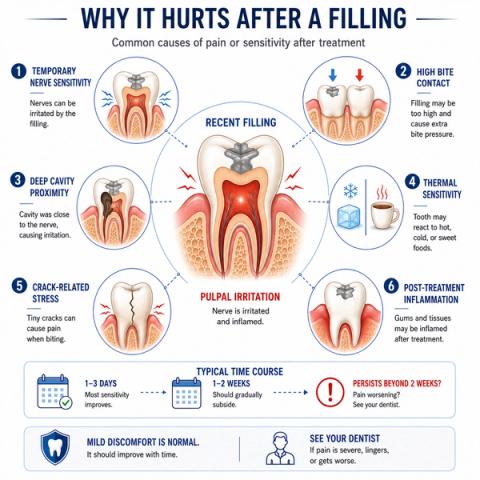
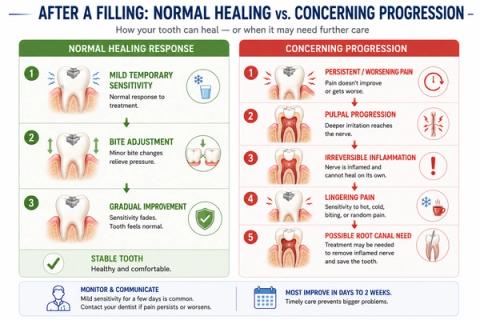
However, if pain worsens instead of improving, lingers for several weeks, becomes sensitive to heat, or starts throbbing without a trigger, the tooth should be reassessed.
A tooth may hurt after a filling because the nerve inside the tooth has become temporarily irritated during treatment or because the way biting forces travel through the tooth has changed.
Mild sensitivity after a filling is often normal, especially during the first few days or weeks. However, persistent, worsening, or unusual pain may suggest that the tooth is not recovering as expected.
The most important question is not whether the tooth hurts after a filling, but whether it is gradually improving over time.
Is Tooth Sensitivity After a Filling Normal?
Yes.
It is not unusual for a tooth to feel different for a short period after treatment.
People often notice:
- Cold sensitivity
- Mild chewing or biting discomfort
- Pressure sensitivity
- Brief sharp sensations
- Increased awareness of the treated tooth
This may happen because:
- The tooth was already irritated before treatment.
- The nerve is recovering from treatment.
- The filling changes how forces move through the tooth.
- Deep decay existed close to the nerve.
In many cases, these symptoms gradually improve over days or weeks.
Why Does a Tooth Hurt After a Filling?
A filling changes both:
- The structure of the tooth
- The way forces travel through the tooth
After treatment, some teeth temporarily become more sensitive while adjusting.
People may notice:
- Cold sensitivity
- Pressure-related discomfort
- Pain during chewing or biting
- Occasional throbbing
- Awareness of the tooth when eating
In some cases:
- The nerve was already significantly inflamed before treatment.
- A bite adjustment may be needed.
- A small crack or structural weakness becomes more noticeable.
The exact pattern of symptoms often provides important clues.
Why the Pattern of Pain Matters
| Pain Pattern | What It May Suggest |
|---|---|
| Mild cold sensitivity improving gradually | Normal recovery |
| Pain during chewing or biting | Bite-related irritation or structural stress |
| Lingering cold or heat pain | Deeper inflammation inside the tooth |
| Spontaneous tooth throbbing | Advanced irritation of the nerve |
| Bite feels uneven | Pressure imbalance |
| Symptoms gradually improving | Recovery process |
| Symptoms worsening over time | Ongoing inflammation |
Dentists often focus on:
- Whether symptoms are improving
- Whether symptoms are worsening
- What triggers the discomfort
- How the pattern changes over time
Improvement is usually more important than the presence of mild sensitivity.
What This Usually Means
Many teeth experience a short adjustment period after a filling.
Temporary symptoms often reflect:
- Recovery of the nerve
- Adaptation to the restoration
- Mild inflammation settling down
However, persistent symptoms may indicate:
- Ongoing inflammation
- Excessive bite pressure
- Structural stress
- A nerve that is not recovering normally
The important question is:
"Is the tooth gradually getting better?"
Symptoms that steadily improve are generally less concerning than symptoms that become stronger, longer-lasting, or more spontaneous.
What Should You Do Right Now?
If your tooth hurts after a filling:
- Pay attention to whether symptoms are improving.
- Notice whether hot, cold, or pressure trigger discomfort.
- Avoid repeatedly testing the tooth.
- Maintain good oral hygiene.
- Avoid excessively hard foods if chewing is uncomfortable.
- Contact your dentist if symptoms continue worsening.
Keeping track of changes over time may help identify the cause more quickly.
When Should You See a Dentist?
You should arrange reassessment if:
- Sensitivity persists beyond a few weeks.
- Pain worsens instead of improving.
- Chewing or biting becomes painful.
- Hot sensitivity develops.
- Spontaneous tooth throbbing appears.
- The bite feels uneven.
- Symptoms continue becoming more frequent.
Pain that follows a worsening pattern deserves attention.
What Are Dentists Learning About Post-Filling Pain?
Dentists are learning more about how teeth recover after restorative treatment and why some teeth remain sensitive longer than others.
Research suggests that symptom patterns after treatment may help predict which teeth are recovering normally and which may require further evaluation. Advances in restorative materials, bite analysis, imaging, and AI-assisted diagnostics may help identify high-risk situations earlier and more accurately than in the past.
Related questions
Clinical interpretation
What this means from a clinical perspective.
This patient explanation is supported by a detailed professional review that examines:
- Post-restorative sensitivity
- Differential diagnosis
- Occlusal overload
- Pulpal inflammation
- Crack-related considerations
- Diagnostic evaluation
Related Professional Topics
Key terms
Filling
A filling is a dental restoration used to repair a tooth damaged by decay or structural loss.
Cold Sensitivity
Cold sensitivity is pain or discomfort triggered by cold foods, drinks, or air exposure.
Occlusal Stress
Occlusal stress refers to forces placed on a tooth during chewing, biting, clenching, or grinding.
Dental Pulp
The dental pulp is the soft tissue inside the tooth that contains nerves and blood vessels. Temporary irritation of this tissue is a common cause of post-filling sensitivity.
Recovery Pattern
A recovery pattern describes how symptoms change over time after treatment. Gradual improvement is usually a reassuring sign.
CoTreat is building the AI colleague for dentists.
CoTreat makes it easy to go above and beyond for your patient. An AI that supports you in clinic.