
Can Antibiotics Replace Root Canal Treatment?



No. Antibiotics usually cannot replace root canal treatment when infection is inside a tooth.
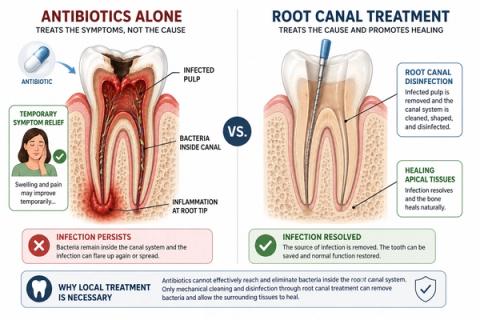
Root canal treatment removes infected tissue and cleans the inside of the tooth directly, while antibiotics have limited ability to fully eliminate infection trapped inside a tooth that has lost its normal blood supply.
Antibiotics may help reduce swelling or control a spreading infection, but they usually do not remove the source of the problem.
No. Antibiotics usually cannot replace root canal treatment when infection is inside a tooth.
Root canal treatment removes infected tissue and cleans the inside of the tooth directly. Antibiotics may help control a spreading infection temporarily, but they usually cannot eliminate the source of infection trapped inside the tooth.
Many people assume antibiotics will cure a tooth infection the same way they treat other infections in the body. Unfortunately, that is often not how tooth infections behave.
When infection develops inside a tooth, removing the source of the infection is usually the most important step.
Why Don't Antibiotics Alone Usually Fix Tooth Infections?
When infection develops inside a tooth:
- Bacteria often become trapped deep inside the tooth.
- The normal blood supply may become severely reduced or absent.
- Infection can persist within areas that antibiotics cannot easily reach.
Because of this:
- Antibiotics may reduce symptoms temporarily.
- Swelling may improve for a period of time.
- The source of infection may still remain inside the tooth.
Many people notice that symptoms improve while taking antibiotics and assume the infection has been cured.
However, if the source remains, symptoms may return once the medication is stopped.
When Are Antibiotics Helpful?
Antibiotics can play an important role when infection is spreading beyond the tooth.
They may help:
- Reduce swelling.
- Control spreading infection.
- Lower the risk of complications.
- Support healing when combined with appropriate dental treatment.
Dentists may be more likely to prescribe antibiotics when:
- Facial swelling develops.
- Swelling is spreading.
- Fever is present.
- Infection affects surrounding tissues.
- General illness develops.
However, antibiotics alone usually do not:
- Remove infected tissue inside the tooth.
- Clean the inside of the tooth.
- Permanently eliminate the source of infection.
Why the Pattern of Symptoms Matters
| Symptom Pattern | What It May Suggest |
|---|---|
| Severe tooth pain without swelling | Infection or inflammation confined mainly within the tooth |
| Swelling near the tooth | Infection extending beyond the tooth |
| Facial swelling | More extensive spread of infection |
| Temporary improvement after antibiotics | Symptoms reduced without removing the source |
| Recurring swelling | Symptoms reduced without removing the source |
| Pain when chewing or biting | Inflammation around the root |
| Fever or feeling unwell | Increased risk of infection spread |
One pattern deserves special attention:
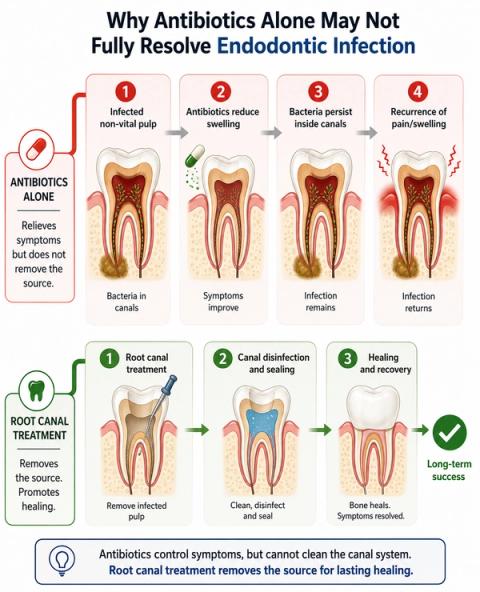
If symptoms improve while taking antibiotics but return soon after the medication is finished, the source of infection may still be present inside the tooth.
What This Usually Means
The important question is not:
"Did the antibiotics reduce the pain?"
The more important question is:
"Was the source of the infection removed?"
Tooth infections behave differently from many infections elsewhere in the body because:
- The blood supply inside the tooth may be severely compromised.
- Bacteria can remain protected inside the tooth.
- Infection may persist even when symptoms improve temporarily.
This means:
- Pain may decrease.
- Swelling may improve.
- The underlying problem may still remain.
Without proper treatment, infection may continue progressing and symptoms may eventually return.
What Should You Do Right Now?
If you have been prescribed antibiotics for a tooth infection:
- Take them exactly as directed.
- Do not stop them early unless advised by your dentist or doctor.
- Do not assume symptom improvement means the problem has been cured.
- Arrange any recommended dental treatment.
- Monitor for worsening swelling, fever, or increasing pain.
- Seek urgent care if swelling begins spreading or affects swallowing or breathing.
Antibiotics are often part of treatment, but they are usually not the entire treatment.
When Should You See a Dentist?
You should arrange an examination if:
- Swelling develops near a tooth.
- Pain becomes severe.
- Symptoms return after antibiotics.
- Chewing or biting becomes uncomfortable.
- A bad taste or drainage develops.
- Fever occurs.
- Facial swelling develops.
A dentist may evaluate:
- Whether infection is present.
- Whether the tooth has lost vitality.
- Whether infection has spread beyond the root.
- Whether root canal treatment, extraction, drainage, or another treatment is needed.
Early treatment may help prevent more serious complications.
What Are Dentists Learning About Antibiotics and Tooth Infections?
Dentists are becoming better at identifying which tooth infections require antibiotics and which are best managed through local treatment alone.
Current research focuses on:
- Improving infection control inside teeth.
- Understanding bacterial biofilms associated with tooth infections.
- Reducing unnecessary antibiotic use.
- Earlier identification of spreading infections.
- Predicting which teeth are most likely to benefit from different treatment approaches.
Researchers are also exploring AI-assisted tools that may help clinicians assess infection severity, treatment needs, and risk of complications more accurately.
Related questions
Clinical interpretation
What this means from a clinical perspective.
This patient explanation is supported by a detailed professional review that examines:
- Endodontic source control.
- Systemic antibiotic therapy.
- Endodontic biofilms.
- Apical infection.
- Antibiotic indications and limitations.
- Differential diagnosis of odontogenic infection.
- Emerging diagnostic technologies.
Related Professional Topics
Key terms
Root Canal Treatment
Root canal treatment removes infected or damaged tissue from inside a tooth and cleans the internal space to help preserve the tooth.
Tooth Infection
A tooth infection occurs when bacteria invade the inner part of a tooth and trigger inflammation or infection that may spread beyond the root.
Antibiotics
Antibiotics are medicines that help control bacterial infections in the body but may not completely eliminate infection trapped inside a tooth.
Swelling
Swelling is enlargement of tissues caused by inflammation or infection and may occur around an affected tooth.
Facial Swelling
Facial swelling occurs when infection spreads into surrounding tissues and may require urgent dental assessment.
Loss of Vitality
Loss of vitality occurs when the living tissue inside a tooth is no longer functioning normally.
Dental Abscess
A dental abscess is a collection of infection that can develop around a tooth when bacteria spread beyond the inside of the tooth.
CoTreat is building the AI colleague for dentists.
CoTreat makes it easy to go above and beyond for your patient. An AI that supports you in clinic.