
Can Tooth Sensitivity Happen Without Cavities?



Yes, tooth sensitivity can happen without cavities.
Common causes include enamel wear, gum recession, exposed dentin, cracks, grinding, whitening treatments, bite stress, and normal wear over time.
The sensitivity is often brief, predictable, and only occurs when triggered.
However, lingering sensitivity, worsening symptoms, or spontaneous pain may indicate deeper irritation inside the tooth even when no cavity is visible.
Yes, teeth can become sensitive even when no cavity is present.
Many people assume that sensitivity automatically means tooth decay, but cavities are only one of many possible causes of sensitive teeth.
Sensitivity can occur when protective tooth structures become thinner, worn, exposed, cracked, or irritated.
Common causes include:
- Gum recession.
- Enamel wear.
- Exposed root surfaces.
- Teeth grinding.
- Cracked teeth.
- Whitening treatments.
- Bite stress.
- Normal wear over time.
- Temporary irritation inside the tooth.
What matters most is not whether a cavity is present, but why the tooth has become sensitive.
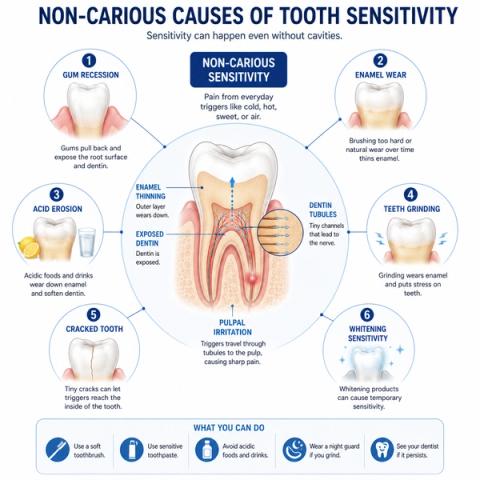
What Does Tooth Sensitivity Without Cavities Usually Mean?
Many people are surprised when a dentist tells them their teeth are sensitive even though no cavities are present.
In reality, sensitivity is often caused by exposed dentin rather than tooth decay.
Dentin contains microscopic channels that communicate with the inner nerve of the tooth.
When dentin becomes exposed, everyday stimuli may reach the nerve more easily.
This can make teeth sensitive to:
- Cold drinks.
- Hot foods.
- Sweet foods.
- Brushing.
- Air exposure.
- Chewing pressure.
Patients commonly describe it as:
- "My teeth are sensitive, but my dentist says I don't have cavities."
- "Cold water suddenly hurts my teeth."
- "My teeth hurt when I brush them."
- "I have sensitivity near the gumline."
- "The tooth looks normal but still feels sensitive."
A tooth can appear healthy on the outside while still having exposed dentin or internal irritation.
Why Can Teeth Become Sensitive Without Cavities?
Several conditions can expose sensitive tooth structures without causing tooth decay.
Common causes include:
- Gum recession.
- Enamel erosion.
- Aggressive brushing.
- Teeth grinding or clenching.
- Cracked teeth.
- Whitening treatments.
- Bite stress.
- Normal tooth wear.
You may notice:
- Sharp cold sensitivity.
- Discomfort near the gumline.
- Sensitivity while brushing.
- Occasional pain while eating or drinking.
- Symptoms affecting several teeth.
In many cases, the sensitivity is brief, predictable, and only occurs when triggered.
However, lingering sensitivity, worsening symptoms, or spontaneous pain may suggest deeper irritation inside the tooth even when no cavity is visible.
Why the Pattern of Sensitivity Matters
The duration and behavior of the sensitivity are often more important than the intensity alone.
Dentists evaluate symptom triggers, response duration, gum condition, tooth wear, crack patterns, and vitality testing results together.
| Symptom Pattern | What It May Suggest |
|---|---|
| Sensitivity near the gumline | Gum recession or root exposure |
| Generalized sensitivity | Enamel wear or erosion |
| Sensitivity during brushing | Exposed dentin |
| Sensitivity after whitening | Temporary irritation |
| Cold sensitivity that resolves quickly | Dentin hypersensitivity |
| Lingering thermal sensitivity | Possible pulpal irritation |
| Sensitivity when biting | Possible crack involvement |
| Increasing symptoms over time | Progressive structural change |
One pattern deserves special attention:
Sensitivity that begins lingering after cold drinks or occurs without an obvious trigger.
This may indicate that irritation is extending beyond simple dentin exposure and affecting deeper tissues inside the tooth.
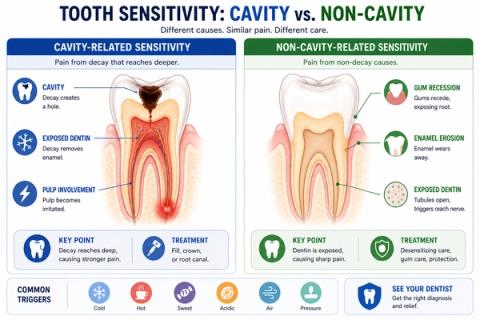
What This Usually Means
Tooth sensitivity does not automatically mean a cavity is present.
Many sensitive teeth are affected by:
- Exposed root surfaces.
- Gum recession.
- Enamel wear.
- Teeth grinding.
- Tooth erosion.
- Temporary pulpal irritation.
Importantly:
- Sensitivity without cavities can still be significant.
- Symptoms should not be ignored simply because no decay is present.
- Early treatment often prevents worsening sensitivity.
The goal is to identify why sensitive structures became exposed and whether the tooth remains healthy internally.
What Should You Do Right Now?
If you have sensitive teeth but no cavities:
- Avoid overly aggressive brushing.
- Use a sensitive-tooth toothpaste if recommended.
- Pay attention to whether one tooth or multiple teeth are affected.
- Notice whether symptoms linger or stop quickly.
- Monitor for chewing discomfort.
- Arrange a dental evaluation if symptoms persist or worsen.
Understanding the pattern of sensitivity often helps identify the cause.
When Should You See a Dentist?
You should arrange an examination if:
- Sensitivity appears suddenly.
- Symptoms worsen over time.
- Cold or heat sensitivity lingers.
- Chewing discomfort develops.
- Visible tooth wear appears.
- Gum recession becomes noticeable.
- Pain occurs without a trigger.
- Sensitivity begins affecting daily activities.
A dentist may evaluate:
- Dentin exposure.
- Tooth wear.
- Gum recession.
- Crack risk.
- Tooth vitality.
- Structural integrity.
- X-ray findings when appropriate.
Early evaluation may help prevent progression toward deeper irritation.
What Are Dentists Learning About Sensitivity Without Cavities?
Dentists increasingly recognize that many cases of tooth sensitivity occur without active decay.
Research continues to improve understanding of dentin hypersensitivity, tooth wear, gum recession, occlusal stress, crack formation, and the biological mechanisms that allow exposed dentin to trigger pain.
Advances in imaging, crack detection, vitality testing, and AI-assisted diagnostic systems may help clinicians identify the underlying causes of sensitivity more accurately and predict which cases are most likely to progress.
Researchers are also studying why some people develop severe sensitivity despite relatively minor structural changes.
Related questions
Clinical interpretation
What this means from a clinical perspective.
This patient explanation is supported by a detailed professional review that examines:
- Non-carious tooth sensitivity.
- Dentin hypersensitivity.
- Tooth wear and erosion.
- Gum recession and root exposure.
- Cracked teeth and occlusal stress.
- Vitality testing and diagnostic evaluation.
- Emerging research and AI-assisted diagnostic support.
Related Professional Topics
Key terms
Dentin
Dentin is the layer beneath enamel that contains microscopic channels capable of transmitting sensations toward the nerve inside the tooth.
Dentin Hypersensitivity
Dentin hypersensitivity occurs when exposed dentin reacts to cold, heat, touch, air, or certain foods and drinks.
Gum Recession
Gum recession occurs when the gumline moves away from the tooth, exposing root surfaces that are more sensitive than enamel.
Enamel Wear
Enamel wear occurs when the protective outer layer of the tooth becomes thinner over time.
Tooth Grinding
Tooth grinding, also called bruxism, places repeated stress on teeth and may contribute to wear, cracks, and sensitivity.
Root Surface Exposure
Root surface exposure occurs when the root of a tooth becomes uncovered by gum tissue, increasing the likelihood of sensitivity.
CoTreat is building the AI colleague for dentists.
CoTreat makes it easy to go above and beyond for your patient. An AI that supports you in clinic.