
Why Are My Teeth Sensitive After Whitening?



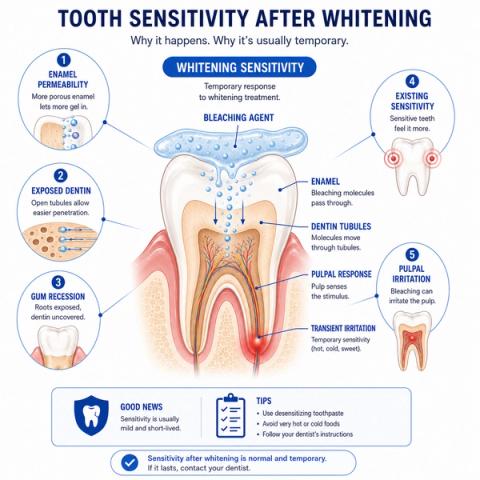
Whitening treatments can temporarily increase sensitivity because bleaching agents increase dentin permeability and mildly irritate the nerve inside the tooth.
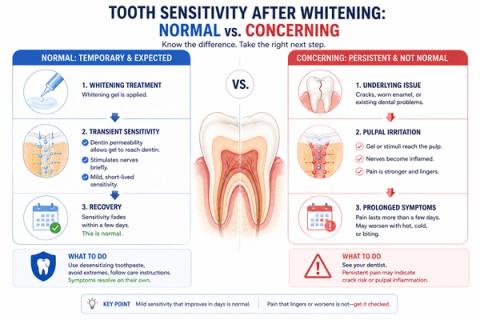
Most whitening-related sensitivity improves within days after treatment stops.
However, persistent pain, severe sensitivity, one tooth hurting much more than others, lingering temperature sensitivity, chewing discomfort, or worsening symptoms may suggest an underlying structural or pulpal problem rather than whitening alone.
Teeth whitening can temporarily increase sensitivity because whitening agents pass through the tooth and affect the inner structures beneath the enamel.
During whitening, bleaching ingredients work by penetrating the tooth and breaking down stain molecules. As part of this process, the tooth may become temporarily more sensitive to temperature changes and other stimuli.
Many people experience some degree of sensitivity during or shortly after whitening treatment.
Common triggers include:
- Cold drinks.
- Cold air.
- Ice cream.
- Tooth brushing.
- Temperature changes.
In most cases, the sensitivity improves after whitening treatment is completed.
What matters most is whether the sensitivity behaves like a temporary whitening reaction or whether it suggests an underlying dental problem.
What Does Tooth Sensitivity After Whitening Usually Mean?
Whitening treatments work by allowing bleaching agents to penetrate the tooth structure and break down stain molecules.
During this process, the inner tooth structures may temporarily become more reactive.
Patients commonly describe it as:
- "My teeth became sensitive after whitening."
- "Cold drinks suddenly hurt after bleaching."
- "My teeth ache after using whitening strips."
- "My teeth feel sore after a whitening session."
- "The sensitivity started after professional whitening."
In most cases:
- The sensitivity is temporary.
- The discomfort gradually improves.
- The teeth return to normal after treatment ends.
However, some people experience stronger symptoms than others.
Why Do Teeth Become Sensitive After Whitening?
Whitening sensitivity commonly occurs because:
- Bleaching agents temporarily increase dentin permeability.
- Fluid movement inside dentin changes.
- The pulp becomes mildly irritated for a short period.
You may notice:
- Cold sensitivity.
- Sharp brief discomfort.
- Sensitivity while breathing cold air.
- Soreness affecting multiple teeth.
- Temporary discomfort after whitening sessions.
Sensitivity may feel stronger if you already have:
- Gum recession.
- Enamel wear.
- Exposed root surfaces.
- Cracked teeth.
- Existing dentin hypersensitivity.
In many cases, symptoms improve within a few days after treatment stops.
However, persistent pain, severe sensitivity, localized symptoms, or worsening discomfort may suggest an underlying dental problem rather than whitening alone.
Why the Pattern of Sensitivity Matters
Whitening-related sensitivity is usually different from infection-related pain because it tends to be generalized, temporary, and triggered by external stimuli.
Dentists evaluate symptom duration, distribution, structural risk factors, tooth vitality, and sensitivity history rather than assuming all post-whitening discomfort is normal.
| Symptom Pattern | What It May Suggest |
|---|---|
| Mild generalized sensitivity | Typical whitening response |
| Cold sensitivity affecting multiple teeth | Increased dentin permeability |
| Brief sharp discomfort | Temporary pulpal irritation |
| Sensitivity while breathing cold air | Dentin exposure response |
| One tooth hurts much more than others | Localized structural concern |
| Lingering temperature pain | Possible pulpal inflammation |
| Chewing discomfort | Crack or structural involvement |
| Symptoms worsening over time | Requires reassessment |
One pattern deserves special attention:
One tooth becoming significantly more sensitive than the surrounding teeth.
This may indicate that whitening has revealed an underlying problem that was already present rather than causing the problem itself.
What This Usually Means
Most whitening-related sensitivity improves naturally after treatment is reduced or completed.
Many cases result from:
- Temporary dentin permeability changes.
- Mild pulpal irritation.
- Previously existing dentin exposure becoming more noticeable.
Importantly:
- Whitening sensitivity is usually reversible.
- Symptoms often improve within days.
- Persistent symptoms deserve attention.
The goal is to distinguish expected temporary sensitivity from previously hidden structural or nerve-related disease.
What Should You Do Right Now?
If your teeth become sensitive after whitening:
- Reduce or pause whitening treatment if advised by your dentist.
- Avoid extremely cold foods and drinks temporarily.
- Use desensitizing products if recommended.
- Monitor whether one tooth is significantly worse than the others.
- Pay attention to whether sensitivity improves after treatment stops.
- Arrange a dental evaluation if symptoms persist or worsen.
Most whitening-related sensitivity gradually settles once treatment is completed.
When Should You See a Dentist?
You should arrange an examination if:
- Sensitivity becomes severe.
- Symptoms persist beyond several days.
- One tooth hurts significantly more than the others.
- Lingering heat or cold pain develops.
- Chewing discomfort appears.
- Swelling occurs.
- Spontaneous pain develops.
- Symptoms continue worsening.
A dentist may evaluate:
- Dentin exposure.
- Enamel condition.
- Crack risk.
- Existing restorations.
- Tooth vitality.
- Structural integrity.
- X-ray findings when appropriate.
Persistent symptoms may indicate an underlying problem unrelated to whitening itself.
What Are Dentists Learning About Whitening Sensitivity?
Dentists continue to improve their understanding of why some patients experience significant whitening sensitivity while others experience very little.
Research is exploring how bleaching agents affect dentin permeability, pulpal responses, nerve stimulation, and individual pain sensitivity.
Advances in whitening formulations, desensitizing agents, personalized treatment protocols, and AI-assisted diagnostic systems may help reduce sensitivity while maintaining whitening effectiveness.
Researchers are also studying how whitening procedures may reveal previously hidden cracks, restoration defects, or pulpal conditions that were not causing obvious symptoms beforehand.
Related questions
Clinical interpretation
What this means from a clinical perspective.
This patient explanation is supported by a detailed professional review that examines:
- Tooth whitening sensitivity.
- Dentin permeability changes.
- Pulpal responses to bleaching.
- Differential diagnosis of post-whitening pain.
- Cracks, restorations, and hidden pathology.
- Vitality testing and diagnostic evaluation.
- Emerging research and AI-assisted diagnostic support.
Related Professional Topics
Key terms
Tooth Whitening
Tooth whitening is a treatment that lightens tooth color using bleaching agents that penetrate tooth structure and break down stain molecules.
Dentin Permeability
Dentin permeability refers to how easily fluids and substances move through dentin. Whitening treatments can temporarily increase this permeability.
Dentin Hypersensitivity
Dentin hypersensitivity occurs when exposed dentin reacts to cold, heat, touch, air, or certain foods and drinks.
Pulp
The pulp is the soft tissue inside the tooth that contains nerves and blood vessels.
Bleaching Agent
A bleaching agent is the active ingredient used in whitening treatments to remove or reduce stains within the tooth.
Transient Sensitivity
Transient sensitivity refers to temporary sensitivity that resolves after the triggering cause is removed or the tooth recovers.
CoTreat is building the AI colleague for dentists.
CoTreat makes it easy to go above and beyond for your patient. An AI that supports you in clinic.