
Why Does Sweet Food Cause Tooth Pain?



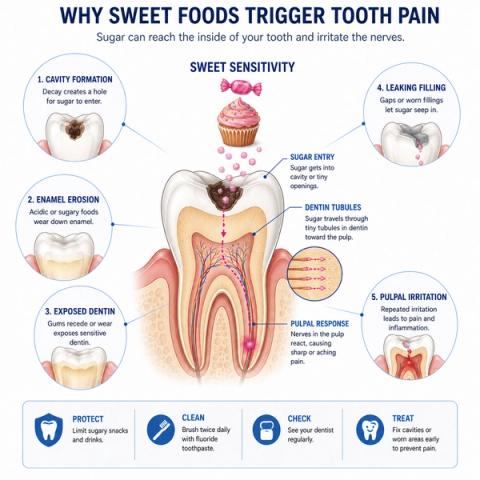
Sweet foods can cause tooth pain when cavities, enamel wear, exposed dentin, leaking fillings, cracks, or early irritation inside the tooth allow sugar to reach sensitive areas.
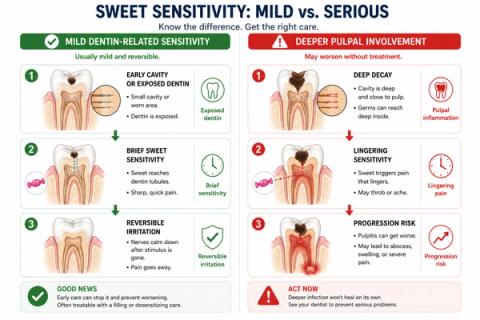
The discomfort is often brief and reversible, but worsening symptoms, lingering pain, or the addition of cold or heat sensitivity may suggest deeper involvement of the tooth.
Sweet sensitivity is often an early warning sign rather than a serious problem by itself.
Sweet foods should not normally cause tooth pain.
When sugar suddenly triggers discomfort, it often means that sensitive parts of the tooth have become exposed, irritated, or inflamed.
This can happen when:
- Protective enamel becomes thinner.
- Dentin becomes exposed.
- A cavity develops.
- A filling begins leaking.
- A crack develops in the tooth.
- The inner tissues of the tooth become irritated.
In many cases, sensitivity to sweets is one of the earliest signs that a tooth needs attention.
What matters most is not simply that sweets cause pain, but how the pain behaves and whether it is changing over time.
What Does Sweet Sensitivity Usually Mean?
Healthy teeth are normally protected from the effects of sugar.
When sweet foods begin causing discomfort, it often means that sensitive parts of the tooth have become exposed.
This may happen when:
- Enamel becomes thinner.
- Dentin becomes exposed.
- A cavity develops.
- A filling begins leaking.
- Inflammation affects the inner tissues of the tooth.
Patients commonly describe it as:
- "Chocolate makes my tooth hurt."
- "Candy causes a sharp pain."
- "Sugary drinks make one tooth sensitive."
- "My tooth only hurts when I eat sweets."
- "The pain goes away after I stop eating."
In many cases, sweet sensitivity is one of the earliest warning signs of a developing dental problem.
Why Do Sweet Foods Trigger Tooth Pain?
Several dental conditions can make a tooth react to sugary foods.
Common causes include:
- Cavities.
- Enamel erosion.
- Exposed root surfaces.
- Leaking fillings.
- Cracked teeth.
- Early irritation inside the tooth.
You may notice:
- Sharp discomfort while eating sweets.
- Brief pain after chocolate or candy.
- Sensitivity near a filling.
- Discomfort around a visible cavity.
- Symptoms that improve after rinsing or brushing.
Some cases remain stable and reversible for long periods.
However, symptoms that worsen, linger, or become associated with cold, heat, or chewing discomfort may suggest that the underlying problem is progressing.
Why the Pattern of Sweet Sensitivity Matters
The trigger itself is only part of the picture.
Dentists evaluate symptom duration, cavity activity, restoration condition, structural findings, and the response of the tooth together.
| Symptom Pattern | What It May Suggest |
|---|---|
| Brief pain from sweets | Exposed dentin |
| Pain near a filling | Possible filling leakage |
| Sweet sensitivity with cold sensitivity | Dentin or tooth nerve involvement |
| Lingering discomfort after sweets | Increasing irritation inside the tooth |
| Visible cavity present | Active tooth decay |
| Multiple teeth affected | Generalized dentin exposure |
| Worsening symptoms over time | Progressive disease process |
| Progressive disease process Sweet pain with chewing discomfort | Possible deeper structural problem |
One pattern deserves special attention:
Sensitivity to sweets that begins lasting longer than before or starts occurring with cold drinks as well.
This may suggest that irritation is extending beyond surface sensitivity and affecting deeper tissues inside the tooth.
What This Usually Means
Sweet sensitivity is often an early warning sign rather than a severe dental problem by itself.
Many cases are related to:
- Exposed dentin.
- Early tooth decay.
- Enamel wear.
- Leaking restorations.
- Root surface exposure.
Importantly:
- Not all sweet sensitivity means a root canal treatment is needed.
- Many cases remain reversible when identified early.
- Early treatment is often simpler than waiting for symptoms to worsen.
The goal is to identify the cause before deeper structural or nerve-related problems develop.
What Should You Do Right Now?
If sweet foods suddenly cause tooth pain:
- Pay attention to whether one tooth or several teeth are affected.
- Notice whether the pain stops immediately or lingers.
- Maintain good oral hygiene.
- Reduce frequent sugary snacks and drinks.
- Monitor for cold sensitivity or chewing discomfort.
- Arrange a dental evaluation if symptoms persist or worsen.
Changes in the pattern of symptoms often provide important clues about the underlying cause.
When Should You See a Dentist?
You should arrange an examination if:
- Sweet sensitivity develops suddenly.
- Symptoms worsen over time.
- Cold or heat sensitivity appears.
- Visible cavities or dark areas develop.
- Chewing discomfort occurs.
- Symptoms linger after eating sweets.
- Pain becomes more frequent.
- One tooth becomes increasingly sensitive.
A dentist may evaluate:
- Cavity activity.
- Enamel integrity.
- Existing restorations.
- Tooth vitality.
- Structural condition.
- Symptom behavior.
- X-ray findings.
Early evaluation may help prevent deeper involvement of the tooth.
What Are Dentists Learning About Sweet Sensitivity?
Dentists continue to improve their understanding of why sugary foods trigger pain in some teeth but not others.
Research is exploring the role of dentin tubules, enamel defects, tooth decay, restoration leakage, pulpal inflammation, and individual pain responses in the development of sweet sensitivity.
Advances in diagnostic imaging, vitality testing, restoration assessment, and AI-assisted diagnostic systems may help clinicians identify the source of sweet sensitivity more accurately and predict which cases are more likely to progress.
Related questions
Clinical interpretation
What this means from a clinical perspective.
This patient explanation is supported by a detailed professional review that examines:
- Sweet-induced tooth pain.
- Dentin hypersensitivity.
- Dental caries and restoration leakage.
- Pulpal inflammation.
- Differential diagnosis of sweet sensitivity.
- Vitality testing and diagnostic evaluation.
- Emerging research and AI-assisted diagnostic support.
Related Professional Topics
Key terms
Dentin
Dentin is the layer beneath enamel. It contains tiny channels that can transmit sensations toward the nerve inside the tooth.
Dentin Hypersensitivity
Dentin hypersensitivity occurs when exposed dentin reacts to temperature changes, touch, air, or certain foods and drinks.
Tooth Decay
Tooth decay is a disease process in which bacteria and acids gradually damage tooth structure, potentially leading to cavities and sensitivity.
Enamel Erosion
Enamel erosion occurs when acids gradually wear away the outer protective layer of the tooth.
Leaking Filling
A leaking filling occurs when gaps develop between a restoration and the tooth, allowing irritants to reach sensitive areas.
Tooth Nerve
The tooth nerve is part of the soft tissue inside the tooth that contains nerves and blood vessels. Irritation of this tissue may contribute to sensitivity and tooth pain.
CoTreat is building the AI colleague for dentists.
CoTreat makes it easy to go above and beyond for your patient. An AI that supports you in clinic.