
Will My Tooth Sensitivity Turn Into Tooth Pain?



Yes, some tooth sensitivity can progress to tooth pain if the underlying cause continues to irritate the tooth.
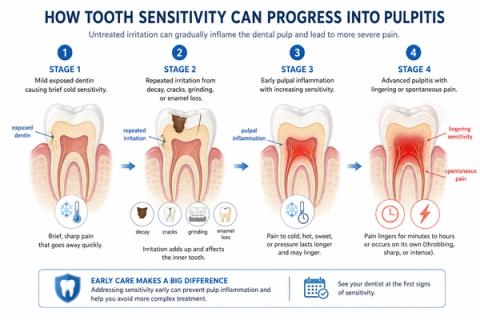
Decay, cracks, grinding, leaking fillings, exposed roots, worn enamel, or ongoing bacterial exposure can gradually increase inflammation inside the tooth. However, many sensitive teeth remain stable when the cause is identified and treated early.
Some forms of tooth sensitivity can eventually lead to tooth pain if the source of irritation continues or worsens.
Repeated irritation from tooth decay, cracks, grinding, exposed roots, worn enamel, leaking fillings, or bacterial leakage can gradually increase inflammation inside the tooth. Over time, a tooth that was once only sensitive to cold or sweets may begin reacting more strongly or more frequently.
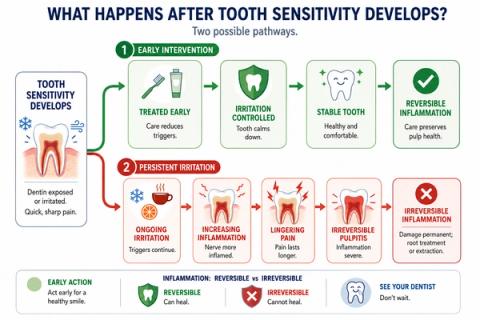
However, most sensitive teeth do not automatically become serious problems. When the underlying cause is identified and managed early, sensitivity often stabilizes and may even improve.
Common causes of progressing sensitivity include:
- Untreated tooth decay.
- Developing cracks.
- Tooth grinding or clenching.
- Worn enamel.
- Exposed root surfaces.
- Leaking or failing restorations.
- Ongoing bacterial irritation.
What matters most is not simply whether the tooth is sensitive, but whether the pattern of symptoms is changing over time.
What Does Tooth Sensitivity Usually Mean?
Tooth sensitivity and tooth pain are related, but they are not the same thing.
Sensitivity usually occurs when the protective layers of the tooth become thinner, damaged, or exposed. This allows temperature changes, sweet foods, air, or touch to affect the tooth more easily.
Patients commonly describe it as:
- "My tooth hurts when I drink cold water."
- "Cold air suddenly bothers my tooth."
- "My tooth feels sensitive to sweets."
- "One tooth reacts to cold more than the others."
- "My tooth became sensitive after a filling."
- "My sensitivity seems to be getting worse."
This often happens when:
- Dentin becomes exposed.
- Enamel wears down.
- Gums recede and expose the root surface.
- A crack develops within the tooth.
- The nerve inside the tooth becomes more reactive.
Sensitivity is usually brief and only occurs when something triggers it. Tooth pain is often less predictable and may occur even without an obvious trigger.
What Happens When Sensitivity Becomes More Painful?
A sensitive tooth may become more painful when irritation continues over time.
As the tooth experiences ongoing stress or irritation, the nerve inside the tooth may become increasingly inflamed.
This can happen because of:
- Untreated tooth decay.
- Progressing cracks.
- Grinding or clenching habits.
- Leaking restorations.
- Ongoing bacterial exposure.
- Increasing structural damage.
As irritation persists, you may notice changes such as:
- Sensitivity becoming more frequent.
- Cold sensitivity lasting longer.
- Increasing discomfort.
- Heat sensitivity developing.
- Pain becoming less predictable.
- Occasional spontaneous toothache.
Importantly, not all sensitivity progresses this way. Many sensitive teeth remain stable for years when the underlying cause is addressed.
Why the Pattern of Symptoms Matters
| Symptom Pattern | What It May Suggest |
|---|---|
| Brief cold sensitivity | Surface sensitivity or exposed dentin |
| Sensitivity that resolves quickly | Mild irritation |
| Cold sensitivity that lingers | Increasing inflammation inside the tooth |
| Heat sensitivity | Deeper involvement of the tooth nerve |
| Spontaneous pain | More advanced irritation |
| Symptoms becoming more frequent | Progressive disease process |
| Pain that wakes you at night | Greater concern for nerve inflammation |
| Stable sensitivity over time | Often lower risk of progression |
One pattern deserves particular attention:
Sensitivity that starts lingering longer than before.
A tooth that initially reacts for only a second or two but gradually remains sensitive for longer periods may be showing signs of increasing inflammation inside the tooth.
The addition of heat sensitivity may also suggest that the problem is becoming more advanced.
What This Usually Means
Most sensitive teeth do not automatically turn into severe toothaches.
Many remain stable when the underlying cause is identified and managed appropriately.
For example:
- Exposed root surfaces can often be protected.
- Enamel wear can be managed.
- Desensitizing treatments may reduce symptoms.
- Cracks can sometimes be stabilized.
- Early tooth decay can often be treated before deeper damage develops.
The greatest risk occurs when the source of irritation remains active for a prolonged period.
Early intervention generally provides the best opportunity to prevent progression and preserve the health of the tooth.
What Should You Do Right Now?
If you have tooth sensitivity:
- Pay attention to whether symptoms are changing.
- Notice if sensitivity lasts longer than it used to.
- Observe whether hot drinks begin causing discomfort.
- Avoid excessive force from chewing hard foods.
- Use desensitizing products if recommended by your dentist.
- Maintain good oral hygiene.
- Arrange a dental evaluation if symptoms persist or worsen.
Changes in symptom behavior are often more important than the intensity of the sensitivity itself.
When Should You See a Dentist?
You should arrange an examination if:
- Sensitivity starts lasting longer than before.
- Symptoms become more frequent.
- Hot drinks begin causing pain.
- Spontaneous pain develops.
- Chewing becomes uncomfortable.
- One tooth becomes increasingly sensitive.
- Symptoms wake you from sleep.
- Sensitivity continues despite desensitizing products.
A dentist may evaluate:
- The tooth's response to cold and heat.
- The health of the tooth nerve.
- Possible cracks.
- Existing restorations.
- Structural integrity.
- Symptom progression.
- X-ray findings.
Persistent changes in sensitivity may indicate that the tooth requires closer attention.
What Are Dentists Learning About the Progression of Tooth Sensitivity?
Dentists are becoming better at identifying which sensitive teeth are likely to remain stable and which are more likely to progress toward deeper inflammation.
Research is improving our understanding of how cracks, bacterial leakage, nerve inflammation, and structural stress contribute to symptom progression.
New diagnostic approaches, advanced imaging technologies, pulp vitality assessment methods, and AI-assisted decision-support systems may help clinicians identify higher-risk teeth earlier and more consistently than in the past.
Related questions
Clinical interpretation
What this means from a clinical perspective.
This patient explanation is supported by a detailed professional review that examines:
- Progression from tooth sensitivity to tooth pain.
- Pulpal inflammation and symptom evolution.
- Reversible and irreversible pulpal disease.
- Structural causes of increasing sensitivity.
- Crack-related symptoms.
- Diagnostic testing and prognosis.
Related Professional Topics
Key terms
Tooth Sensitivity
Tooth sensitivity is a painful or uncomfortable reaction to cold, heat, sweets, air, touch, or pressure. It often occurs when protective tooth structures become thinner or exposed.
Dentin
Dentin is the layer beneath the enamel. It contains tiny channels that can transmit sensations to the nerve inside the tooth when exposed.
Enamel Wear
Enamel wear occurs when the outer protective layer of the tooth gradually becomes thinner, making the tooth more vulnerable to sensitivity.
Exposed Root Surface
An exposed root surface occurs when the gumline recedes and reveals part of the tooth root. Root surfaces are often more sensitive than enamel-covered areas.
Tooth Nerve
The tooth nerve is part of the soft tissue inside the tooth that contains nerves and blood vessels. Increasing irritation of this tissue can sometimes cause sensitivity to progress toward pain.
Tooth Crack
A tooth crack is a small fracture within a tooth. Some cracks cause sensitivity that gradually becomes more frequent or painful over time.
CoTreat is building the AI colleague for dentists.
CoTreat makes it easy to go above and beyond for your patient. An AI that supports you in clinic.