
What Are the First Signs of a Cavity?



Early signs of tooth decay may include white chalky spots, brown or dark discoloration, mild cold sensitivity, sensitivity to sweets, rough or catching areas, food trapping between teeth, and occasional mild chewing discomfort.
Many early cavities cause no pain and are found during routine dental checkups.
Pain is often a late finding in tooth decay.
Tooth decay often begins silently long before severe pain develops.
Many people expect a cavity to cause immediate pain, but the earliest stages of tooth decay frequently produce little or no discomfort. In fact, many cavities are discovered during routine dental examinations before patients notice any symptoms at all.
Common early signs include:
- White chalky spots on teeth.
- Brown or dark discoloration.
- Mild sensitivity to cold foods or drinks.
- Sensitivity to sweets.
- Food trapping between teeth.
- Rough areas on the tooth surface.
- Occasional mild chewing discomfort.
What matters most is not whether a tooth hurts, but whether changes are occurring in the tooth structure.
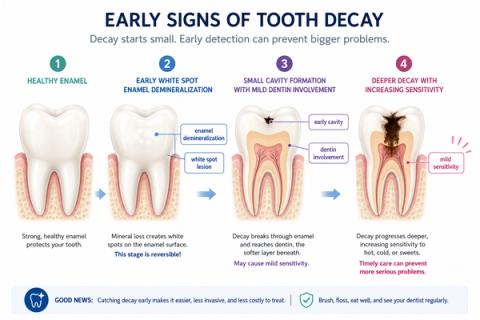
What Do Early Signs of Tooth Decay Usually Mean?
Tooth decay usually starts gradually.
The earliest changes often affect the minerals within the enamel before deeper structural breakdown occurs.
Because enamel does not contain nerves, these early stages frequently cause little or no discomfort.
Many people are surprised to learn they have tooth decay because:
- The tooth does not hurt.
- Chewing feels normal.
- There is no visible hole.
- Daily activities remain unaffected.
This is one reason routine dental examinations remain important.
Early decay is often easier to manage before deeper tooth structures become involved.
What Do the First Signs of a Cavity Look Like?
Early tooth decay can appear in several different ways.
You may notice:
- White chalky spots on a tooth.
- Brown or dark discoloration.
- Mild cold sensitivity.
- Sensitivity to sweets.
- Rough or catching areas.
- Food trapping between teeth.
- Occasional mild chewing discomfort.
Patients commonly describe it as:
- "I noticed a white spot on my tooth."
- "My tooth feels rough in one area."
- "Cold drinks bother one tooth slightly."
- "Food keeps getting stuck in the same place."
- "I have a dark spot but no pain."
- "My tooth feels different, but it doesn't hurt."
Not all discoloration represents active decay, and not all early decay produces symptoms.
Why the Pattern of Changes Matters
Pain is often a late finding in tooth decay.
For this reason, dentists evaluate changes in tooth structure and lesion activity rather than waiting for symptoms to appear.
| Early Sign | What It May Suggest |
|---|---|
| White chalky spot | Early mineral loss |
| Brown discoloration | Possible lesion progression |
| Rough surface | Surface breakdown |
| Food trapping | Structural change |
| Mild cold sensitivity | Dentin involvement may be developing |
| Sweet sensitivity | Early decay activity |
| No symptoms | Early decay may still be present |
| Increasing sensitivity | Increased progression risk |
One pattern deserves special attention:
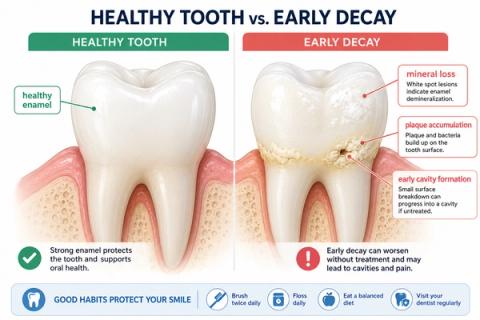
White chalky spots near the gumline or between teeth.
These are often among the earliest visible signs of enamel mineral loss and may appear before a cavity forms.
The absence of pain does not necessarily mean the absence of decay.
What This Usually Means
Early tooth decay does not always progress rapidly.
Some early lesions may:
- Remain stable.
- Re-mineralize.
- Stop progressing when risk factors improve.
Others may continue advancing deeper into the tooth.
The earlier decay is identified, the greater the opportunity for preventive and minimally invasive treatment.
This is one reason dentists aim to detect tooth decay before pain develops.
What Should You Do Right Now?
If you notice possible early signs of a cavity:
- Maintain good oral hygiene.
- Reduce frequent sugar exposure.
- Pay attention to new sensitivity.
- Monitor changes in discoloration.
- Avoid ignoring food trapping that repeatedly occurs in the same area.
- Arrange a dental examination if changes persist.
Early evaluation often provides more treatment options and may help prevent progression.
When Should You See a Dentist?
You should arrange an examination if:
- New discoloration appears.
- Sensitivity develops.
- Food repeatedly traps in one area.
- Rough spots are noticed on teeth.
- Chewing discomfort occurs.
- Existing fillings appear to be changing.
- A visible hole develops.
- Symptoms gradually worsen.
A dentist may evaluate:
- Lesion activity.
- Cavity depth.
- Risk to the tooth nerve.
- Structural stability.
- X-ray findings.
- Overall cavity risk.
Early treatment often helps preserve more natural tooth structure.
What Are Dentists Learning About Early Tooth Decay?
Dentists are increasingly focusing on detecting tooth decay before cavities become large enough to require extensive treatment.
Research continues to improve understanding of enamel demineralization, lesion activity, cavity progression, and factors that determine whether an early lesion remains stable or continues advancing.
Advanced imaging systems, fluorescence-based technologies, caries-risk assessment tools, and AI-assisted diagnostic systems may help clinicians identify early tooth decay more accurately and consistently than in the past.
Researchers are also studying how early intervention and remineralization strategies may reduce the need for more invasive treatment.
Related questions
Clinical interpretation
What this means from a clinical perspective.
This patient explanation is supported by a detailed professional review that examines:
- Early dental caries detection.
- Enamel demineralization.
- White spot lesions.
- Lesion activity assessment.
- Caries progression and risk evaluation.
- Diagnostic imaging and examination.
- Emerging research and AI-assisted caries detection.
Related Professional Topics
Key terms
Cavity
A cavity is an area of tooth structure that has been damaged by tooth decay.
Tooth Decay
Tooth decay is a disease process in which bacteria and acids gradually damage the tooth.
Enamel
Enamel is the hard outer layer of the tooth. Early decay often begins here before deeper structures become involved.
White Spot Lesion
A white spot lesion is an early sign of mineral loss from enamel. It may appear as a chalky white area on the tooth surface.
Demineralization
Demineralization occurs when minerals are lost from enamel, making the tooth more vulnerable to decay.
Re-mineralization
Re-mineralization is the process of restoring minerals back into weakened enamel, helping to strengthen the tooth and potentially slow or stop early decay.
CoTreat is building the AI colleague for dentists.
CoTreat makes it easy to go above and beyond for your patient. An AI that supports you in clinic.