
When Does a Cavity Start Hurting?



A cavity often starts causing symptoms when decay reaches the dentin layer beneath the enamel or when irritation begins affecting the living tissues inside the tooth.
As a cavity gets deeper, sensitivity and pain become more likely. However, cavity size and pain do not always match perfectly. Some small cavities are sensitive, while some deep cavities remain painless.
A cavity does not need to reach the nerve before it can cause sensitivity or discomfort.
Many cavities begin silently and cause no symptoms at all. However, as decay progresses deeper into the tooth, it becomes more likely to trigger sensitivity to cold, sweets, chewing pressure, or eventually tooth pain.
Small cavities can sometimes be surprisingly sensitive, while some deep cavities remain completely painless.
Common factors that influence whether a cavity hurts include:
- How deep the decay has progressed.
- Whether dentin has become involved.
- The location of the cavity.
- The condition of the tooth nerve.
- How quickly the decay is progressing.
- Individual differences in sensitivity.
What matters most is not simply the size of the cavity, but how the tooth responds as the decay progresses.
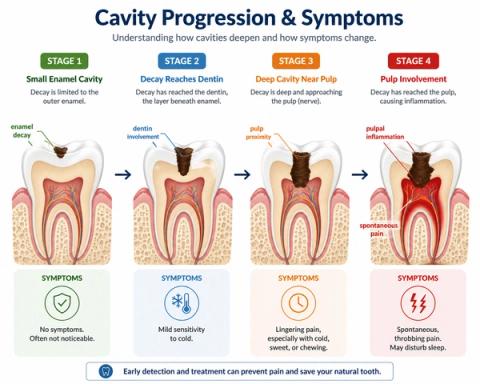
What Does Cavity Pain Usually Mean?
Cavities usually begin in the outer enamel layer of the tooth.
Early enamel decay often causes no symptoms because enamel does not contain nerves.
As the cavity grows deeper, it may reach the dentin beneath the enamel. Dentin contains tiny channels that communicate more closely with the nerve inside the tooth.
Because of this, deeper cavities are more likely to cause:
- Cold sensitivity.
- Sweet sensitivity.
- Brief discomfort.
- Intermittent tooth pain.
- Increased sensitivity during eating or drinking.
Patients commonly describe it as:
- "My cavity hurts when I drink cold water."
- "Sweets suddenly hurt my tooth."
- "I have a cavity but no pain."
- "My tooth only hurts sometimes."
- "The pain comes and goes."
- "My cavity is getting more sensitive."
The presence or absence of pain does not always indicate how serious the cavity is.
What Happens as a Cavity Gets Deeper?
As decay progresses deeper into the tooth, the risk of irritation increases.
In the early stages, you may notice:
- No symptoms at all.
- Mild sensitivity.
- Occasional discomfort.
As decay advances further, you may experience:
- Stronger cold sensitivity.
- Sweet sensitivity.
- Chewing discomfort.
- Lingering sensitivity.
- More frequent pain.
If irritation continues, inflammation inside the tooth may gradually increase and symptoms can become more noticeable.
However, cavity depth and pain do not always follow the same pattern.
Some deep cavities remain surprisingly painless, while smaller cavities in sensitive locations may cause significant discomfort.
This is one reason why dentists rely on both symptoms and clinical examination when assessing tooth decay.
Why the Pattern of Pain Matters
| Pain Pattern | What It May Suggest |
|---|---|
| No symptoms | Early decay or slow progression |
| Cold sensitivity | Decay involving dentin |
| Sweet sensitivity | Active decay or exposed dentin |
| Brief discomfort | Mild irritation |
| Lingering sensitivity | Increasing inflammation inside the tooth |
| Chewing discomfort | Deeper structural involvement |
| Pain that wakes you at night | Greater concern for advanced disease |
| Spontaneous toothache | Significant involvement of the tooth nerve |
One pattern deserves special attention:
Sensitivity that lingers after cold foods or drinks are removed.
Lingering sensitivity may suggest that irritation is extending beyond simple surface sensitivity and affecting the deeper tissues inside the tooth.
Spontaneous pain is another important warning sign because it often indicates more advanced involvement.
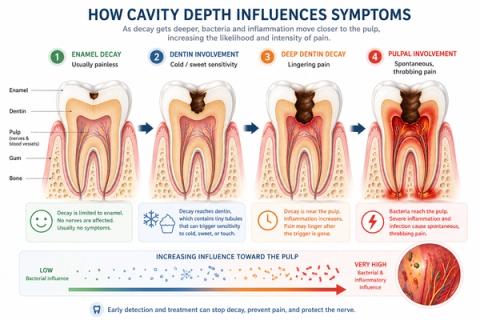
What This Usually Means
A cavity does not need to reach the nerve before symptoms begin.
As decay moves deeper, the likelihood of sensitivity and pain generally increases.
However:
- Small cavities can sometimes be sensitive.
- Deep cavities can sometimes remain painless.
- Pain does not always reflect the true depth of decay.
- The absence of pain does not mean the cavity is harmless.
Many patients assume that a painless cavity is not serious, but some advanced cavities remain symptom-free until substantial damage has already occurred.
The safest approach is to identify and treat decay before symptoms become severe.
What Should You Do Right Now?
If you think you may have a cavity:
- Maintain good oral hygiene.
- Avoid frequently consuming sugary foods and drinks.
- Pay attention to increasing sensitivity.
- Notice whether symptoms occur with cold, sweets, or chewing.
- Monitor whether discomfort is becoming more frequent.
- Arrange a dental examination if symptoms develop or worsen.
Even if a cavity does not hurt, it may still require treatment.
When Should You See a Dentist?
You should arrange an examination if:
- Sensitivity is increasing.
- Pain lingers after cold foods or drinks.
- Sweets repeatedly trigger discomfort.
- Chewing becomes uncomfortable.
- Food repeatedly gets trapped in one area.
- A visible dark area or hole develops.
- Spontaneous pain occurs.
- Toothache begins disturbing sleep.
A dentist may evaluate:
- The depth of the decay.
- The health of the tooth nerve.
- Structural integrity.
- Whether the tooth can still be restored.
- X-ray findings.
- Symptom progression.
Early treatment often prevents more extensive treatment later.
What Are Dentists Learning About Cavity Pain?
Dentists are becoming better at understanding why some cavities cause significant symptoms while others remain painless despite substantial decay.
Research suggests that cavity depth is only one factor influencing symptoms. The location of the cavity, the rate of progression, bacterial activity, dentin involvement, and the response of the tooth nerve all appear to play important roles.
Advanced imaging methods, improved caries-risk assessment, pulp vitality testing, and AI-assisted diagnostic systems may help clinicians predict which cavities are most likely to progress toward pain and pulpal disease.
Related questions
Clinical interpretation
What this means from a clinical perspective.
This patient explanation is supported by a detailed professional review that examines:
- Caries progression and symptom development.
- Dentin involvement.
- Pulpal inflammation.
- Why cavity depth and pain do not always correlate.
- Risk assessment and prognosis.
- Diagnostic testing and imaging.
- Emerging research and AI-assisted caries evaluation.
Related Professional Topics
Key terms
Cavity
A cavity is an area of tooth decay caused by the gradual breakdown of tooth structure. Cavities often begin silently before symptoms develop.
Enamel
Enamel is the hard outer layer of the tooth. Because enamel contains no nerves, early enamel decay often causes no pain.
Dentin
Dentin is the layer beneath the enamel. It contains tiny channels that can transmit sensations toward the nerve inside the tooth.
Tooth Decay
Tooth decay is the process by which bacteria and acids gradually damage tooth structure, leading to cavities.
Tooth Nerve
The tooth nerve is part of the soft tissue inside the tooth that contains nerves and blood vessels. Increasing irritation of this tissue can eventually cause tooth pain.
Lingering Sensitivity
Lingering sensitivity is discomfort that continues after a cold or sweet trigger is removed. It may indicate increasing irritation within the tooth.
CoTreat is building the AI colleague for dentists.
CoTreat makes it easy to go above and beyond for your patient. An AI that supports you in clinic.