
Can Stress Cause Tooth Pain?



Yes, stress can make your teeth hurt.
Most often, this happens because stress causes clenching, grinding, tight jaw muscles, or increased awareness of pain. These changes can place extra pressure on teeth and supporting tissues, leading to soreness, sensitivity, or discomfort.
Stress may also worsen symptoms from an already irritated tooth or a cracked tooth.
Yes, stress can sometimes contribute to tooth pain, but usually indirectly.
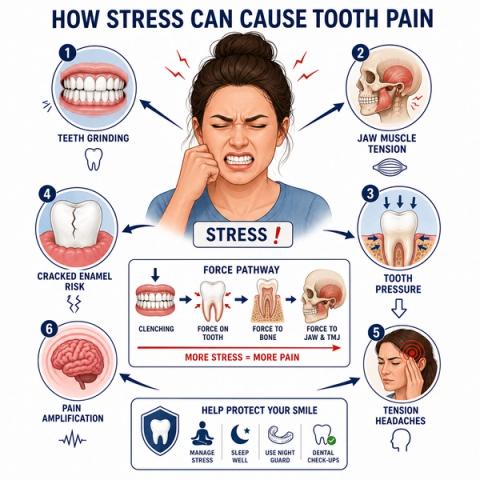
Stress does not directly cause cavities or infection. Instead, it may lead to clenching, grinding, muscle tension, jaw fatigue, and increased sensitivity to pain. These effects can create pressure on the teeth, supporting tissues, and jaw muscles that feels very similar to a dental problem.
Stress can also make existing tooth problems feel worse.
How Can Stress Affect Teeth and Jaw Pain?
Stress can affect the mouth and jaw in several ways.
Some people unconsciously:
- Clench their teeth
- Grind their teeth during sleep
- Tighten their jaw muscles
- Place excessive pressure on certain teeth
Over time, this may create:
- Tooth soreness
- Pressure sensitivity
- Jaw discomfort
- Headaches
- Fatigue while chewing or biting
- Irritation of vulnerable teeth
People often describe it as:
- "My teeth feel sore in the morning."
- "My jaw feels tight."
- "The pain seems to move between teeth."
- "Chewing feels tiring."
- "My teeth feel sensitive but nothing looks wrong."
- "Stress seems to make everything worse."
What Happens During Stress-Related Tooth Pain?
Stress itself does not directly cause:
- Cavities
- Tooth infection
- Tooth decay
However, stress-related clenching and grinding can place repeated force on:
- Teeth
- Supporting tissues
- Jaw muscles
- Existing restorations
- Small structural weaknesses
People may notice:
- Pressure sensitivity
- Jaw fatigue
- Tooth soreness
- Morning discomfort
- Headaches
- Pain that shifts location
Stress can also increase how strongly the brain perceives pain, making existing symptoms feel more intense.
Why the Pattern of Pain Matters
| Pain Pattern | What It May Suggest |
|---|---|
| Morning tooth soreness | Night grinding or clenching |
| Jaw tightness or fatigue | Muscle overactivity |
| Pain shifting between teeth | Muscle-related discomfort |
| Pain during chewing or biting | Pressure-related overload |
| Worn or flattened teeth | Long-term grinding |
| Sharp pain in one tooth | Possible cracked tooth or local tooth problem |
| Lingering cold sensitivity | Inflammation inside the tooth |
| Pain that worsens during stressful periods | Stress-related contribution |
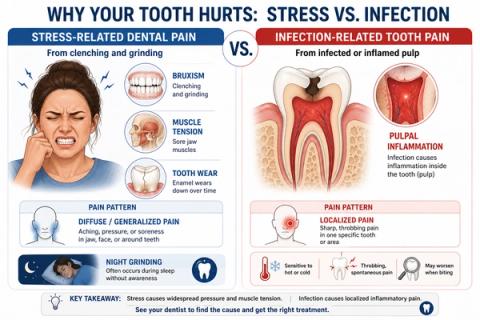
Stress-related pain often behaves differently from inflammation inside a single tooth.
Instead of remaining in one location, symptoms may shift, fluctuate, or involve multiple teeth and jaw muscles.
The overall pattern often provides more clues than the intensity of the pain.
What This Usually Means
Stress-related tooth pain is often:
- Pressure-related
- Muscle-related
- Bite-force related
- Sensitivity-related
Rather than directly caused by infection.
However, persistent tooth pain should never automatically be dismissed as "just stress."
Stress may:
- Worsen symptoms from inflamed teeth
- Increase discomfort from a cracked tooth
- Make existing sensitivity more noticeable
- Amplify underlying dental problems
The important question is not simply:
"Am I stressed?"
But rather:
"What is actually producing the pain?"
What Should You Do Right Now?
If you think stress may be contributing to tooth pain:
- Pay attention to clenching or grinding habits.
- Notice whether symptoms are worse in the morning.
- Observe whether stressful periods make symptoms worse.
- Avoid chewing excessively hard foods.
- Maintain good oral hygiene.
- Arrange a dental evaluation if symptoms continue.
These observations can help identify whether stress may be contributing to the problem.
When Should You See a Dentist?
You should arrange an examination if:
- Tooth soreness keeps returning.
- Jaw tightness develops regularly.
- Headaches occur alongside tooth discomfort.
- Chewing or biting becomes uncomfortable.
- Teeth appear worn or chipped.
- Pain persists or worsens over time.
- One specific tooth repeatedly hurts.
Stress-related habits can sometimes contribute to structural damage if left unchecked.
What Are Dentists Learning About Stress and Tooth Pain?
Dentists are learning more about how stress affects the teeth, jaw muscles, and pain perception.
Research suggests that clenching, grinding, poor sleep, and heightened pain sensitivity may all contribute to dental discomfort. Advances in bite analysis, muscle assessment, sleep research, and AI-assisted diagnostics may help identify stress-related contributors more accurately than in the past.
Related questions
Clinical interpretation
What this means from a clinical perspective.
This patient explanation is supported by a detailed professional review that examines:
- Bruxism and clenching
- Occlusal overload
- Myofascial pain
- Differential diagnosis
- Structural damage from grinding
- Diagnostic evaluation
Key terms
Bruxism
Bruxism is the habit of clenching or grinding the teeth, often during sleep or stressful periods.
Clenching
Clenching occurs when the upper and lower teeth are pressed together with excessive force.
Jaw Muscles
The jaw muscles control chewing and biting. Overuse or tension can sometimes cause pain that feels like tooth pain.
Occlusal Overload
Occlusal overload occurs when excessive biting forces are placed on teeth and supporting tissues.
Pain Amplification
Pain amplification refers to increased awareness or sensitivity to discomfort, making symptoms feel more noticeable than they otherwise would.
CoTreat is building the AI colleague for dentists.
CoTreat makes it easy to go above and beyond for your patient. An AI that supports you in clinic.