
How to Differentiate Tooth Pain vs Gum Pain?



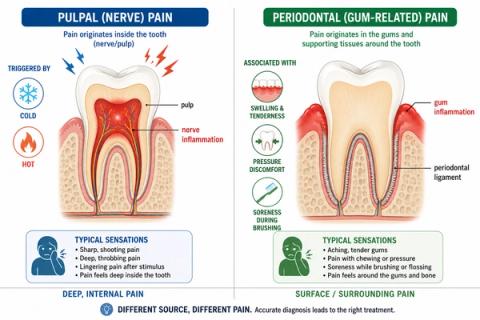
Tooth nerve pain usually feels deep, sharp, responsive to hot or cold, throbbing, or comes on without a clear trigger. Gum-related pain more often feels like soreness, swelling, pressure, tenderness, or discomfort around the gums and supporting tissues.
The key difference is not just location but behavior. Nerve pain is often temperature-sensitive or spontaneous, while gum pain is more commonly associated with pressure, swelling, bleeding, or chewing discomfort.
Tooth nerve pain usually feels deeper, sharper, temperature-sensitive, throbbing, or spontaneous, while gum-related pain is more commonly associated with soreness, swelling, pressure, or tenderness around the gums and supporting tissues.
The difference often depends more on how the pain behaves than where it is felt. Some conditions can also involve both the tooth nerve and surrounding gums at the same time.
Not all tooth pain comes from the tooth nerve itself. The pattern, trigger, and location of pain often provide useful clues about whether the source is inside the tooth or around it.
What Does Tooth Nerve Pain Usually Feel Like?
Tooth nerve pain usually comes from irritation or inflammation inside the tooth.
People often describe it as:
- "A deep throbbing toothache."
- "Sharp pain with cold drinks."
- "Pain that lingers after eating or drinking."
- "A toothache that wakes me at night."
- "Pain that is hard to pinpoint exactly."
- "Sudden pain without an obvious cause."
Nerve-related pain often becomes worse with:
- Cold sensitivity
- Hot foods or drinks
- Pressure
- Progressing inflammation inside the tooth
This type of pain may linger after the trigger is gone or may occur without an obvious trigger.
What Does Gum-Related Pain Usually Feel Like?
Gum-related pain usually comes from the tissues surrounding and supporting the tooth.
People often describe it as:
- "My gums feel sore around the tooth."
- "The area feels swollen."
- "The tooth feels bruised when I bite."
- "The gums bleed when I brush."
- "There is pressure around the tooth."
- "I can point exactly where it hurts."
Gum-related pain is more commonly associated with:
- Swelling
- Tenderness
- Bleeding
- Pressure
- Discomfort during chewing or biting
This type of pain is often easier to locate because it tends to stay close to the gums or supporting tissues.
Why the Pattern of Pain Matters
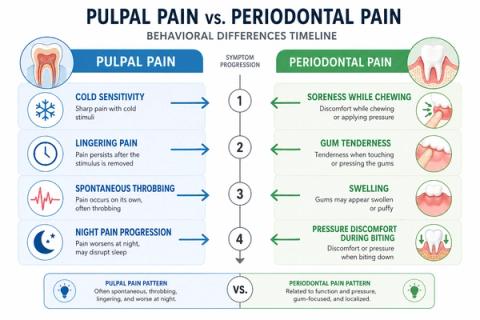
| Pain Pattern | What It May Suggest |
|---|---|
| Sharp pain to cold | Cold sensitivity related nerve irritation |
| Lingering sensitivity | Inflammation inside the tooth |
| Spontaneous tooth throbbing | Deeper nerve irritation |
| Pain that worsens at night | Increasing inflammation |
| Pain during chewing or biting | Pressure-related irritation around the tooth |
| Swelling around the gums | Gum-related inflammation |
| Bleeding with tenderness | Possible gum disease |
| Pain that is difficult to locate | Nerve-related pain referral |
| Pain that is easy to pinpoint | Gum-related irritation |
Symptoms sometimes overlap.
A tooth problem can irritate the surrounding gums, and gum disease can sometimes make a tooth feel painful.
This is why dentists focus on the overall pattern rather than any single symptom.
What This Usually Means
Pain location alone does not always identify the source of the problem.
For example:
- Nerve pain may feel deep, diffuse, or difficult to locate.
- Gum-related pain is often easier to pinpoint near the gumline.
- A tooth with nerve inflammation may cause pain that seems to spread to nearby teeth.
- Gum inflammation may create tenderness that feels pressure-related rather than temperature-related.
Sometimes both the tooth and surrounding gums become inflamed at the same time, creating mixed symptoms that are difficult to interpret without an examination.
Because of this, the overall pattern of symptoms is often more useful than the location of the pain alone.
What Should You Do Right Now?
If you are unsure whether the pain comes from the tooth or the gums:
- Pay attention to whether hot or cold triggers symptoms.
- Look for swelling or bleeding around the gums.
- Notice whether chewing or biting causes discomfort.
- Avoid repeatedly testing the painful area.
- Maintain good oral hygiene.
- Arrange a dental evaluation if symptoms continue.
These observations can help identify the source of the problem more quickly.
When Should You See a Dentist?
You should arrange an examination if:
- Pain becomes persistent.
- Swelling develops.
- Gums bleed repeatedly.
- Cold sensitivity lingers.
- Chewing or biting becomes uncomfortable.
- Pain wakes you from sleep.
- The source of the pain is difficult to identify.
Different causes of pain often require very different treatments, so persistent symptoms should not be ignored.
What Are Dentists Learning About Tooth Pain vs Gum Pain?
Dentists are learning more about how pain patterns can help distinguish problems inside the tooth from problems affecting the gums and supporting tissues.
Research continues to improve our understanding of how different tissues generate pain and how symptoms overlap. Advances in imaging, vitality testing, periodontal assessment, and AI-assisted diagnostic tools may help identify the source of pain earlier and more accurately than in the past.
Related questions
Clinical interpretation
What this means from a clinical perspective.
This patient explanation is supported by a detailed professional review that examines:
- Pulpal versus periodontal pain
- Differential diagnosis
- Referred pain patterns
- Vitality assessment
- Periodontal evaluation
- Diagnostic testing
Related Professional Topics
Key terms
Dental Pulp
The dental pulp is the soft tissue inside the tooth that contains nerves and blood vessels. Inflammation of this tissue can cause deep, temperature-sensitive tooth pain.
Periodontal Tissues
Periodontal tissues are the gums, ligament, and supporting bone surrounding a tooth. Problems affecting these tissues often cause soreness, tenderness, or pressure around the tooth.
Lingering Sensitivity
Lingering sensitivity is pain that continues after a hot, cold, or sweet trigger has been removed. It may indicate inflammation inside the tooth.
Referred Pain
Referred pain occurs when discomfort seems to come from a different location than the actual source of the problem.
Gingivitis
Gingivitis is inflammation of the gums that may cause redness, tenderness, swelling, and bleeding.
CoTreat is building the AI colleague for dentists.
CoTreat makes it easy to go above and beyond for your patient. An AI that supports you in clinic.