
How Many Appointments Does Root Canal Treatment Need?



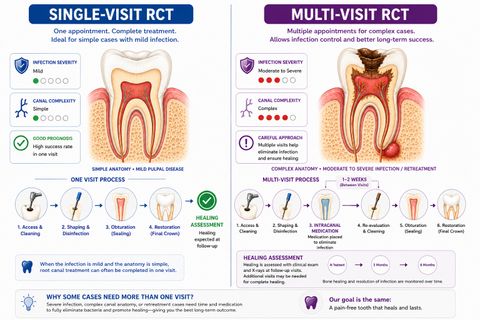
Root canal treatment may sometimes be completed in one appointment, while other cases require multiple visits.
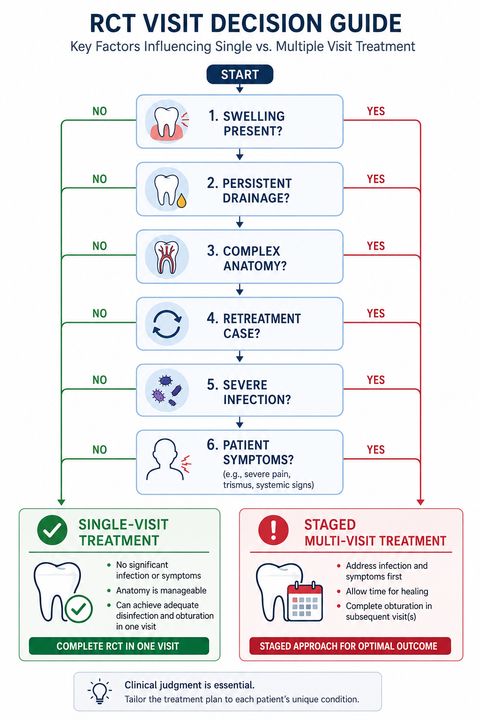
The number of appointments depends on factors such as:
- The amount of infection present.
- Whether swelling or drainage is present.
- The complexity of the root canal system.
- Whether the tooth has been treated before.
- How the tooth responds during treatment.
More appointments do not automatically mean the tooth is worse, and fewer appointments do not automatically mean the treatment is simpler.
The number of appointments needed for root canal treatment is not fixed. It depends on the condition of the tooth, whether infection is present, how complex the root canals are, and how the tooth responds during treatment.
Some teeth can be treated in a single visit, while others need two or more appointments.
Many people assume that needing multiple appointments means the tooth is in very poor condition. That is not always true. Likewise, a tooth treated in one visit is not automatically a simpler case. The treatment plan is based on what gives the tooth the best chance of healing successfully.
Can Root Canal Treatment Be Done in One Visit?
Yes.
Some root canal treatments can be completed in a single appointment, especially when:
- Infection is limited.
- Symptoms are relatively stable.
- The root canal system can be cleaned and disinfected predictably.
- The tooth can be sealed safely during the same visit.
Many patients are surprised to learn that some teeth need only one appointment while others require more.
This difference does not necessarily mean one tooth is healthier than another. It often reflects the specific challenges of that individual tooth.
Why Do Some Teeth Need More Than One Appointment?
Some teeth require additional visits because the dentist wants to improve infection control, allow symptoms to settle, or manage a more complex situation.
Multiple appointments may be recommended when:
- Infection is extensive.
- Swelling is present.
- Drainage continues from the tooth.
- The root canal anatomy is unusually complex.
- Previous root canal treatment has failed.
- Medication placed inside the tooth may improve healing.
Additional appointments sometimes allow the dentist to reassess the tooth before completing treatment.
Why the Number of Appointments Matters
| Situation | More Likely One Visit | More Likely Multiple Visits |
|---|---|---|
| Infection severity | Lower | Higher |
| Swelling or drainage | Minimal | Persistent |
| Root canal anatomy | Simpler | More complex |
| Previous root canal treatment | Less common | More common |
| Ability to disinfect canals | Higher | Reduced |
| Symptom stability | Stable | Unstable |
One point deserves special attention:
A tooth requiring multiple appointments is not automatically a more serious case. Sometimes the dentist simply wants additional time to improve cleaning, disinfection, and long-term treatment success.
What This Usually Means
The important question is not:
"How many appointments will it take?"
The more important question is:
"Can the tooth be treated safely and predictably?"
Dentists do not follow a fixed rule about the number of appointments.
Instead, they consider:
- The amount of infection present.
- The shape and complexity of the root canals.
- Whether swelling is present.
- How the tooth responds during treatment.
- How predictable healing is likely to be.
Some teeth respond quickly and predictably. Others benefit from treatment being completed over more than one visit.
What Should You Do Right Now?
If you are undergoing root canal treatment:
- Attend all scheduled appointments.
- Avoid chewing heavily on a tooth with a temporary filling.
- Keep the area clean.
- Follow any instructions provided by your dentist.
- Contact your dentist if symptoms suddenly worsen.
- Report any swelling, drainage, or loss of a temporary filling.
Completing treatment as planned helps give the tooth the best chance of long-term success.
When Should You See a Dentist?
You should contact your dentist if:
- Pain becomes worse instead of improving.
- Swelling develops or returns.
- A temporary filling falls out.
- Chewing or biting becomes increasingly uncomfortable.
- Symptoms return between appointments.
- Drainage continues from the tooth.
- The tooth feels different from what your dentist expected during recovery.
A dentist may reassess the tooth, infection control, healing progress, and whether any changes to the treatment plan are needed.
What Are Dentists Learning About Root Canal Treatment Appointments?
Dentists continue to study when single-visit and multiple-visit treatment provide the best outcomes.
Current research is exploring:
- Which infections can be treated predictably in one visit.
- Improved methods for cleaning complex root canal systems.
- Advanced imaging techniques that identify difficult anatomy.
- Better ways to control infection between appointments.
- Technologies that improve treatment planning and success prediction.
Researchers are also investigating AI-assisted tools that may help identify complex canal anatomy, predict treatment difficulty, and support decision-making about single-visit versus multiple-visit treatment.
Related questions
Clinical interpretation
What this means from a clinical perspective.
This patient explanation is supported by a detailed professional review that examines:
- Single-visit versus multiple-visit root canal treatment.
- Infection control strategies.
- Root canal anatomy and treatment complexity.
- Intracanal medication use.
- Treatment planning and case selection.
- Healing outcomes and prognosis.
- Emerging technologies and research.
Related Professional Topics
Key terms
Root Canal Appointment
A root canal appointment is a visit during which a dentist or endodontist cleans, disinfects, or seals part of the root canal system.
Single-Visit Root Canal Treatment
Single-visit root canal treatment is completed in one appointment without the need for additional treatment visits.
Multi-Visit Root Canal Treatment
Multi-visit root canal treatment is completed over two or more appointments, often to allow additional cleaning, medication placement, or healing assessment.
Root Canal Infection
A root canal infection occurs when bacteria enter and multiply inside the soft tissue space within a tooth.
Intracanal Medication
Intracanal medication is a material placed inside a tooth between appointments to help reduce bacteria and improve infection control.
Root Canal Anatomy
Root canal anatomy refers to the number, shape, size, and complexity of the canals inside a tooth that must be cleaned and treated.
Temporary Filling
A temporary filling is a short-term seal placed between root canal appointments to protect the tooth until treatment is completed.
CoTreat is building the AI colleague for dentists.
CoTreat makes it easy to go above and beyond for your patient. An AI that supports you in clinic.