
Is My Pain Coming from My Tooth or My Gums?



Pain can come from either the tooth itself or the surrounding gums and supporting tissues.
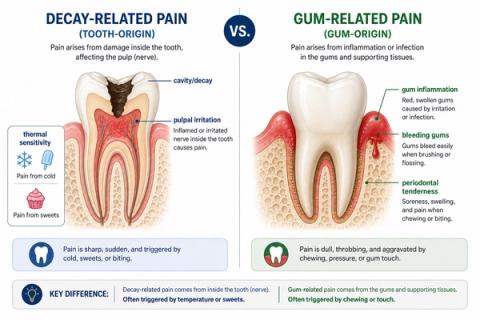
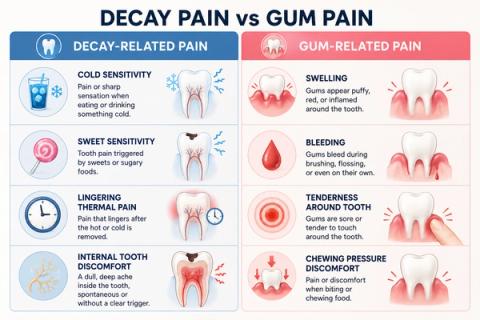
Tooth-related pain commonly involves cold sensitivity, sweet sensitivity, heat sensitivity in deeper cases, lingering discomfort, or pain that feels as though it is inside the tooth.
Gum-related pain more commonly involves soreness around the tooth, swollen gums, bleeding during brushing, chewing tenderness, or pressure sensations near the gums.
Tooth decay and gum disease can both cause discomfort, but they usually behave differently in how the pain is triggered and where the inflammation begins.
Pain coming from inside a tooth often causes sensitivity to cold, sweets, heat, or other temperature changes. Pain originating from the gums and supporting tissues is more likely to involve tenderness, swelling, bleeding, pressure, or discomfort around the tooth rather than inside it.
The challenge is that these tissues are closely connected.
Because of this, many people find it difficult to tell exactly where the pain is coming from.
What matters most is not where the pain feels like it is coming from, but which tissues are actually responsible.
What Does It Mean If You Can't Tell Where the Pain Is Coming From?
Many people assume they can easily tell whether pain is coming from a tooth or from the gums.
In reality, that is often difficult.
Pain may originate from:
- Inside the tooth.
- The gums.
- The periodontal ligament.
- The supporting bone around the tooth.
Because these tissues are closely connected, symptoms frequently overlap.
Patients commonly describe situations such as:
- "My tooth hurts, but my gums are swollen."
- "I can't tell whether the pain is in the tooth or around it."
- "Cold drinks hurt, but my gums are also sore."
- "The pain feels like a toothache, but my dentist says it is my gums."
- "One area hurts when I chew, but I don't know why."
Pain location alone is often unreliable.
How Does Tooth Pain Differ from Gum Pain?
The way the pain behaves often provides important clues about where it is coming from.
Tooth-Related Pain
Pain originating from inside the tooth commonly involves:
- Cold sensitivity.
- Sweet sensitivity.
- Heat sensitivity in deeper cases.
- Lingering discomfort after triggers.
- Pain that feels as though it is inside the tooth.
As decay or inflammation progresses, symptoms often become more noticeable.
Gum-Related Pain
Pain originating from the supporting tissues more commonly involves:
- Soreness around the tooth.
- Swollen gums.
- Bleeding during brushing.
- Chewing tenderness.
- Pressure sensations near the gums.
You may also notice:
- A bad taste.
- Localized swelling.
- Gum recession.
- Food trapping.
- Tenderness when touching the gums.
In some cases, gum inflammation can feel remarkably similar to a toothache even when the tooth nerve remains healthy.
Why the Pattern of Pain Matters
Dentists rely heavily on symptom patterns because tooth pain and gum pain can sometimes feel very similar.
Understanding how the pain behaves often provides important clues about its source.
| Symptom Pattern | What It May Suggest |
|---|---|
| Cold sensitivity | More commonly tooth-related |
| Sweet sensitivity | Decay-related irritation |
| Bleeding gums | Gum disease |
| Swollen gums | Periodontal inflammation |
| Lingering sensitivity | Deeper tooth involvement |
| Pain when chewing | May occur in either condition |
| Bad taste or drainage | Possible gum infection |
| Food trapping | Decay or periodontal disease |
One pattern deserves special attention:
Lingering sensitivity after cold drinks or cold foods.
This pattern often points more strongly toward a problem inside the tooth than a problem affecting the gums alone.
By contrast, bleeding, swelling, and pressure tenderness often point more strongly toward gum disease.
What This Usually Means
Tooth pain does not always mean the problem is inside the tooth.
Similarly, gum pain does not always mean the gums are the only tissues involved.
For example:
- Tooth decay may irritate the nerve inside the tooth.
- Gum disease may inflame the tissues around the tooth.
- A crack may affect both the tooth and supporting tissues.
- Tooth disease and gum disease may sometimes occur together.
This is why dentists evaluate more than the location of pain alone.
Proper diagnosis often requires combining symptoms, clinical examination findings, and imaging information.
What Should You Do Right Now?
If you are unsure whether the pain is coming from your tooth or your gums:
- Pay attention to what triggers the pain.
- Notice whether cold or sweets cause discomfort.
- Look for swelling or bleeding around the gums.
- Observe whether chewing makes symptoms worse.
- Monitor whether food repeatedly becomes trapped in one area.
- Arrange a dental evaluation if symptoms persist.
These observations can help identify the source of the problem more quickly.
When Should You See a Dentist?
You should arrange an examination if:
- Pain persists or worsens.
- Swelling or bleeding develops.
- Sensitivity begins lingering.
- Chewing becomes uncomfortable.
- One area repeatedly traps food.
- Gums become swollen or tender.
- Pain starts occurring without an obvious trigger.
- Symptoms interfere with daily activities.
Both tooth disease and gum disease can progress silently if left untreated.
A dentist may evaluate:
- Cavity depth.
- Gum health.
- Tooth vitality.
- Periodontal support.
- Probing measurements.
- X-ray findings.
- Structural integrity.
Early diagnosis often makes treatment simpler and more predictable.
What Are Dentists Learning About Tooth Pain Versus Gum Pain?
Dentists are becoming better at identifying whether symptoms originate from the tooth itself, the supporting tissues, or both.
Research continues to improve understanding of how pulpal inflammation, periodontal disease, structural damage, and bacterial infection create overlapping pain patterns that can be difficult to distinguish.
Advanced imaging, vitality testing, periodontal assessment techniques, and AI-assisted diagnostic systems may help clinicians identify the true source of symptoms earlier and more accurately.
Researchers are also studying how tooth disease and gum disease influence each other when both affect the same area.
Related questions
Clinical interpretation
What this means from a clinical perspective.
This patient explanation is supported by a detailed professional review that examines:
- Differential diagnosis of tooth pain versus gum pain.
- Pulpal and periodontal pain patterns.
- Thermal sensitivity interpretation.
- Periodontal disease and toothache-like symptoms.
- Vitality testing and periodontal assessment.
- Diagnostic imaging and clinical examination.
- Emerging research and AI-assisted diagnosis.
Related Professional Topics
Key terms
Tooth Decay
Tooth decay is the gradual breakdown of tooth structure caused by bacteria and acids. It can eventually irritate the nerve inside the tooth.
Gum Disease
Gum disease is inflammation or infection affecting the tissues that support the teeth. It may cause swelling, bleeding, tenderness, and bone loss.
Periodontal Ligament
The periodontal ligament is a thin layer of tissue that connects a tooth to the surrounding bone. Inflammation of this tissue can make a tooth feel sore when chewing.
Tooth Nerve
The tooth nerve is part of the soft tissue inside the tooth that contains nerves and blood vessels. Irritation of this tissue may cause sensitivity or tooth pain.
Thermal Sensitivity
Thermal sensitivity refers to discomfort triggered by hot or cold foods and drinks. It often provides important clues about the health of the tooth.
Periodontal Pocket
A periodontal pocket is a space that develops between the tooth and gum when periodontal disease progresses. Deeper pockets may indicate damage to the supporting tissues.
CoTreat is building the AI colleague for dentists.
CoTreat makes it easy to go above and beyond for your patient. An AI that supports you in clinic.