
What Happens If a Tooth Infection Spreads?



When a tooth infection spreads, it can move from the tooth into the gums, bone, facial tissues, or deeper spaces around the jaw and neck.
You may notice increasing swelling, severe pain, difficulty chewing, fever, a bad taste, drainage, or facial swelling.
Most tooth infections can be treated successfully when identified early, but delaying treatment increases the risk of larger abscesses, facial swelling, deeper tissue involvement, and more complex treatment.
A tooth infection can sometimes extend beyond the tooth and surrounding bone into nearby tissues if it is not controlled.
Most dental infections remain localized and can be treated successfully before they spread. However, when bacteria continue multiplying and the source of infection remains untreated, the infection may begin affecting surrounding tissues.
A spreading tooth infection may involve:
- The gums around the tooth.
- The bone supporting the tooth.
- Nearby facial tissues.
- Areas around the jaw.
- Deeper spaces within the face or neck.
What matters most is not simply how painful the tooth feels, but whether the infection is beginning to affect surrounding tissues and overall health.
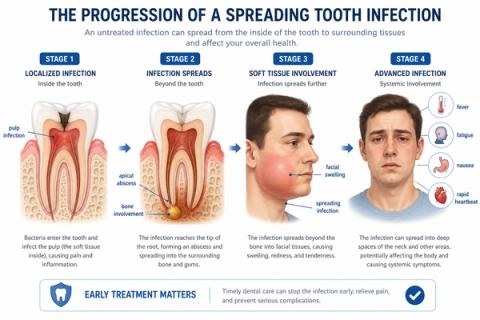
What Does It Mean When a Tooth Infection Spreads?
A tooth infection often begins inside the soft tissue in the center of the tooth or around the root.
Many infections remain localized and are successfully treated before they affect surrounding structures.
However, if bacteria continue spreading:
- Nearby tissues may become inflamed.
- Swelling may develop.
- Infection may extend into surrounding areas.
- Symptoms may become more severe.
Patients commonly describe it as:
- "My toothache is getting worse."
- "My face is starting to swell."
- "I have a bad taste coming from the tooth."
- "The swelling seems to be spreading."
- "My jaw feels sore and swollen."
- "I feel unwell in addition to the tooth pain."
The appearance of swelling often suggests that the infection is no longer confined to the tooth alone.
How Can a Tooth Infection Spread?
As bacteria multiply, infection may extend beyond the tooth into surrounding tissues.
You may notice:
- Increasing throbbing pain.
- Gum swelling.
- Facial swelling.
- Difficulty chewing.
- A bad taste or drainage.
- Tenderness near the jaw.
- Increasing pressure around the tooth.
In more advanced situations:
- Swelling may spread into facial tissues.
- Opening the mouth may become difficult.
- Swallowing may become uncomfortable.
- General illness may develop.
Importantly:
- Some infections progress slowly.
- Others worsen more rapidly.
The speed of progression depends on factors such as the tooth involved, bacterial activity, anatomy, and the body's response to infection.
Not all tooth infections spread extensively, especially when treated early.
Why the Pattern of Symptoms Matters
Pain intensity alone does not always reflect the seriousness of an infection.
The pattern of swelling and general symptoms often provides more useful clues.
| Symptom | What It May Suggest |
|---|---|
| Localized tooth pain | Localized infection |
| Gum swelling | Nearby tissue involvement |
| Facial swelling | More extensive spread |
| Bad taste or drainage | Active infection drainage |
| Fever | Body-wide response to infection |
| Difficulty opening the mouth | Deeper tissue involvement |
| Difficulty swallowing | Urgent evaluation required |
| Rapidly increasing swelling | Escalating infection risk |
One pattern deserves special attention:
Facial swelling accompanied by fever, difficulty opening the mouth, or difficulty swallowing.
These symptoms require prompt professional evaluation because they may indicate that the infection is spreading beyond the immediate area of the tooth.
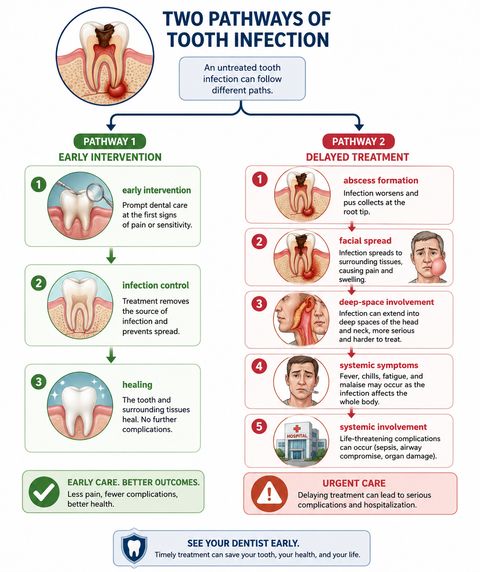
What This Usually Means
Most tooth infections can be treated successfully when identified early.
However, delaying treatment may increase the risk of:
- Larger abscesses.
- Facial swelling.
- Infection involving surrounding tissues.
- General illness.
- More complex treatment.
Not every infection spreads significantly.
The goal is to control the source of infection before it extends beyond the tooth and surrounding structures.
This is one reason dentists evaluate more than pain alone when assessing dental infections.
What Should You Do Right Now?
If you think you may have a tooth infection:
- Arrange a dental evaluation as soon as possible.
- Monitor for swelling.
- Pay attention to worsening symptoms.
- Notice whether chewing becomes more difficult.
- Watch for fever or feeling unwell.
- Seek urgent care if swelling spreads or swallowing becomes difficult.
Prompt treatment often prevents more serious complications.
When Should You See a Dentist?
You should seek prompt evaluation if:
- Swelling develops.
- Facial swelling appears.
- Pain rapidly worsens.
- Fever develops.
- Swallowing becomes uncomfortable.
- Opening your mouth becomes difficult.
- Drainage or a bad taste occurs.
- Symptoms continue worsening.
A spreading dental infection may require urgent treatment.
A dentist may evaluate:
- The extent of the infection.
- The location of swelling.
- The health of the tooth and surrounding tissues.
- Signs of systemic involvement.
- Imaging findings.
- The most appropriate treatment approach.
Early treatment often prevents more extensive spread.
What Are Dentists Learning About Spreading Tooth Infections?
Dentists continue to improve their understanding of why some dental infections remain localized while others spread into surrounding tissues.
Research is helping clinicians better identify risk factors associated with severe odontogenic infections, facial swelling, deep tissue involvement, and systemic illness.
Advances in imaging, infection-risk assessment, artificial intelligence, and treatment planning may help clinicians recognize higher-risk infections earlier and intervene more effectively.
Researchers are also studying how early intervention influences outcomes and reduces the likelihood of serious complications.
Related questions
Clinical interpretation
What this means from a clinical perspective.
This patient explanation is supported by a detailed professional review that examines:
- Odontogenic infections.
- Dental abscesses.
- Infection spread through surrounding tissues.
- Facial swelling and cellulitis.
- Warning signs requiring urgent care.
- Diagnostic imaging and clinical evaluation.
- Emerging research and AI-assisted risk assessment.
Related Professional Topics
Key terms
Tooth Infection
A tooth infection occurs when bacteria invade the inner tissues of a tooth or the tissues surrounding its root.
Dental Abscess
A dental abscess is a collection of pus caused by bacterial infection. It may develop near the root of a tooth or within surrounding tissues.
Facial Swelling
Facial swelling occurs when inflammation or infection spreads into the soft tissues of the face.
Drainage
Drainage occurs when infected fluid escapes from an area of infection. It may create a bad taste or unpleasant odor in the mouth.
Fever
Fever is a rise in body temperature that may occur when the body is responding to infection.
Cellulitis
Cellulitis is a spreading bacterial infection affecting soft tissues. In dental infections, cellulitis may develop when infection extends beyond the tooth and surrounding bone.
CoTreat is building the AI colleague for dentists.
CoTreat makes it easy to go above and beyond for your patient. An AI that supports you in clinic.