
Can Gum Disease Cause Tooth Pain?



Gum disease can cause pain that feels like a toothache.
Inflamed or infected gums, periodontal ligament tissues, or supporting bone can create pressure, tenderness, throbbing discomfort, or chewing pain that mimics tooth pain.
Not all "tooth pain" actually starts inside the tooth. Sometimes the surrounding tissues are responsible.
Yes, gum disease and other problems affecting the tissues around a tooth can cause pain that feels very similar to a toothache.
Many people assume that all tooth pain comes from inside the tooth. However, the gums, supporting ligament, and bone around a tooth also contain nerves and can become inflamed, infected, or irritated.
When this happens, the discomfort may feel as though it is coming directly from the tooth itself.
Common causes include:
- Gum disease.
- Gum infections.
- Periodontal abscesses.
- Food trapping between teeth.
- Inflammation around the tooth root.
- Excess pressure on a tooth.
- Problems affecting the supporting tissues.
What matters most is not where the pain feels like it is coming from, but which tissues are actually causing the problem.
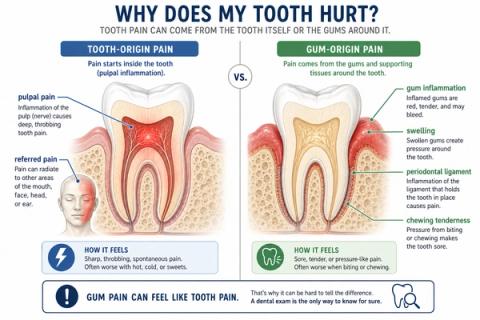
What Does Gum-Related Tooth Pain Usually Mean?
Not all tooth pain originates from the tooth itself.
Sometimes the surrounding tissues are responsible, including:
- The gums.
- The periodontal ligament.
- The supporting bone around the tooth.
Inflammation in these tissues can create:
- Pressure.
- Tenderness.
- Throbbing discomfort.
- Chewing pain.
- Localized soreness.
Because these tissues surround the tooth, the brain may interpret the discomfort as coming from the tooth itself.
Patients commonly describe it as:
- "My tooth hurts, but the dentist says the problem is my gums."
- "It feels like a toothache, but my tooth looks normal."
- "One tooth hurts when I bite down."
- "The area around my tooth feels swollen and tender."
- "My gums hurt, but it feels like the pain is inside the tooth."
These situations are more common than many people realize.
How Can Gum Problems Feel Like Tooth Pain?
The tissues supporting a tooth contain nerves, blood vessels, and pressure-sensitive structures.
When these tissues become inflamed or infected, they can produce symptoms that closely resemble a toothache.
Common causes include:
- Gum disease.
- Gum infections.
- Periodontal abscesses.
- Food trapping.
- Excessive biting pressure.
- Inflammation around the tooth root.
You may notice:
- Sore or swollen gums.
- Bleeding during brushing.
- Tenderness around one tooth.
- Pain while chewing.
- A bad taste in the mouth.
- Drainage from the gums.
- Gum recession.
- A loose tooth in some cases.
In some situations, infection around the supporting tissues creates pressure around the root of the tooth, making it difficult to distinguish from pain originating inside the tooth.
Why the Pattern of Pain Matters
Pain location alone is often unreliable.
Dentists interpret symptom patterns together with clinical findings rather than relying only on where the patient feels the pain.
| Symptom Pattern | What It May Suggest |
|---|---|
| Pain with cold drinks | More commonly a problem inside the tooth |
| Gum swelling | Periodontal involvement |
| Bleeding gums | Gum inflammation |
| Pain when chewing | Periodontal ligament involvement or pressure-related irritation |
| Bad taste or drainage | Possible gum or periodontal infection |
| Deep gum pocket | Periodontal disease |
| No temperature sensitivity | More suggestive of a gum-related source |
| Tooth mobility | Loss of periodontal support |
One pattern deserves special attention:
Pain when chewing without significant hot or cold sensitivity.
This pattern often raises suspicion that the supporting tissues around the tooth may be contributing to the problem rather than the tooth nerve itself.
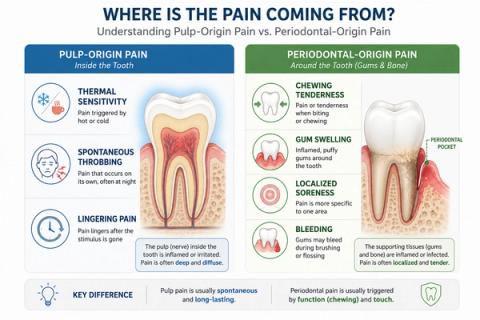
What This Usually Means
A painful tooth does not always mean the tooth itself is the source of the problem.
Sometimes the surrounding tissues are responsible.
For example:
- Inflamed gums may create tenderness.
- Gum infections may create pressure.
- Food trapping may irritate supporting tissues.
- Inflammation around the tooth root may make chewing uncomfortable.
Because gum-related pain and tooth-related pain can feel remarkably similar, professional evaluation is often needed to identify the true source.
Early diagnosis can help prevent progression of both gum disease and tooth disease.
What Should You Do Right Now?
If you think your pain may be related to your gums:
- Continue brushing and cleaning the area gently.
- Clean between the teeth daily.
- Pay attention to swelling or bleeding.
- Notice whether chewing makes symptoms worse.
- Watch for drainage or a bad taste.
- Arrange a dental evaluation if symptoms persist.
Observing these patterns can help your dentist identify the source of the problem more quickly.
When Should You See a Dentist?
You should arrange an examination if:
- Your gums swell or bleed repeatedly.
- Chewing becomes painful.
- One tooth feels tender to pressure.
- A bad taste or drainage develops.
- Gum recession becomes noticeable.
- A tooth becomes loose.
- Pain becomes persistent.
- Symptoms continue worsening.
Gum disease and tooth disease sometimes occur together, making professional evaluation especially important.
A dentist may evaluate:
- Gum health.
- Periodontal support.
- Tooth vitality.
- Structural integrity.
- Periodontal measurements.
- X-ray findings.
- Signs of infection.
Early treatment can help prevent progression and preserve both the tooth and its supporting tissues.
What Are Dentists Learning About Gum-Related Tooth Pain?
Dentists are becoming better at distinguishing pain originating from the tooth from pain originating in the supporting periodontal tissues.
Research continues to improve understanding of how inflammation, pressure changes, bacterial infection, and structural damage within the periodontal tissues contribute to symptoms that patients often interpret as toothache.
Advances in imaging, periodontal diagnostics, vitality testing, and AI-assisted diagnostic systems may help clinicians identify the true source of pain earlier and more accurately.
Researchers are also studying how periodontal disease and pulpal disease can influence each other when both conditions affect the same tooth.
Related questions
Clinical interpretation
What this means from a clinical perspective.
This patient explanation is supported by a detailed professional review that examines:
- Periodontal causes of tooth pain.
- Gum disease and toothache-like symptoms.
- Periodontal abscesses.
- Periodontal ligament inflammation.
- Differential diagnosis between gum pain and pulpal pain.
- Diagnostic testing and imaging.
- Emerging research and AI-assisted diagnostic support.
Related Professional Topics
Key terms
Gum Disease
Gum disease is inflammation or infection affecting the tissues that support the teeth. It can range from mild gum inflammation to more advanced destruction of supporting structures.
Gums
The gums are the soft tissues that surround and protect the teeth. Inflamed gums may become swollen, tender, or bleed easily.
Periodontal Ligament
The periodontal ligament is a thin layer of tissue that connects the tooth to the surrounding bone. Inflammation of this tissue can make a tooth feel sore when chewing or biting.
Periodontal Abscess
A periodontal abscess is a localized infection affecting the supporting tissues around a tooth. It often causes swelling, tenderness, and pressure.
Tooth Mobility
Tooth mobility means a tooth has become looser than normal. This can occur when supporting tissues are damaged by advanced gum disease.
Toothache
A toothache is pain that feels as though it comes from a tooth. Sometimes the source is inside the tooth, and sometimes it originates from the surrounding tissues.
CoTreat is building the AI colleague for dentists.
CoTreat makes it easy to go above and beyond for your patient. An AI that supports you in clinic.