
Why Doesn't My Cavity Hurt?



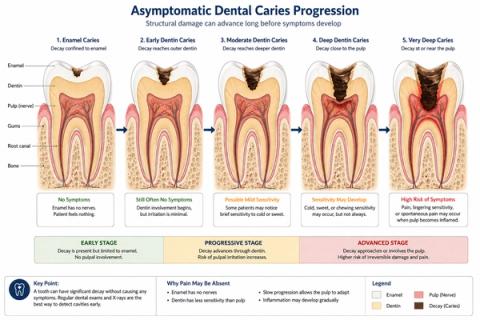
Some cavities do not hurt because early decay is often limited to enamel, which contains no nerves.
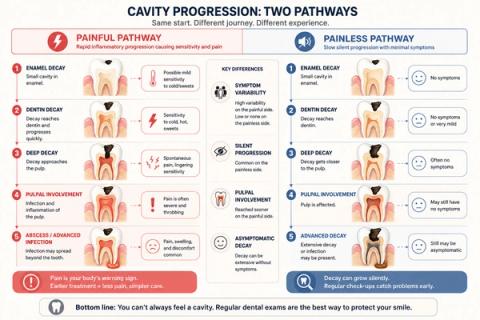
In other cases, decay progresses slowly without significantly irritating the inner part of the tooth. Even deep cavities can sometimes remain painless if inflammation develops gradually or the tooth temporarily adapts to the damage.
A painless cavity is not always a harmless cavity.
Many cavities continue growing silently for months or even years before causing pain.
A cavity does not need to hurt to be present, and pain is not always an early warning sign of dental disease. In fact, many cavities are discovered during routine dental examinations or on X-rays before patients notice any symptoms at all.
Common reasons a cavity may not hurt include:
- The decay is limited to the enamel.
- The cavity is progressing slowly.
- The tooth nerve has not yet become irritated.
- The location of the cavity does not trigger noticeable symptoms.
- Inflammation is developing gradually.
What matters most is not whether a cavity hurts, but whether the decay is continuing to damage the tooth.
What Does It Mean If a Cavity Doesn't Hurt?
Many people assume that if a cavity is not painful, it must be small or unimportant.
Unfortunately, pain and cavity severity do not always match.
Many cavities:
- Begin silently.
- Progress slowly.
- Remain painless for long periods.
- Cause structural damage before symptoms appear.
This commonly happens because:
- Enamel contains no nerves.
- Early decay may remain far from the inner part of the tooth.
- Inflammation may develop gradually.
- The tooth nerve may not yet be strongly affected.
Patients commonly describe situations such as:
- "My dentist found a cavity but I don't feel anything."
- "I have a cavity with no pain."
- "The tooth looks damaged but doesn't hurt."
- "Food gets stuck there, but it isn't painful."
- "The cavity was discovered during a routine checkup."
- "My X-ray showed decay but I have no symptoms."
These situations are extremely common.
What Happens When a Cavity Stays Painless?
A cavity may remain painless for several reasons.
In the early stages, decay often affects only the outer layers of the tooth.
Even when decay becomes deeper:
- The tooth may temporarily adapt.
- Inflammation may develop slowly.
- Symptoms may remain mild.
- Sensitivity may never become obvious.
You may notice:
- Visible discoloration.
- Food trapping.
- Roughness.
- Occasional mild sensitivity.
- No symptoms at all.
This can create the false impression that the tooth is healthy, the cavity is not serious, or treatment is unnecessary.
However, decay can continue progressing biologically and structurally even when symptoms are absent.
Why the Absence of Pain Matters
Pain is only one piece of information.
The absence of pain does not necessarily mean the absence of disease.
| Situation | What It May Suggest |
|---|---|
| No symptoms | No symptoms Early decay or slow progression |
| Food trapping | Food trapping Structural breakdown of the tooth |
| Visible dark area | Active decay |
| Occasional sensitivity | Dentin involvement |
| Deep cavity without pain | May still require treatment |
| Broken filling with no pain | Hidden decay may be present |
| Decay found on X-ray | Disease may be more advanced than symptoms suggest |
| Sudden disappearance of symptoms | Requires professional evaluation |
One situation deserves special attention:
A cavity that suddenly stops hurting.
While there can be harmless explanations, a sudden change in symptoms may indicate that the tooth is no longer responding normally and should be professionally evaluated.
What This Usually Means
A painless cavity is not always a harmless cavity.
Many significant dental problems begin without symptoms.
Some cavities remain painless because:
- They have not reached sensitive tissues.
- They progress slowly.
- The tooth has not developed a strong inflammatory response.
- Symptoms have not yet become noticeable.
For this reason, dentists evaluate:
- Cavity depth.
- Structural integrity.
- X-ray findings.
- Proximity to the tooth nerve.
- Risk of future progression.
rather than relying on pain alone.
Early detection often allows simpler and more conservative treatment.
What Should You Do Right Now?
If you have been told you have a cavity but do not have pain:
- Do not assume the cavity is harmless.
- Maintain good oral hygiene.
- Reduce frequent sugar exposure.
- Monitor for developing sensitivity.
- Avoid delaying recommended examinations.
- Follow your dentist's advice regarding monitoring or treatment.
Many cavities are easiest to treat before symptoms develop.
When Should You See a Dentist?
You should arrange an evaluation if:
- A dark area becomes visible on the tooth.
- Food repeatedly traps in one location.
- Sensitivity develops.
- A filling breaks down.
- Chewing becomes uncomfortable.
- A dentist identifies decay during an examination.
- The cavity appears to be growing.
- An X-ray shows deeper involvement.
Waiting for pain to develop may allow decay to progress significantly before treatment occurs.
A dentist may evaluate:
- Cavity depth.
- Tooth nerve health.
- Structural stability.
- Radiographic findings.
- Whether the tooth can still be restored.
- Risk of future progression.
Early treatment often preserves more healthy tooth structure and reduces the risk of future complications.
What Are Dentists Learning About Painless Cavities?
Dentists are increasingly recognizing that symptoms alone are not a reliable way to judge the severity of tooth decay.
Research continues to improve understanding of why some cavities become painful early while others remain asymptomatic despite extensive structural damage.
Advances in imaging, caries-risk assessment, lesion activity evaluation, and AI-assisted diagnostic systems may help clinicians identify higher-risk cavities before significant symptoms develop.
Researchers are also studying biological factors that influence how different patients experience cavity-related pain and sensitivity.
Related questions
Clinical interpretation
What this means from a clinical perspective.
This patient explanation is supported by a detailed professional review that examines:
- Asymptomatic dental caries.
- Why cavity depth and pain do not always correlate.
- Caries progression and pulpal response.
- Hidden and radiographic decay.
- Risk assessment and prognosis.
- Diagnostic testing and imaging.
- Emerging research and AI-assisted caries detection.
Related Professional Topics
Key terms
Cavity
A cavity is an area of tooth decay caused by the gradual breakdown of tooth structure by bacteria and acids.
Enamel
Enamel is the hard outer layer of the tooth. Because it contains no nerves, early enamel decay often causes no pain.
Tooth Decay
Tooth decay is a disease process that gradually damages tooth structure and can eventually lead to cavities, infection, or tooth loss if left untreated.
Dentin
Dentin is the layer beneath the enamel. It contains tiny channels that can transmit sensations toward the nerve inside the tooth.
Tooth Nerve
The tooth nerve is part of the soft tissue inside the tooth that contains nerves and blood vessels. Irritation of this tissue may lead to sensitivity or tooth pain.
Dental X-ray
A dental X-ray allows dentists to detect areas of decay that may not be visible during a routine visual examination, including cavities that cause no symptoms.
CoTreat is building the AI colleague for dentists.
CoTreat makes it easy to go above and beyond for your patient. An AI that supports you in clinic.