
Can Cavities Heal on Their Own?



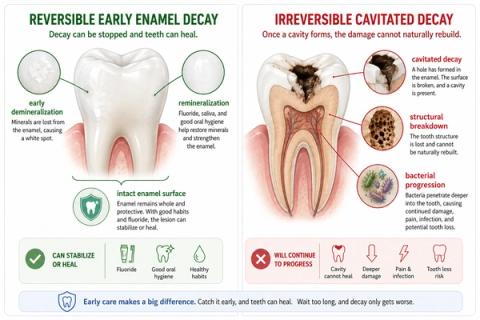
Very early tooth decay may sometimes remineralize if the enamel surface is still intact and the conditions causing decay improve.
However, once a true cavity forms with visible structural breakdown, it usually cannot heal completely on its own and may continue progressing without treatment.
Not all early decay requires immediate drilling, but not all cavities can be reversed naturally.
Some very early stages of tooth decay may stabilize or partially reverse, but not all cavities can heal naturally.
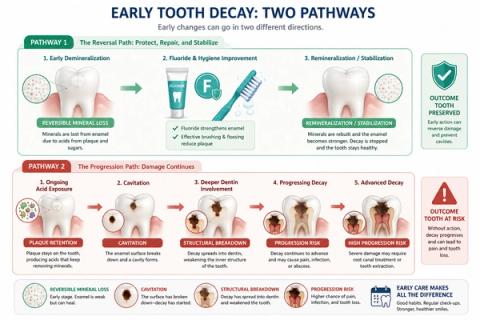
Tooth decay develops gradually. In the earliest stages, minerals are lost from the enamel before a visible hole forms. If conditions improve during this stage, the tooth may be able to regain some of those minerals through a process called remineralization.
However, once significant structural breakdown occurs and a true cavity forms, the tooth cannot fully rebuild itself naturally.
Common factors that influence whether early decay may stabilize include:
- The condition of the enamel surface.
- Fluoride exposure.
- Oral hygiene habits.
- Sugar consumption patterns.
- Saliva quality and flow.
- Whether a visible cavity has already formed.
What matters most is not simply the size of the lesion, but whether the tooth structure remains intact.
What Does It Mean When a Cavity "Heals"?
Many people assume that a cavity either exists or does not exist.
In reality, tooth decay develops gradually through the loss of minerals from enamel.
In the earliest stages:
- The enamel surface may remain intact.
- Minerals are being lost beneath the surface.
- No visible hole may be present.
- Symptoms may be absent.
At this stage, the process may sometimes stabilize or partially reverse if conditions improve.
Importantly, remineralization does not mean the tooth grows back completely.
Instead, minerals are redeposited into weakened enamel, helping strengthen the tooth and slow or stop further progression.
Patients commonly ask:
- "My dentist said I have early decay."
- "Can this cavity heal naturally?"
- "Do I really need a filling?"
- "I have a white spot but no hole."
- "Can fluoride repair this?"
Can Early Tooth Decay Reverse Naturally?
Some early lesions can stabilize or remineralize when the environment around the tooth improves.
This may involve:
- Better plaque control.
- Regular fluoride exposure.
- Reduced sugar frequency.
- Improved saliva protection.
- Professional preventive care.
The greatest opportunity for remineralization exists when:
- The enamel surface remains intact.
- Structural breakdown has not yet occurred.
- Lesion activity is controlled.
However, once a true cavity develops:
- Bacteria become more difficult to remove.
- Plaque becomes trapped more easily.
- Structural integrity is lost.
- Complete natural repair becomes much less predictable.
This is why some early lesions can be managed conservatively while others require active treatment.
Why the Pattern of Decay Matters
Dentists evaluate lesion behavior rather than relying on size alone.
A small active lesion may require more attention than a larger inactive lesion.
| Finding | What It May Suggest |
|---|---|
| White spot lesion | Possible remineralization potential |
| Intact enamel surface | Better reversal potential |
| Chalky appearance | Active lesion |
| Smooth shiny surface | Arrested lesion |
| Visible hole | Structural breakdown |
| Food trapping | Cavitation more likely |
| Increasing size | Progression risk |
| No symptoms | Early lesions may still be active |
One pattern deserves special attention:
A white chalky area without a visible hole.
This often represents the stage where remineralization potential is greatest.
Once structural breakdown occurs, natural repair becomes much less predictable.
What This Usually Means
Not all tooth decay requires immediate drilling.
Likewise, not all cavities heal naturally.
Modern dentistry focuses on understanding:
- Lesion activity.
- Structural integrity.
- Progression risk.
- Remineralization potential.
Some early lesions may stabilize with preventive care.
Others may continue progressing despite their small size.
The goal is to identify which lesions remain biologically controllable and which have already reached structural breakdown.
What Should You Do Right Now?
If you have been told you have early tooth decay:
- Maintain good oral hygiene.
- Use fluoride products as recommended.
- Reduce frequent sugar exposure.
- Attend regular dental reviews.
- Monitor any areas identified by your dentist.
- Follow preventive advice carefully.
Early intervention does not always mean drilling. Sometimes it means improving the conditions that allow the tooth to repair itself.
When Should You See a Dentist?
You should arrange an evaluation if:
- White or dark spots appear.
- Sensitivity develops.
- Food repeatedly traps in one area.
- Rough areas form on teeth.
- Existing decay appears to deepen.
- Chewing discomfort develops.
- A visible hole appears.
- Symptoms gradually worsen.
A dentist may evaluate:
- Lesion activity.
- Cavitation status.
- Structural integrity.
- Risk to the tooth nerve.
- X-ray findings.
- Future progression risk.
Early evaluation may allow more conservative management before deeper structural damage occurs.
What Are Dentists Learning About Early Cavity Reversal?
Dentists are increasingly focusing on identifying which lesions can be managed through remineralization and which have progressed beyond the point of natural repair.
Research continues to improve understanding of enamel demineralization, lesion arrest, fluoride therapies, biofilm management, and factors that influence cavity progression.
Advanced imaging technologies, lesion activity assessment systems, caries-risk models, and AI-assisted diagnostic tools may help clinicians identify reversible lesions more accurately and consistently.
Researchers are also studying new materials and preventive strategies that may improve the long-term management of early tooth decay.
Related questions
Clinical interpretation
What this means from a clinical perspective.
This patient explanation is supported by a detailed professional review that examines:
- Enamel demineralization and remineralization.
- Lesion activity assessment.
- Cavitated versus non-cavitated lesions.
- Caries progression and arrest.
- Risk-based treatment planning.
- Diagnostic imaging and monitoring.
- Emerging research and AI-assisted caries management.
Related Professional Topics
Key terms
Tooth Decay
Tooth decay is a disease process in which bacteria and acids gradually damage tooth structure.
Remineralization
Remineralization is the process of replacing minerals that have been lost from enamel, helping strengthen weakened areas of a tooth.
Enamel
Enamel is the hard outer layer of the tooth. Early tooth decay often begins here before deeper structures become involved.
White Spot Lesion
A white spot lesion is an early area of enamel mineral loss that may sometimes be stabilized or remineralized before a cavity forms.
Cavitation
Cavitation occurs when tooth structure breaks down and a visible hole develops. At this stage, complete natural repair is generally not possible.
Fluoride
Fluoride is a mineral that helps strengthen enamel and supports remineralization of early tooth decay.
CoTreat is building the AI colleague for dentists.
CoTreat makes it easy to go above and beyond for your patient. An AI that supports you in clinic.