
How Fast Does Tooth Decay Progress?



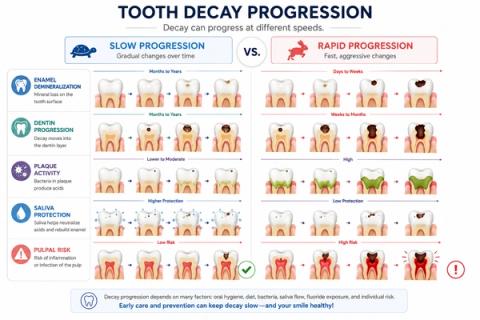
Tooth decay can progress slowly over years or advance much more rapidly, depending on your diet, oral hygiene, saliva, bacteria, cavity location, tooth structure, fluoride exposure, and individual risk factors.
Early enamel lesions often progress slowly and may sometimes stabilize, but once decay reaches dentin, progression may accelerate because dentin is softer than enamel.
Pain is not a reliable indicator of how quickly decay is progressing.
Tooth decay does not progress at the same speed in every person or every tooth.
Some cavities may remain stable for years, while others can worsen much more quickly. The speed of progression depends on a combination of factors including oral hygiene, diet, saliva protection, bacterial activity, fluoride exposure, and the location of the decay.
This is why two people with similar-looking cavities may experience very different outcomes.
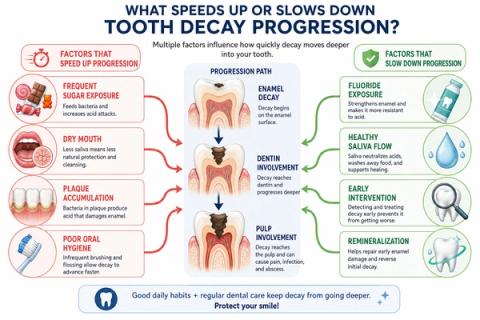
Common factors that influence progression include:
- Sugar consumption frequency.
- Oral hygiene habits.
- Saliva flow and protection.
- Fluoride exposure.
- Bacterial activity.
- Tooth anatomy.
- Existing restorations.
- Overall cavity risk.
What matters most is not simply how long a cavity has been present, but whether the decay is biologically active and continuing to progress.
What Does Tooth Decay Progression Usually Mean?
Tooth decay develops gradually through repeated cycles of:
- Acid exposure.
- Mineral loss.
- Bacterial activity.
- Structural weakening.
However, not all cavities behave the same way.
Some lesions may:
- Remain stable for long periods.
- Progress very slowly.
- Become inactive.
Others may:
- Advance deeper into the tooth.
- Reach dentin relatively quickly.
- Increase the risk of sensitivity, pain, and infection.
Patients commonly ask:
- "How fast does a cavity get worse?"
- "Can tooth decay spread quickly?"
- "How long can I leave a cavity untreated?"
- "Will this small cavity become a big problem?"
- "How long does it take for decay to reach the nerve?"
The answer depends on both the tooth and the individual.
What Makes Some Cavities Progress Faster Than Others?
Several factors influence how quickly decay progresses.
Common risk factors include:
- Frequent sugar consumption.
- Plaque accumulation.
- Poor oral hygiene.
- Reduced saliva flow.
- Dry mouth.
- Limited fluoride exposure.
- Cavity location.
- Tooth anatomy.
- Existing fillings or restorations.
Early enamel lesions often progress slowly and may sometimes stabilize when conditions improve.
Once decay reaches dentin:
- Bacterial penetration becomes easier.
- Dentin permeability becomes important.
- Structural breakdown may accelerate.
You may notice:
- Increasing sensitivity.
- Food trapping.
- Visible discoloration.
- Chewing discomfort.
- No symptoms at all.
Importantly, pain is not a reliable indicator of progression speed.
Why the Pattern of Decay Matters
Dentists evaluate lesion behavior over time rather than relying on symptoms alone.
A painless cavity may sometimes progress faster than a mildly sensitive cavity depending on the underlying biological activity.
| Finding | What It May Suggest |
|---|---|
| Stable white spot lesion | Slow progression |
| Intact enamel | Lower short-term risk |
| Dentin involvement | Greater progression potential |
| Food trapping | Structural breakdown |
| Increasing sensitivity | Possible advancement |
| Multiple new cavities | Higher disease activity |
| Dry mouth | Increased progression risk |
| No symptoms | Decay may still be active |
One pattern deserves special attention:
New cavities appearing in multiple locations over a short period of time.
This often suggests increased disease activity and may indicate that the factors causing decay are not adequately controlled.
The biological activity of the lesion often matters more than whether it causes pain.
What This Usually Means
Tooth decay is not a predictable countdown that affects every person equally.
Some cavities:
- Remain stable for years.
- Progress slowly.
- Respond well to preventive measures.
Others may:
- Advance rapidly.
- Weaken tooth structure.
- Increase the risk of tooth nerve involvement.
Modern dentistry focuses on:
- Lesion activity.
- Progression risk.
- Structural integrity.
- Opportunities for prevention.
The earlier active decay is identified, the more options usually exist to slow or stop progression.
What Should You Do Right Now?
If you have been told you have tooth decay:
- Maintain good oral hygiene.
- Reduce frequent sugar exposure.
- Use fluoride products as recommended.
- Attend regular dental reviews.
- Follow preventive advice carefully.
- Monitor any areas identified by your dentist.
Managing the factors that drive decay is often just as important as treating the cavity itself.
When Should You See a Dentist?
You should arrange an evaluation if:
- Sensitivity develops or worsens.
- Visible discoloration appears.
- Food repeatedly traps in one area.
- Rough areas form on teeth.
- Chewing discomfort develops.
- Existing fillings begin changing.
- A visible cavity appears.
- Symptoms gradually worsen.
Decay may progress silently before major symptoms develop.
A dentist may evaluate:
- Lesion activity.
- Cavity depth.
- Risk to the tooth nerve.
- Structural integrity.
- Progression pattern.
- Overall cavity risk.
Early evaluation can help slow progression before deeper damage develops.
What Are Dentists Learning About Tooth Decay Progression?
Dentists increasingly recognize that cavity progression is influenced by biological activity rather than cavity size alone.
Research continues to improve understanding of biofilm behavior, saliva protection, dietary influences, lesion activity, and why some cavities remain stable while others progress rapidly.
Advanced imaging systems, caries-risk assessment models, lesion monitoring technologies, and AI-assisted diagnostic tools may help clinicians identify higher-risk lesions earlier and tailor preventive strategies more effectively.
Researchers are also studying how personalized risk assessment may improve long-term cavity prevention and management.
Related questions
Clinical interpretation
What this means from a clinical perspective.
This patient explanation is supported by a detailed professional review that examines:
- Dental caries progression.
- Lesion activity assessment.
- Risk factors for rapid decay.
- Enamel and dentin involvement.
- Caries-risk evaluation.
- Monitoring and preventive strategies.
- Emerging research and AI-assisted risk prediction.
Related Professional Topics
Key terms
Tooth Decay
Tooth decay is a disease process in which bacteria and acids gradually damage tooth structure over time.
Enamel
Enamel is the hard outer layer of the tooth. Early decay often begins here and may progress slowly.
Dentin
Dentin is the layer beneath enamel. Once decay reaches dentin, progression may become faster because dentin is softer and more permeable.
Saliva
Saliva helps protect teeth by neutralizing acids, supplying minerals, and reducing the effects of harmful bacteria.
Fluoride
Fluoride is a mineral that helps strengthen enamel and reduce the risk of cavity progression.
Dry Mouth
Dry mouth occurs when saliva production is reduced. Lower saliva levels may increase the risk of tooth decay and faster cavity progression.
CoTreat is building the AI colleague for dentists.
CoTreat makes it easy to go above and beyond for your patient. An AI that supports you in clinic.